Metallica’s “Master of Puppets” Brings Sphere’s Opening Night to a Thunderous Close
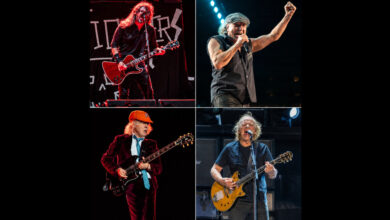
During Metallica’s first concert at Sphere in Las Vegas on October 1, 2026, “Master of Puppets” delivered the final surge of an evening built around familiar music in extraordinary surroundings. James Hetfield, Kirk Hammett, Robert Trujillo, and Lars Ulrich reached the closing song after a set that moved through several eras of the band’s catalogue. The choice gave opening night a natural destination: a piece whose opening attack can turn recognition into anticipation before the first vocal arrives.
The appeal begins with the riff. Its tightly articulated movement feels almost physical, with the guitars pulling the music forward while the drums reinforce each change. This is a song that rewards concentration as much as enthusiasm. Beneath its immediate force sits a carefully constructed arrangement, full of transitions that keep the listener involved. At Sphere, that structure provides a clear thread through a room capable of presenting more visual information than a viewer can absorb at once.
Hetfield’s role is especially compelling because the vocal and rhythm guitar have to share that demanding framework. His delivery gives the song its commanding character, while the picking supplies the pressure underneath it. Hammett’s lead playing opens another dimension, letting phrases climb and bend above the rhythmic machinery. Trujillo and Ulrich hold the moving parts together, making the performance feel like a conversation between four players even when the setting suggests something much larger than a conventional stage.
Released as the title track of Master of Puppets, the song has accumulated decades of associations for its audience. Some listeners remember discovering the album in its original era. Others arrived through later concerts, recommendations, or the track’s renewed visibility with younger listeners. Those different paths matter in a live setting. A huge crowd can contain many private histories, and this particular piece offers enough recognizable landmarks for those histories to meet without requiring everyone to have experienced them in the same way.
The closing performance offers more than a collection of striking images. Its force depends on a sequence of ideas being played together, with the rhythm section giving the guitars a firm foundation and the vocal drawing the arrangement into focus. The screen contributes to the occasion, while the song gives the audience a musical route through it. Familiar passages arrive with the added weight of the evening that has led up to them, making recognition part of the final release.
As a closer, “Master of Puppets” also changes the meaning of everything that precedes it. “Battery” started the night; “Seek & Destroy” came immediately before the final song. Between those bookends, Metallica made room for heavy grooves, instrumental storytelling, and more reflective material. The last number therefore arrives with the momentum of a whole concert behind it. Its familiar form gives listeners somewhere to place that accumulated excitement while allowing the band to finish with music that still demands their attention.
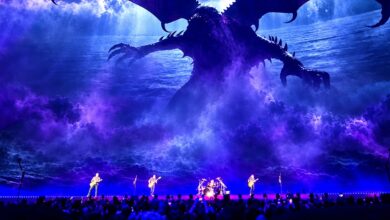
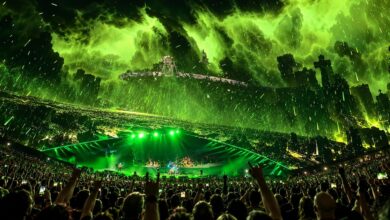
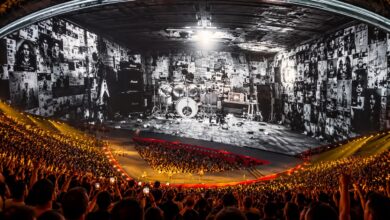
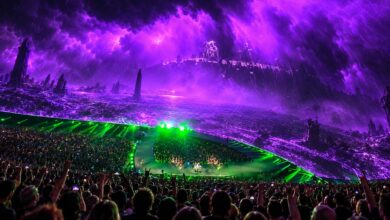
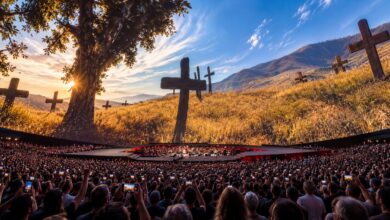
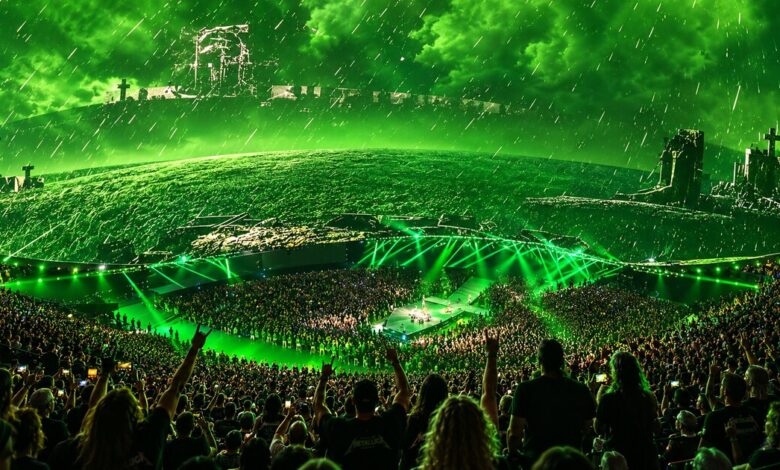
The ten shorter stage-visual videos below widen the view beyond this single performance. Filmed from different positions, they show how Sphere’s images can dwarf the musicians, rise above the crowd, and change the apparent surroundings of the stage. They are separate glimpses of the evening’s production rather than one uninterrupted recording of “Master of Puppets.” Watching them after the main clip gives a better sense of the visual world through which the concert had travelled before reaching its conclusion.
The middle section is one reason the track can sustain such a prominent position. It briefly changes the relationship between tension and release, opening space where the first part had pushed insistently forward. That contrast makes the return to heavier material feel earned. In a visually overwhelming venue, these musical changes are particularly valuable. They offer a rhythm for the audience’s attention, giving the performance its own proportions even when the screen seems capable of expanding without a visible limit.
There is also an interesting contrast between the size of the production and the precision of the playing. A curved screen can transform a spectator’s surroundings in an instant, but a demanding passage still depends on musicians agreeing on its movement. Follow the guitars, bass, and drums through the transitions and the human work becomes easier to notice. The technological spectacle gives the concert reach; the coordination between the players gives the closing song its shape and keeps it intelligible.
For a viewer watching at home, the crowd provides another point of orientation. People in the foreground establish the distance to the stage and reveal the scale of the images above it. Their presence also changes the emotional character of the footage. This music is being shared in a room, with listeners reacting at the same time, rather than performed into an empty visual installation. That communal setting is a large part of what makes a familiar song worth watching again.
The title track’s subject adds another layer to its force. Its imagery of domination and dependency gives the vocal a darker purpose than simple bravado. The performance can sound triumphant without making the song’s underlying ideas cheerful. That tension is central to its identity: listeners enjoy the power of the music while following a narrative concerned with losing control. A monumental concert environment suits the scale of the arrangement, but the meaning still comes from the relationship between words and sound.
Opening night gave the residency a strong foundation without answering every question about what later shows would bring. Metallica’s catalogue contains enough contrasts to make a changing set rewarding, and “Master of Puppets” represents one particularly ambitious way to finish. The performance’s value is not dependent on declaring the entire event the greatest concert ever staged. It is enough to notice how a long-established composition continues to create anticipation, carry an audience through several moods, and provide a convincing final destination.
For a direct comparison, watch Metallica’s official “Master of Puppets” performance from Chicago’s Lollapalooza on July 28, 2022. The open-air festival setting changes the visual experience, making the song itself an especially clear point of continuity. Its opening rhythm, melodic interlude, and return to forceful playing remain recognizable across the two locations. The Chicago clip helps show how much of the closing number’s authority travels with the musicians, independent of the architecture around them.
The second related performance, “Nothing Else Matters” with the San Francisco Symphony at S&M2, explores expansion through a different musical language. Orchestral texture surrounds a familiar melody, while the vocal gives the arrangement its intimate center. Set alongside the Sphere closer, it makes an illuminating contrast: Metallica can create scale through sustained speed and complex transitions, or through the space around a quieter passage. Both performances depend on shaping the listener’s attention rather than merely making everything louder.
By the end of “Master of Puppets,” Sphere’s opening night had a closing statement that connected the residency’s new surroundings to a central part of Metallica’s identity. The venue offered an enormous canvas, but the song supplied a beginning, a journey, and a final release. That combination makes the footage rewarding even for someone who never stood inside the room. The setting invites a first look; the arrangement gives the viewer reasons to stay until the last passage lands.