Amy Lee, Poppy and Courtney LaPlante United at The O2, but the Crowd Became the Talking Point
Three extraordinary voices finally shared the same stage, yet the conversation spilling onto social media has focused on something beyond the microphones. When Amy Lee, Poppy and Courtney LaPlante performed “End of You” together at London’s O2 Arena, the moment had all the ingredients of a major live-music event. Footage of the audience, however, prompted a provocative question: why did some spectators appear so still?
The performance took place on September 13, 2026, during Evanescence’s London show. This was the first time all three singers had performed the collaboration together live. That distinction matters. This was not simply another guest appearance during a familiar touring arrangement; London received the complete trio behind the recording.
Released in 2025, “End of You” brought Lee, LaPlante and Poppy together across different corners of heavy music. Evanescence’s dramatic melodies, Spiritbox’s intensity and Poppy’s restless approach to genre made the pairing intriguing before anyone stepped onto a stage. Hearing the three voices share a song offered something more specific than star power: an opportunity to see how their contrasting styles could occupy the same space.
The tour had already introduced audiences to versions of that collaboration. Spiritbox joined Evanescence on the North American run, while Poppy supported the UK and European dates. London’s surprise was LaPlante joining Lee and Poppy, turning a song already associated with guest appearances into its first full-trio live outing. For anyone who knew the recording, the extra arrival changed what they were watching.
The excitement surrounding that lineup is easy to understand. Each singer has built a recognisable musical identity, and a collaboration allows those identities to interact without asking them to become identical. For fans following the song from its release to the stage, London supplied a missing piece: the chance to see the partnership fully assembled in front of an arena audience.
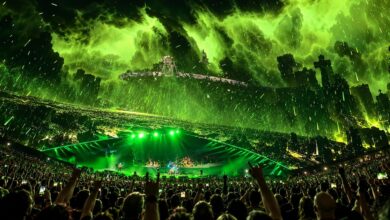
The Facebook post circulating the crowd debate frames the scene as a missed eruption of excitement: three prominent women in heavy music together, with sections of the audience apparently barely moving. It is a striking hook because the visual contrast is immediate. The performers are expressive and the occasion is unusual, so a comparatively stationary patch of spectators can look conspicuous on a phone screen.
But the reports from inside The O2 complicate that picture. An eyewitness account described a sea of phones capturing the trio’s appearance and also noted the strong response to Evanescence favourites. That account offers a plausible explanation for at least some of the stillness: people were recording a surprise they wanted to preserve. It does not establish what every person felt, but it gives the footage useful context.
Other eyewitness coverage was enthusiastic about the event itself. Another account of the London show described a substantial response to the three singers appearing together. These accounts do not make every criticism invalid, nor can a review measure an entire arena’s energy. They do make a sweeping claim that the audience simply did not care much harder to support.
There is also an important distinction between dates. Evanescence and Poppy had performed “End of You” in Manchester earlier in the tour, and coverage of that separate show discussed a comparatively subdued audience. Manchester was not the London trio performance. Reactions from one night should not become evidence about another just because the artist and song overlap.
A concert video shows bodies, phones and movement much more readily than it shows attention. Someone singing quietly, absorbing a new arrangement or concentrating on an unexpected guest may look almost inactive from behind. Equally, some people may simply be less engaged than the fans around them. Both possibilities can exist in the same audience, and a camera angle rarely provides enough information to sort them out.
None of that means crowd energy is irrelevant. A room singing, cheering and moving together can transform a performance, and viewers are entitled to wish the response looked bigger. The useful question is how much a particular recording lets us judge. A close view of a still section can support a comment about that section; it cannot automatically establish the mood of every tier, every song or the whole evening.
Calling the footage proof that “rock is dead” also places an enormous argument on a very small piece of evidence. This performance brought an established arena act together with two distinctive contemporary voices, giving their shared song a new live milestone. Whether one enjoys the collaboration or thinks the audience should have reacted differently, the musical event deserves more attention than an instant verdict about an entire genre.
That is what makes the debate interesting rather than conclusive. One set of images invites disappointment; accounts from the room describe a more animated and appreciative occasion. The fairest way to approach the moment is to keep both in view, listen to the three singers and remember what London actually hosted: the first live performance of “End of You” with its full vocal lineup together.
For another side of Lee’s stage presence, Evanescence’s official “My Immortal” performance from Synthesis Live places her voice in an orchestral setting. The contrast with “End of You” is revealing: a familiar song can hold attention through space and restraint as well as through force. It is a useful companion to this discussion because visible movement is only one part of how a live performance connects.
LaPlante’s official one-take performance of Spiritbox’s “Circle With Me” provides a different companion piece. With the camera concentrated on the singer, the transitions between melodic passages and harsher vocals become the focus. After a debate dominated by shots of spectators, this clip directs attention back to the vocal work itself and the range LaPlante brings to a collaboration such as “End of You”.