Metallica’s Full Sphere Concert Footage Surfaces Online — Fans Call It the Clearest Yet
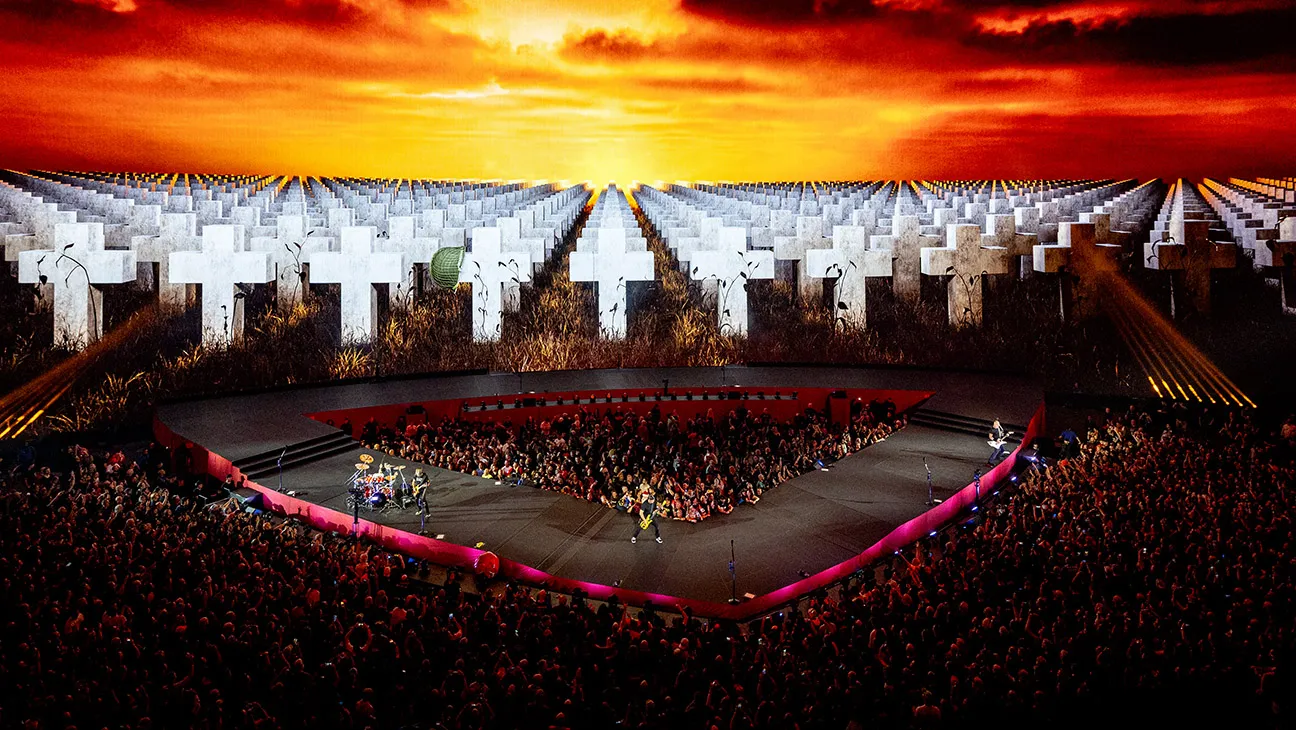
Ever wondered what Metallica’s first Las Vegas Sphere weekend actually looked and sounded like from inside the room? Full-length fan footage from the October 1–3 opening run is now circulating online, giving people who were not there a far more complete view of the Life Burns Faster production than the short clips that dominated social media immediately after the shows.
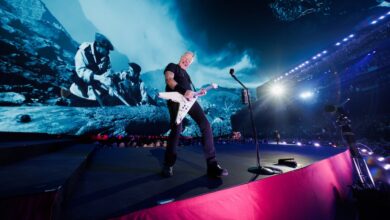
The reaction has centered on one detail again and again: clarity. Fans have described the new recordings as some of the clearest audience-shot footage from the weekend, a particularly important distinction at Sphere. The venue is difficult to capture because a phone camera has to balance the musicians onstage with an enormous curved LED environment filled with bright fire, deep blacks, giant moving objects and constantly changing perspective.
Metallica opened the residency on October 1 with “Battery,” turning one of the band’s most aggressive songs into the first real test of how heavy metal would translate to Sphere. “Creeping Death,” “Now That We’re Dead” and “Sad But True” followed, and the first show quickly established that the production was not going to treat the screen as a conventional backdrop. The images behaved more like an environment surrounding the audience.
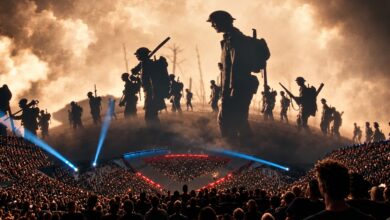
At different points, white graveyard crosses appeared to stretch toward a glowing horizon, flames filled enormous sections of the screen, cathedral imagery rose above the crowd and darker sequences transformed the venue into something closer to a science-fiction film than an arena concert. The scale is difficult to understand in still photography. Longer video makes it easier to see how each visual develops around the music rather than simply appearing as a single spectacular frame.
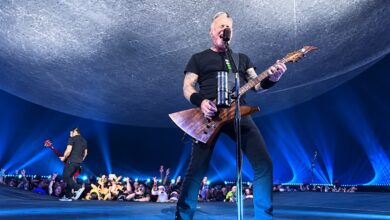
That is also why the complete fan recordings are drawing more attention than isolated viral clips. A thirty-second video can capture the biggest visual reveal, but the longer footage shows how Metallica control the pace of the night. Some songs push Sphere’s technology to an overwhelming extreme, while others reduce the visual noise and pull attention back toward James Hetfield, Lars Ulrich, Kirk Hammett and Robert Trujillo.
Opening night also gave longtime followers several reasons to look beyond the technology. “…And Justice for All” returned to a Metallica set after a twelve-year absence, while “Now That We’re Dead” reappeared after several years away from regular rotation. “The Call of Ktulu” was dedicated to Cliff Burton, adding a much more personal dimension to one of the night’s most dramatic visual sequences.
Then October 3 changed the entire picture. Metallica carried their No Repeat Weekend concept into Sphere and played a completely different 16-song set. Instead of repeating opening night with a few substitutions, the second concert began with “Blackened” and built an entirely separate journey through the band’s catalogue. For fans watching the full footage from both nights, that makes the opening weekend feel like two connected chapters rather than one show performed twice.
The biggest surprise on the second night was “Devil’s Dance.” Metallica had not played the Reload track live since June 2008, making its return after eighteen years one of the weekend’s most discussed setlist moments. “The Outlaw Torn” also came back after seven years away, reinforcing the idea that the Sphere residency could become as interesting for rare songs as it is for the giant visuals.
The October 3 set moved through “Fuel,” “Leper Messiah,” “72 Seasons,” “King Nothing,” “Welcome Home (Sanitarium),” “The Unforgiven,” “Orion,” “Hardwired,” “Whiskey in the Jar” and “For Whom the Bell Tolls” before closing with “One” and “Enter Sandman.” Because none of those songs had appeared on October 1, viewers comparing the recordings can see how differently the production behaves when the music changes.
Clearer footage also reveals details that disappear when a concert is reduced to compressed social-media clips. You can see when a visual begins building before it fills the room, how the musicians reposition themselves while the imagery changes, and how the audience repeatedly shifts attention from the stage to the screen above them. That movement of thousands of people looking in the same direction is part of the spectacle.
There is another reason the fan-shot perspective works especially well here. A professional concert film usually decides exactly where the viewer should look through close-ups and rapid camera changes. A steady audience recording does something different: it allows the stage and the visual environment to exist in the frame at the same time. At Sphere, that wider relationship is essential to understanding what the show actually feels like.
The imperfections can even help. Crowd noise, slight camera movement and the difficulty of fitting the whole screen into one frame preserve the sense that this is a real person trying to capture something almost too large for the lens. When viewers call the footage unusually clear, they are responding not only to sharpness but to how much of the room can finally be understood at once.
“Enter Sandman” provided the final release on October 3, following the darker intensity of “One.” It was a familiar ending placed inside an unfamiliar visual world, and it showed why the residency does not need to reinvent the songs themselves to make them feel new. The surrounding environment changes the scale, while the riff still does the work of connecting immediately with the crowd.
For fans unable to travel to Las Vegas, the full-length footage now circulating is the closest available way to understand the difference between seeing an image from Sphere and actually watching a Metallica show unfold there. The venue can produce breathtaking individual frames, but the complete concert reveals the pacing, the pauses and the transitions that give those images meaning.
“Devil’s Dance” may be the best example of why the residency could stay unpredictable. A song absent for eighteen years suddenly appeared inside one of the most technologically advanced concert spaces in the world. That collision between deep catalogue history and new production is more interesting than spectacle alone, because it gives longtime fans something genuinely unexpected to watch for.
Metallica’s Sphere run is scheduled to continue into March 2027, with the opening weekend serving only as the first chapter. If the October 1–3 shows are the blueprint, the residency will not be defined by one fixed set of visuals or one definitive setlist. The no-repeat structure creates room for rare songs, different pacing and new combinations that could make every paired weekend feel distinct.
What the newly surfaced recordings ultimately capture is a band with more than four decades of history testing its music inside one of the newest concert environments on the planet. The screen is enormous and the technology is impossible to ignore, but the clearest footage also makes something else obvious: the spectacle only works because the songs still command the room underneath it.