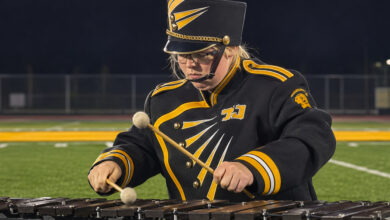
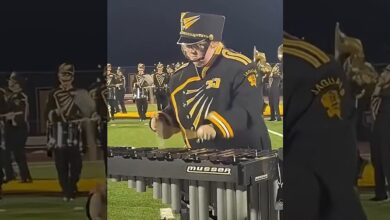
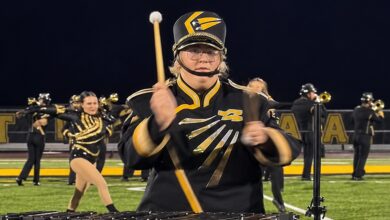
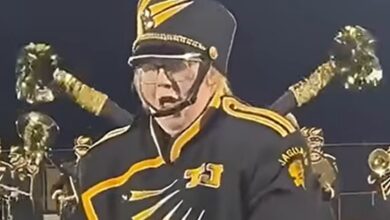
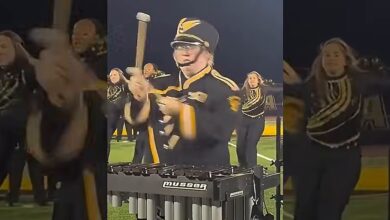
The Tiny Gaps That Make Layla Clark’s “Thunderstruck” Riff Work
Try listening to Layla Clark’s “Thunderstruck” with the screen turned away. The first thing that comes through is how clearly the notes begin. A mallet hits a bar and moves on. There is a tiny space before the next attack, and the opening of an AC/DC song is suddenly recognizable through an instrument with a very different sound.
Angus Young’s guitar brings the connected sound of a string to the original. On Clark’s instrument, the tune is carried by a succession of separate strikes. The ringing note can continue under the next one, but each new attack tells your ear precisely where you are in the pattern. A shaky accent would announce itself.
The speed is visible as soon as Clark raises the mallets. The spacing takes longer to appreciate. Each repetition gives you another chance to hear whether one note has crept ahead of its neighbor or whether a harder strike has pulled your attention out of the phrase. The sense of forward motion survives the repetition.
The football field makes that clarity useful. A riff delivered from the front has to reach people whose attention is spread across the field. One strong melodic shape gives the audience something to catch even before the rest of the band arrives. Once you have recognized it, the pattern is easy to follow through the handoff.
A percussionist’s reaction to the performance singled out the difficulty of holding a pattern consistently over time. The video makes that observation concrete. The fastest-looking bit lasts a few seconds on your screen. The challenge continues each time the same notes come around and the audience begins to expect them.
Listen once for the pitch of the riff, and once for the separation between the notes. The second pass helps explain how Clark can keep the passage sounding sharp while the other performers prepare to enter.
Listen between the strikes
The original AC/DC recording makes a useful comparison because it has the same job at the opening. The figure has to tell you what song you are hearing while leaving space for the sound to grow. A guitar and a mallet instrument create that anticipation in different ways.
Clark’s playing also makes the arrival of the band easy to hear. The texture changes around a phrase you already know, so the entrance feels bigger immediately. It is an arrangement decision that depends on the first voice being clear enough to stick in the listener’s head.
On the next loop, listen to the end of the opening as closely as the first few notes. The tone grows fuller around Clark’s playing while the rhythm she established stays easy to pick out.