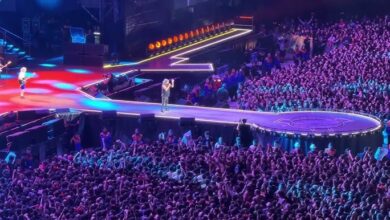
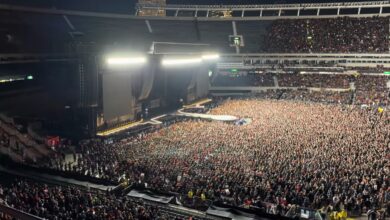
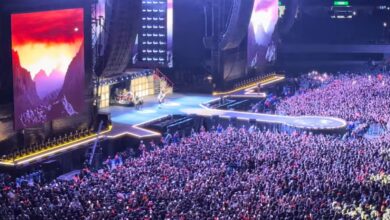
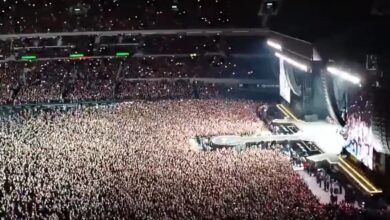
Three Days Grace Ignite PPG Paints Arena With “Riot” In Pittsburgh On March 3, 2026
The air inside PPG Paints Arena had that specific pre-show electricity you only get on nights when the crowd arrives already halfway hoarse. Pittsburgh is a sports town, sure, but it also knows how to turn an arena into a pressure cooker for rock shows, and March 3, 2026 felt like the kind of date people circle without realizing it until they’re living it. The building’s scale matters here: this isn’t a club where volume is a given and chaos is contained. In an 18,000-ish seat bowl, momentum has to be engineered, then released, like a controlled demolition. That’s why the night’s pacing mattered as much as the songs themselves.
This stop landed in the middle of a modern Three Days Grace era where the band’s catalog works like a highlight reel of 2000s hard rock, but with the muscle of a current touring machine. The bill helped shape the mood too. With I Prevail and The Funeral Portrait on the lineup, the evening leaned heavy, youthful, and loud from the first distorted chord of the night. That matters because by the time Three Days Grace hit the stage, the audience wasn’t warming up anymore—they’d already spent hours practicing their loudest instincts. It created the perfect conditions for one particular moment to land like a match tossed into gasoline.
If you’re trying to understand why “Riot” still hits so hard, it helps to remember it isn’t just a fast song with a shout-along hook. It’s a piece of stadium psychology. The lyrics don’t politely invite participation; they dare the room to become something bigger than itself. It’s built around a command—start the riot—and in a live setting, that phrase becomes less metaphor and more instruction manual. In 2026, that formula doesn’t feel dated. If anything, it feels sharper, because the crowd has grown up with it and now sings it like a memory they can physically step inside.
That Pittsburgh performance also carried the advantage of placement. “Riot” wasn’t tossed out early like a quick sugar rush. It arrived late, after the set had already run the audience through heavier grooves, melodic lifts, and the emotional midpoints that make the peaks feel earned. By the time those first familiar notes showed up, the room had already been trained to respond. People weren’t debating whether to jump; they were already moving. You could feel it in the way the floor sections tightened together, in the way arms went up before the chorus even arrived, like everyone recognized the next three minutes were going to get messy.
There’s a special kind of chemistry when a song that once lived on rock radio turns into a live-crowd ritual. “Riot” has that quality of being both simple and inexhaustible. The riff is blunt, the rhythm is built for stomping, and the vocal cadence is designed to be shouted by thousands of people who don’t need perfect timing to be perfectly right. In Pittsburgh, the song functioned like a switch: the arena went from “watching a concert” to “being inside an event.” That’s the difference between a performance and a moment—the moment swallows the boundary between band and audience.
It also helped that the show’s overall structure left room for a real explosion at the end. Three Days Grace have enough hits to stack a setlist with no dead space, and Pittsburgh got a run that balanced older staples with newer material, creating a sense that the band’s history wasn’t being dusted off—it was being actively used. When “Riot” finally arrived, it didn’t feel like nostalgia. It felt like payoff. Even people who came primarily for a different era of the band locked in, because the song doesn’t ask you to remember your past; it asks you to react in the present.
From a pure live-performance standpoint, “Riot” is a great closer because it’s short, lean, and relentless. At around three and a half minutes, there’s no time for the energy to sag. It starts hot, stays hot, and ends before anyone can get tired. That compact runtime is part of why it becomes so replayable online, too—fans clip it, share it, and rewatch it the way people replay a knockout. The Pittsburgh clip carries that same quick-hit adrenaline, the sense that the entire arena is bouncing in unison like the building is briefly running on a different set of physics.
What made this Pittsburgh version feel different wasn’t some dramatic rearrangement or a surprise guest. It was the arena-scale intensity: the way a crowd of that size turns a straightforward song into something massive. You can hear it in the roar that swallows the spaces between lines, the way the chorus becomes a single, unified chant. It’s the sound of a band triggering a response it has triggered for years, and a crowd responding like it’s happening for the first time. That’s the real trick Three Days Grace pulled off on March 3, 2026—making a familiar anthem feel newly dangerous.
If the fan-shot clip is the proof of life, the studio track is the blueprint. “Riot” first arrived as part of One-X in 2006, an era when hard rock choruses were built to dominate car speakers and arena PAs alike. The studio version is tight and polished, but it’s also designed like a live weapon: big accents, clear call-and-response phrasing, and a chorus that practically comes preloaded with a crowd in mind. Listening back after seeing a 2026 performance, you notice how much of the song’s identity is rhythmic—the snap of the groove, the way it pushes you forward—making it perfect for a modern crowd that wants motion, not just melody.
Comparing “Riot” across different dates is a fun way to track how a song matures without changing its DNA. The 2025–2026 run shows a band that understands its classics are less like museum pieces and more like tools. In each city, the core stays the same, but the atmosphere shifts depending on the room, the camera angle, the crowd’s loudness, and the way the energy has been built earlier in the set. Pittsburgh stands out because it feels like a late-set detonation in a big building—everything funnels toward it. Other nights can feel more like a sprint, or more like a party. Pittsburgh feels like a release valve.
There’s also something revealing about how “Riot” plays in different kinds of venues and crowds. Some nights you’ll hear more individual voices, more distinct pockets of screaming; other nights the chant blends into one huge sound. That difference isn’t just audio—it’s culture. It’s how a city shows excitement, how a floor section reacts, how people decide whether to jump, shove, sing, or just throw their hands up and let the chorus carry them. The best “Riot” performances are the ones where the audience doesn’t treat it like a song they know, but like a signal to collectively lose their minds in the safest, happiest way possible.
By late February 2026, you can feel the tour-tightness kicking in: the band is locked, the transitions are crisp, and the crowd knows what it’s there for. That’s why comparing a late-February “Riot” to Pittsburgh is interesting. The performance engine is similar, but the emotional temperature can change fast depending on the night’s flow. Pittsburgh had that sense of inevitability, like the whole set was pointing toward the closer and everyone knew it. When a crowd anticipates the final eruption, it doesn’t conserve energy—it spends it early so there’s nothing left to hold back when the last anthem hits.
Then there’s the near-date comparison that makes Pittsburgh even clearer: another Pennsylvania night, another arena-style roar, a different crowd personality. What separates a good “Riot” from a great one is how completely the room commits. In Pittsburgh, the commitment feels total—like the audience is singing the chorus not because it’s expected, but because silence would feel wrong. That’s the power of an anthem that’s survived trends: it creates its own rules in the room. On March 3, 2026, PPG Paints Arena didn’t just host a Three Days Grace set. For a few minutes at the end, it hosted a full-body reaction.
The lasting takeaway from Pittsburgh is that “Riot” remains a live-song first, even if people found it through streaming or old rock radio. The track’s legacy isn’t just chart life or album placement—it’s the way it repeatedly turns crowds into participants. When that happens in a massive arena, it feels like the song has grown up with its audience, and the audience has grown up with the song, meeting each other at the same volume level years later. That’s why clips from nights like March 3 travel fast: they don’t just document the band. They document the crowd becoming part of the performance.
And maybe that’s the real reason this Pittsburgh version matters. In 2026, people have infinite entertainment options, infinite scrolling, infinite noise. It takes something specific to make thousands of strangers agree on one shared action at the same time—jump here, yell this, throw your hands up now. “Riot” still does that. It cuts through distraction and turns attention into movement. Three Days Grace didn’t need to reinvent the song to make it hit; they just needed to put it in the right spot, in the right building, with the right crowd. Pittsburgh supplied the rest.
Long after the last chord, that kind of moment sticks because it feels physical. People remember where they were standing, who they were next to, how the floor felt under their shoes, and how the chorus sounded when it wasn’t coming from speakers anymore—it was coming from everyone. On March 3, 2026, “Riot” didn’t feel like an old favorite dragged out for tradition. It felt like a living button the band could press and the arena would instantly respond to, proving that some songs don’t age out. They just keep finding new nights to explode.