Patriotic Counter-Show: Turning Point USA’s Kid Rock Halftime Draws 5 Million Viewer
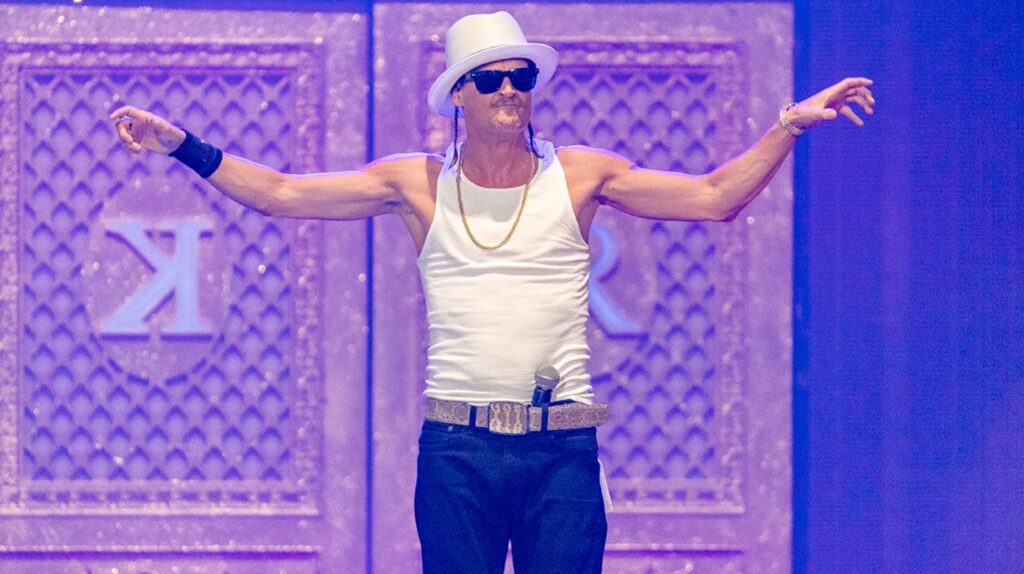
Turning Point USA’s “alternative halftime show” didn’t try to quietly exist in the shadow of the Super Bowl broadcast. It was designed as a statement: a parallel stage, a deliberately patriotic frame, and a headliner (Kid Rock) meant to signal cultural allegiance as much as entertainment. The pitch was simple and provocative—if the NFL’s halftime direction didn’t represent you, here was a different option, wrapped in the language of “faith, family, and freedom.” And because it aired online at the exact same time as the official halftime show, it wasn’t just another concert stream. It was counterprogramming, the way networks used to schedule movies against big TV events, except this time the competition was ideological as well as musical.
The headline number that immediately traveled was viewership: around five million tuning in at peak, depending on how you define “watched.” Some outlets reported roughly 5–6 million concurrent live viewers on YouTube as the show hit its busiest point, which is a genuinely large live audience for a single-channel stream. Others emphasized total views after the fact, claiming numbers that climbed much higher once replays and additional platforms were counted. The confusion wasn’t accidental; big cultural moments now produce multiple “scoreboards”—concurrent viewers, total views, platform reach, clips, reposts—and each tells a different story. What’s clear is that TPUSA succeeded in one narrow sense: it got millions of people to choose something else during the most watched TV moment of the year.
A big part of the story, though, is that the show’s distribution plan reportedly changed at the last minute. TPUSA signaled that it would stream widely, but coverage around the event said a licensing-related issue prevented it from airing on X, pushing viewers toward YouTube (and, depending on reporting, other platforms). That kind of hiccup can kill a live event—audiences don’t like scavenger hunts mid-Super Bowl—yet the stream still surged. In a strange way, the scramble became a marketing hook: the narrative shifted from “here’s our show” to “they tried to stop it, but people found it anyway.” In internet culture, friction can become fuel, and TPUSA’s audience is especially responsive to any storyline that feels like gatekeepers versus outsiders.
The production itself leaned hard into symbolism. This wasn’t a neutral concert with a few flags tossed in; it was staged to feel like a values broadcast. The branding positioned it as “All-American,” and the set list and performers were chosen to match that label—Kid Rock at the top, backed by country acts that already have overlap with conservative audiences. It didn’t have the NFL’s stadium-scale lighting and broadcast polish, but that was partly the point. The vibe was closer to a rally-concert hybrid than a pop spectacle: direct-to-camera energy, messaging built into the framing, and a sense that the stream was meant to feel like a home-base hangout for people rolling their eyes at the official halftime show.
The other half of the equation was the NFL’s choice: Bad Bunny headlining the official halftime show, which coverage described as historic and culturally specific, including Spanish-language elements and Puerto Rican references. That contrast—TPUSA’s “patriotic” alternative versus the NFL’s Latino global superstar—turned the night into a cultural Rorschach test. The official halftime show could be interpreted as America’s modern identity: multilingual, international, hybrid. The alternative show cast itself as the “traditional” answer: explicitly nationalistic, familiar genre signifiers, and a performer roster that felt rooted in a specific political moment. In other words, this wasn’t simply two music events happening at once; it was two competing definitions of what a mass-audience celebration should look like.
Kid Rock’s role was central because he functions as a shortcut symbol. For supporters, he’s the loud, unapologetic avatar of working-class swagger and right-leaning culture. For critics, he’s a predictable choice that signals grievance politics and nostalgia. Either way, he’s instantly legible—which matters in a split-second attention economy. When you’re trying to pull viewers away from a Super Bowl halftime show, you don’t lead with subtlety. You lead with a face that your audience recognizes as “ours,” and you build the event around that shared recognition. That’s how counterprogramming works now: the brand identity of the performer is as important as the performance itself.
If you zoom out, the five-million-viewer figure (or thereabouts) matters less as a “ratings win” and more as a proof of concept. For decades, the Super Bowl halftime show functioned as a singular national stage—one dominant performance that everyone argued about together the next day. A parallel show chips away at that shared experience, replacing it with segmented experiences that run on different feeds. It’s not that the alternative show “beat” the halftime show; it’s that it didn’t need to. It needed to demonstrate that a big enough crowd would choose the identity-aligned option even when the mainstream option was right there, unavoidable, and culturally central.
The criticism came just as quickly, and it followed familiar lines. Some commentary mocked the production scale and the idea of trying to compete with the NFL machine. Others fixated on performance quality, including chatter about lip-syncing or heavy backing tracks—exactly the kind of online nitpicking that can turn a live set into a meme. But that kind of backlash can also harden an audience’s attachment. In polarized culture, mockery doesn’t always reduce impact; sometimes it increases it, because supporters interpret ridicule as confirmation that they’re “over the target.” The show wasn’t aiming for universal approval. It was aiming for cohesion inside a specific community.
There’s also a distinctly modern irony in how this played out. A conservative youth organization attempted to counter a massive mainstream TV broadcast by using the most mainstream infrastructure imaginable: YouTube, viral clips, influencer amplification, and headline-driven controversy. The strategy wasn’t “build an alternative culture slowly.” It was “hijack the biggest moment on the calendar and siphon attention with a competing stream.” That’s not a fringe tactic; it’s how pop culture has worked for years. The difference is that it’s now being deployed overtly as politics—entertainment not as soft influence, but as explicit counter-narrative programming.
The number “five million” also invites a reality check. Even if the stream peaked around that level, the official Super Bowl audience—and the halftime audience in particular—operates on a completely different scale. The alternative show’s significance isn’t that it matched the mainstream; it’s that it carved out a measurable slice during a moment that used to feel monolithic. In older media eras, you could assume most viewers were having the same experience simultaneously. Now, even the biggest stage in American entertainment can be split into parallel “rooms” with millions inside each, arguing afterward as if they watched entirely different events—which, functionally, they did.
What makes this moment stick is how cleanly it illustrates the new rules of attention. You don’t need a network. You don’t need a stadium. You need a narrative hook, a recognizable headliner, and a platform that can handle a surge. TPUSA had the hook (counterprogramming), the headliner (Kid Rock), and—after the last-minute platform shuffle—the distribution that still reached millions. Whether you see it as savvy, cynical, ridiculous, or inevitable probably depends on your politics. But as a media event, it’s a signpost: the Super Bowl halftime show is no longer the only halftime show that matters to millions of people. It’s the biggest one. It’s just not singular anymore.
Reporting notes (not part of the article): viewership and platform details were summarized from recent coverage including Front Office Sports, Wired, Fox News, The Independent, and other outlets describing TPUSA’s “All-American Halftime Show,” the reported peak live viewership on YouTube, and the contrast with Bad Bunny’s official halftime set.