They Invited Bad Bunny to Their Wedding — He Married Them on the Super Bowl Stage
Every so often in entertainment history, a moment arrives that refuses to stay inside its expected lane—the kind of scene that feels too emotional, too surreal, and too perfectly timed to be planned. On February 8, 2026, that moment unfolded during the Super Bowl LX halftime show, when music, love, and spectacle collided in a way no one saw coming. In front of a packed stadium and a global television audience numbering well into the hundreds of millions, a real couple didn’t just appear as part of the performance. They got married. Not symbolically. Not theatrically. Legally, emotionally, and unmistakably real—right there on the field.
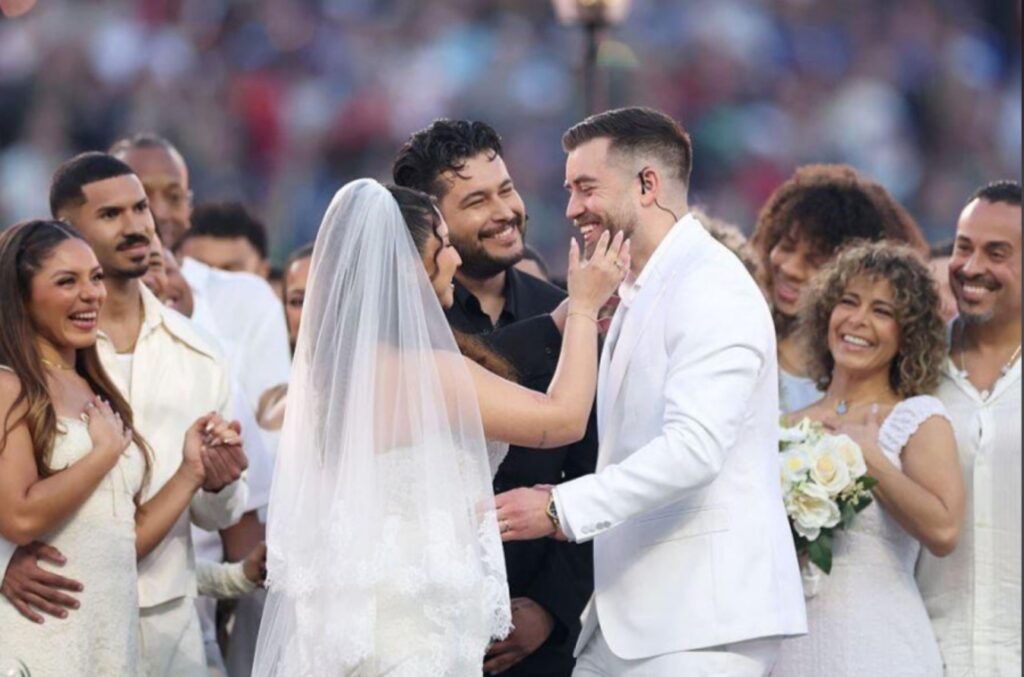
The idea sounded almost unbelievable when viewers first realized what they were watching. In the middle of a high-energy halftime set, the cameras shifted focus from dancers and lights to a bride and groom dressed in white, standing beside an officiant. At first, many assumed it was a visual metaphor or a staged interlude meant to underline a song’s theme. But as the vows began and the emotion on the couple’s faces became impossible to fake, it became clear: this wasn’t performance art. This was someone’s wedding day, unfolding on the largest stage in American entertainment.
What made the moment even more extraordinary was the backstory. Months earlier, the couple had sent a wedding invitation to Bad Bunny, half as a gesture of admiration and half as a dream scenario they never expected to come true. He didn’t attend their ceremony. Instead, he did something far more unexpected. He invited them to flip the script entirely—to step into his world and exchange vows during his Super Bowl halftime show. It was a move that transformed a fan gesture into a once-in-a-lifetime exchange.
As the performance progressed, the pacing was intentional. The halftime show had already established its rhythm, cultural energy, and visual identity before the wedding segment arrived. That timing mattered. By the time the couple appeared, the audience was fully locked in, emotionally primed, and ready for something surprising. The transition felt seamless, not jarring—almost as if love itself had been waiting backstage for its cue. When the officiant began speaking, the stadium quieted in a way that no rehearsal could have guaranteed.
The vows were short but unmistakably sincere. The couple’s voices trembled just enough to remind viewers that this wasn’t scripted television. They held hands, exchanged rings, and smiled through the kind of nerves that only come from real life. When the officiant pronounced them married, the crowd erupted—not with the roar reserved for touchdowns, but with the kind of applause usually saved for moments that feel shared rather than watched.
What elevated the moment from emotional to historic was its legitimacy. This was not a symbolic ceremony designed for cameras. The marriage was legally binding, with paperwork prepared in advance and signed immediately after. Bad Bunny himself acted as a witness, turning the halftime stage into something closer to a chapel than a concert set. In a broadcast famous for polish and precision, the raw authenticity of that detail stood out powerfully.
The visual contrast was striking. Surrounding the couple were dancers, musicians, lighting rigs, and massive screens—yet the focus never drifted from the two people at the center. For a brief stretch of time, one of the most complex live productions on Earth revolved entirely around a shared promise between two individuals. It was spectacle serving intimacy, rather than the other way around.
@iamchrisrodgers FULL BAD BUNNY SUPER BOWL PERFORMANCE!!!! #SuperBowl #badbunny #halftimeshow #halftimeshow2026 ♬ original sound – Chris
As the show continued, the newly married couple didn’t disappear. They remained part of the celebration, cutting a wedding cake on the field and dancing as the music swelled around them. The moment blurred the line between performance and reception, between halftime show and wedding party. Viewers at home watched something that felt less like television and more like being invited into someone else’s joy.
Online, reactions were immediate and intense. Social media lit up with disbelief, admiration, and emotional responses from viewers who hadn’t expected to cry during a football game. Clips of the vows spread rapidly, often accompanied by captions marveling at how real it all felt. In a media landscape saturated with irony and cynicism, the sincerity of the moment caught people off guard in the best possible way.
For Bad Bunny, the wedding fit naturally into the broader narrative of the show. The halftime performance was already designed as a celebration of culture, identity, and human connection. Including a real wedding wasn’t a detour from that vision—it was its emotional core. Love, after all, is one of the few experiences that transcends language, genre, and background, making it universally legible even in a stadium full of noise.
The couple themselves later described the experience as overwhelming in the most positive sense. What would normally be an intimate moment shared with family and friends became a global event, yet it never felt impersonal to them. The scale was enormous, but the emotions were deeply personal. In that balance lay the magic of the moment.
From a cultural standpoint, the wedding marked a turning point in how halftime shows are remembered. Long after debates about setlists and surprise guests fade, this moment stands apart because it wasn’t about performance metrics or production value. It was about people. It reminded viewers that even in the most commercialized entertainment spaces, genuine human milestones can still take center stage.
In the days that followed, the wedding became one of the most discussed aspects of the Super Bowl—not the score, not the commercials, but the vows. Commentators called it bold, risky, and unprecedented. Others simply called it beautiful. Regardless of interpretation, it was undeniably memorable.
What made the moment endure was its lack of cynicism. There was no twist, no punchline, no reveal meant to provoke controversy. It was a straightforward act of generosity and imagination—an artist using his platform to elevate someone else’s most important day. In doing so, he created a memory that belonged not just to the couple, but to everyone who witnessed it.
Years from now, when people look back on Super Bowl halftime shows, this wedding will likely be recalled not as a stunt, but as a reminder of what live television can still achieve. In the middle of flashing lights and roaring crowds, two people promised their lives to each other—and the world paused just long enough to feel it with them.