They Thought It Was CGI — Then America Met Lincoln
When Budweiser’s “American Icons” aired during Super Bowl LX, the final seconds felt almost too perfect to be real. A bald eagle launched into the air as the Clydesdales thundered beneath him, wings stretching wide against a glowing sunset. Social media did what social media always does—zoomed in, slowed it down, questioned the physics, debated the realism. It had to be digital, people insisted. No way a live eagle would take off mid-gallop like that on cue.
Except he did.
His name is Lincoln, and long before he became the emotional crescendo of a Super Bowl commercial, he was a rescued bald eagle with a story that could have ended very differently. Found injured in Tennessee in the late 1990s, Lincoln was ultimately deemed non-releasable. He could not survive on his own in the wild. For many animals, that’s the quiet end of the story. For Lincoln, it became the beginning of a different kind of purpose.
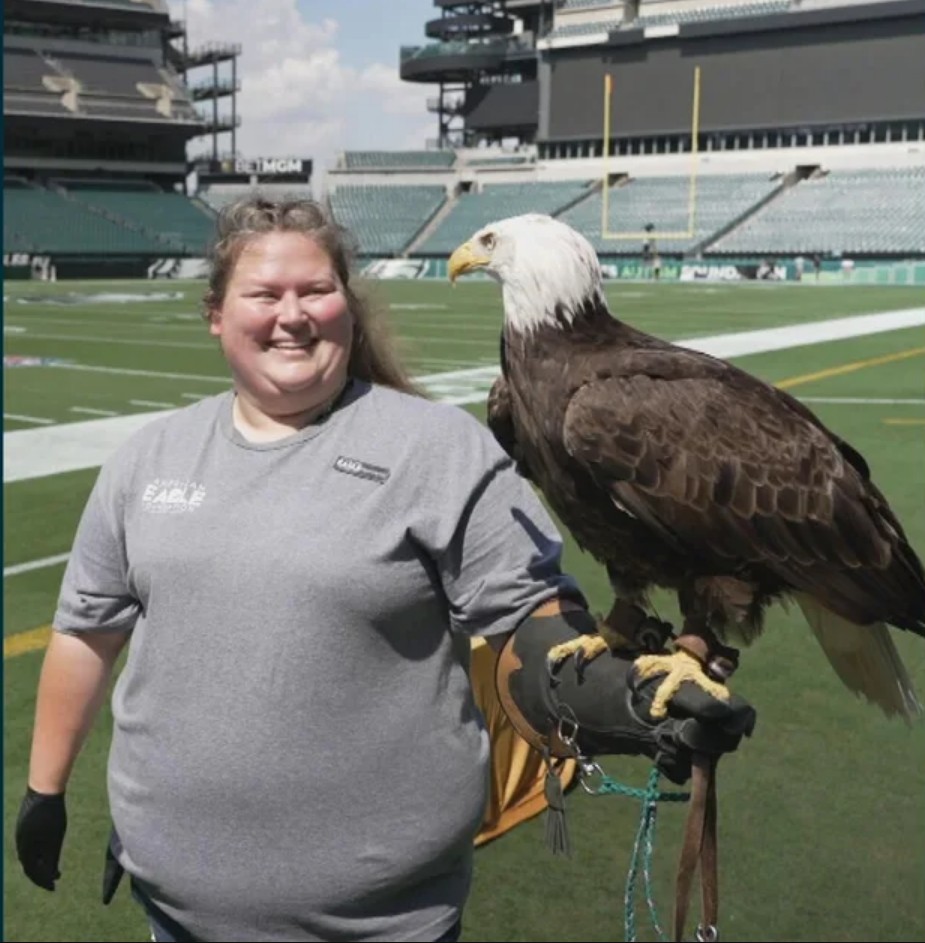
Lincoln has lived under the care of the American Eagle Foundation, an organization dedicated to conservation and wildlife education. Over decades, he has become one of the most recognized ambassador eagles in the country. Instead of hunting rivers and forests, he learned to fly over stadiums. Instead of disappearing into wilderness anonymity, he became a living symbol of the species’ recovery and resilience. His life has been built around trust—between bird and handler, instinct and training, power and control.
That context changes everything about the Budweiser moment.
Budweiser’s Clydesdales have appeared in Super Bowl commercials since 1975, and they are arguably the most enduring animal icons in advertising. Massive, deliberate, almost mythic in presence, they carry the weight of American nostalgia on their backs. Pairing them with a bald eagle was never going to be subtle. It was a bold stacking of symbols—strength, freedom, heritage, continuity.
But what made “American Icons” different was not the symbolism. It was the realism.
The campaign was rolled out during Budweiser’s 150th anniversary year, and the creative direction leaned into sincerity rather than spectacle. The ad didn’t rely on celebrities or punchlines. It relied on animals behaving like animals, captured with cinematic care. The final shot—Lincoln launching into flight as the Clydesdales surged below—was not stitched together in a rendering lab. It was the product of preparation, patience, and trust built over years.
Lincoln is no stranger to massive crowds. He has performed stadium flights at Philadelphia Eagles home games, soaring above tens of thousands of fans with calm precision. The roar of 70,000 people is not chaos to him—it’s routine. That experience matters. It explains why, when the cameras rolled for Budweiser, he did not flinch. He did not hesitate. He flew.
The emotional reaction to the commercial had as much to do with that knowledge as the imagery itself. Once viewers realized the eagle was real, the narrative shifted. The flight was no longer a special effect; it was a second chance story unfolding in real time. An injured bird who could never return to the wild had found a different sky—one made of stadium lights and national broadcasts.
Seeing Lincoln in a real stadium environment helps explain the composure visible in the Super Bowl ad. The flight pattern, the handler positioning, the smooth arc upward—it’s all consistent with years of professional training. Wildlife ambassadors are not “tamed”; they are conditioned through repetition and relationship. That distinction matters. The flight isn’t forced. It’s guided by familiarity and trust.
The official Budweiser “American Icons” commercial captures that trust in cinematic form. The pacing mirrors the rise of Lynyrd Skynyrd’s “Free Bird,” beginning in stillness and ending in lift. The Clydesdales ground the scene with physical weight. Lincoln provides the vertical release. The shot works because it balances two forces: earth and sky, muscle and motion, stability and ascent.
The training behind that balance is often invisible. Handlers work carefully to ensure both animals are comfortable in shared space. Clydesdales are powerful but controlled; eagles are instinct-driven but responsive to cues. Weeks of preparation ensure the moment reads as effortless. Effortlessness, in wildlife performance, is the result of structure—not improvisation.
Budweiser’s earlier teaser, “Stable,” hinted at something larger without revealing it. Five Clydesdales turning toward a mysterious rattling bucket built suspense around what viewers would eventually discover. The strategy worked because it leaned into curiosity instead of overselling emotion. By the time Lincoln appeared in full flight, the audience was primed to feel something.
Local coverage of Lincoln over the years shows the broader arc of his life—education programs, conservation events, and stadium appearances that extend far beyond a single commercial. That’s why the Super Bowl moment resonated differently. It wasn’t a random casting choice. It was the national amplification of a story that had been unfolding quietly for decades.
Comparisons to other live eagle flights only reinforce how rare this kind of precision is under pressure. Large crowds, unpredictable conditions, and tight timing windows introduce risk. When everything aligns, it feels almost scripted—but it isn’t. It’s discipline meeting instinct at exactly the right second.
The reason people cried isn’t just because the shot was beautiful. It’s because beauty plus authenticity hits harder than beauty alone. In an era where audiences assume digital enhancement, discovering that Lincoln is real feels like uncovering something honest. The moment becomes less about brand messaging and more about resilience—about how a bird who could not survive in the wild found a different kind of sky.
Budweiser benefited from that authenticity, but the emotional core belongs to Lincoln. The Clydesdales carried the weight of tradition. The music carried the swell of nostalgia. Lincoln carried the lift. Together, they created a final frame that blurred the line between advertising and myth.
An injured eagle found in a dumpster decades ago ended up soaring across one of the most watched broadcasts in the world. That arc is almost too poetic to script. And that’s exactly why it worked.
Not because it was perfect.
But because it was real.