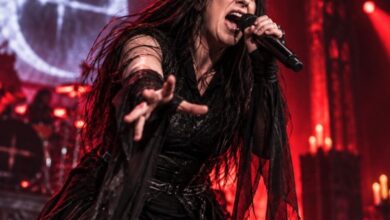
Def Leppard’s “Personal Jesus” At The Colosseum In Las Vegas February 17, 2026
Def Leppard have spent decades turning big riffs into big rooms, but there’s something especially electric about hearing them take a song that wasn’t born in their world and make it feel like it always belonged there. On February 17, 2026, at The Colosseum at Caesars Palace in Las Vegas, “Personal Jesus” landed like a left turn that everyone secretly hoped would happen. It wasn’t treated as a novelty or a quick wink to the crowd; it was played like a statement, wedged confidently into the early part of the set where momentum matters most. That placement alone changes the temperature in the room, because it tells you the band believes in it, and the audience quickly follows that belief into something loud, playful, and unexpectedly heavy.
The venue matters here. The Colosseum isn’t a sweaty club where covers are thrown out to kill time, and it isn’t a stadium where details get swallowed by distance. It’s the kind of room where you can feel the band’s timing as much as you hear it, and where a familiar chorus becomes communal in seconds. A residency crowd is also its own beast: part diehard fan, part curious traveler, part “I’ve waited years for this” energy, all mixed together under Vegas lights. That mix is perfect for a song like “Personal Jesus,” because it comes preloaded with recognition, and it thrives on call-and-response tension. Def Leppard lean into that tension, letting the groove breathe just enough before snapping it back into their own arena-rock muscle memory.
What makes this February 17 performance different is how naturally it sits inside Def Leppard’s current live identity rather than feeling like a side quest. In the same stretch of the show, you’re hearing the band move from modern fire to classic singalongs, then pivot into a cover that’s built on a hypnotic riff and a slightly menacing swagger. That contrast sharpens everything around it. You feel the band’s confidence in their own catalog, because only a band comfortable in its skin can borrow a song this iconic and still sound unmistakably like itself. The crowd reaction, too, isn’t polite appreciation. It’s that immediate “oh, they’re really doing it” surge, the kind that turns phones on and voices up without anyone needing permission.
The song choice also speaks to Def Leppard’s long relationship with melody, tension, and that sweet spot between polished and dangerous. “Personal Jesus” has always been a riff song disguised as something else, with a pulse that can be pushed toward rock without breaking its spine. Def Leppard don’t just amplify it; they reshape its silhouette. The beat feels sturdier, the edges feel sharper, and the chorus gains that Def Leppard lift where everything opens up and gets brighter even when the lyric stays dark. It’s a clever emotional trick: the band keeps the song’s sly intensity, but they deliver it with the kind of mass singalong power they’ve mastered since the biggest nights of their career.
There’s also a storytelling element in where “Personal Jesus” sits in the set. Coming early, it works like a provocation: a reminder that this residency isn’t only about greatest-hits comfort food, it’s about giving the crowd moments they didn’t walk in expecting. Setlists are basically narratives, and on this night the plot twist happens while everyone is still settling into the ride. Then, by the time the show shifts back into the band’s own classics, the room is already a little more awake, a little less predictable. The cover becomes a hinge, swinging the night from familiar to surprising, and that’s a powerful trick for a band with nothing left to prove but still plenty left to play with.
If you zoom in on why “Personal Jesus” works for Def Leppard specifically, it’s the way their strengths map onto the song’s demands. The track needs a riff that feels like a hook, a vocal that can flirt with menace without getting theatrical, and a band tight enough to keep the groove from turning into a stomp. Def Leppard are built for that kind of control. Even in a big room, their arrangements tend to stay clean and punchy, and that lets the song’s central riff do its job: lure everyone in, then dare them not to sing along. When the chorus hits, it becomes less of a lyric and more of a crowd ritual, especially in a residency where fans are primed to treat every standout moment like a souvenir.
Another reason this version pops is cultural. “Personal Jesus” is one of those songs that has traveled through genres and decades like a passport stamp collector, partly because its theme is both specific and universal. It’s about intimacy framed like religion, confession framed like comfort, devotion framed like temptation. That’s why it survives translation. Def Leppard tapping into it in 2026 isn’t random; it’s the band choosing a song that already carries a mythos, then adding their own chapter to that mythos live, in real time. And because it’s a cover with real history behind it, the audience arrives with expectations, which makes it even more satisfying when the band meets those expectations and then overshoots them.
The night itself also benefits from the residency momentum that’s been building around the set, the talk, and the surprises. When a cover becomes a talking point in a run of shows, it starts functioning like a signature moment: people compare versions, trade clips, argue about which night felt “heavier,” and build a little fan folklore around it. February 17 lands right in the middle of that kind of conversation, where the performance isn’t isolated; it’s part of an evolving Vegas story. You can feel that in how the crowd responds, not like they’re discovering it for the first time, but like they’re claiming it as theirs, like this is the version they came to witness and remember.
The best fan-shot clips capture something that polished pro footage rarely can: the exact emotional temperature of the room, including all the tiny imperfections that make it real. In this performance, the sound in the venue carries that thick, bright crunch that makes the riff feel physical, and the crowd noise rises in waves the moment recognition hits. You can sense how the song functions as a reset button, pulling attention toward the band in a new way because it’s not one of the expected tentpoles. The energy is less “we know every second of this” and more “we can’t believe this is happening right now,” which is exactly the magic a well-chosen cover can create during a residency.
To understand what Def Leppard are playing with, it helps to step back to the original Depeche Mode blueprint and why it hit so hard in the first place. The song’s guitar-forward, blues-tinged attitude was a sharp stylistic move for a band associated with sleek electronics, and that hybrid DNA is why rock bands keep circling back to it. The lyric is built like a late-night dare, and the hook is engineered for repetition, which makes it perfect for live reinvention. Def Leppard’s 2026 version essentially drags the riff a little closer to hard rock’s center of gravity, but the core appeal stays the same: a groove that’s both inviting and slightly dangerous, with a chorus that turns the room into a single voice.
Looking at earlier live eras of “Personal Jesus” also shows why the song keeps evolving on stage. In the early 1990s, it often carried a leaner, more urgent feel, with performance choices that emphasized tension and attitude. That lineage matters because it sets a standard: the song has to feel alive, not just recognizable. Def Leppard meet that standard by letting the riff lead without over-decorating it, and by leaning into the push-pull dynamic between swagger and singalong. The result is a version that feels less like a tribute and more like a takeover, as if the band is borrowing the song only to hand it back changed.
The cover tradition around “Personal Jesus” is the real proof of how flexible the song is. One artist can pull it toward gospel, another toward industrial menace, another toward arena-rock uplift, and the lyric still holds because it’s built on need, not trend. That’s the same reason Def Leppard can perform it in a Vegas residency and make it feel like a centerpiece rather than a detour. When the song is strong enough to survive radical reinterpretation, the question stops being “should anyone cover this?” and becomes “what does your version reveal about you?” Def Leppard’s answer, on February 17, is clarity: they’re still curious, still sharp, and still able to make a room move on command.
By the time the last echoes fade, what sticks isn’t just that Def Leppard played a Depeche Mode classic, but how they used it to underline who they are right now. This performance isn’t nostalgia cosplay; it’s a living band making a deliberate choice in a high-profile room, in a year where it would be easy to coast on greatest hits alone. The cover becomes a pressure test, and they pass it by sounding like a band with both history and appetite. That’s why this February 17 “Personal Jesus” feels important: it’s a reminder that the best live moments aren’t always the ones you expect to hear, they’re the ones that surprise you and still feel inevitable once they happen.