Megadeth’s “Symphony Of Destruction” Live In Winnipeg On Feb 25, 2026
Winnipeg has a way of turning big touring shows into something that feels oddly personal, and Megadeth’s stop at Canada Life Centre on February 25, 2026 played right into that tradition. This wasn’t just another midweek arena date where a legendary band runs through the hits and heads to the next city. The night carried an extra pulse because it landed in the early stretch of a major 2026 run, with the kind of crowd that shows up ready to prove their city belongs on the metal map. You could feel that energy building long before “Symphony of Destruction” arrived, because the set was paced like a story—tight openers, escalating tension, and then the inevitable moment when the room finally gets to explode together.
The context matters, because “Symphony of Destruction” is one of those songs that lives in multiple eras at once. It’s inseparable from the early-’90s breakthrough moment that pushed Megadeth beyond thrash’s inner circle, but it also keeps resurfacing every time a new generation discovers how heavy music can be both catchy and dangerous. In 2026, that dual identity hits even harder: the riff is still instantly recognizable, yet the song’s bite feels fresh because it’s built around timeless instincts—cynicism, spectacle, power, manipulation. That’s why it tends to sound different depending on the room. A complacent crowd will treat it like karaoke. A hungry crowd turns it into a chant, a rally, a communal shove forward.
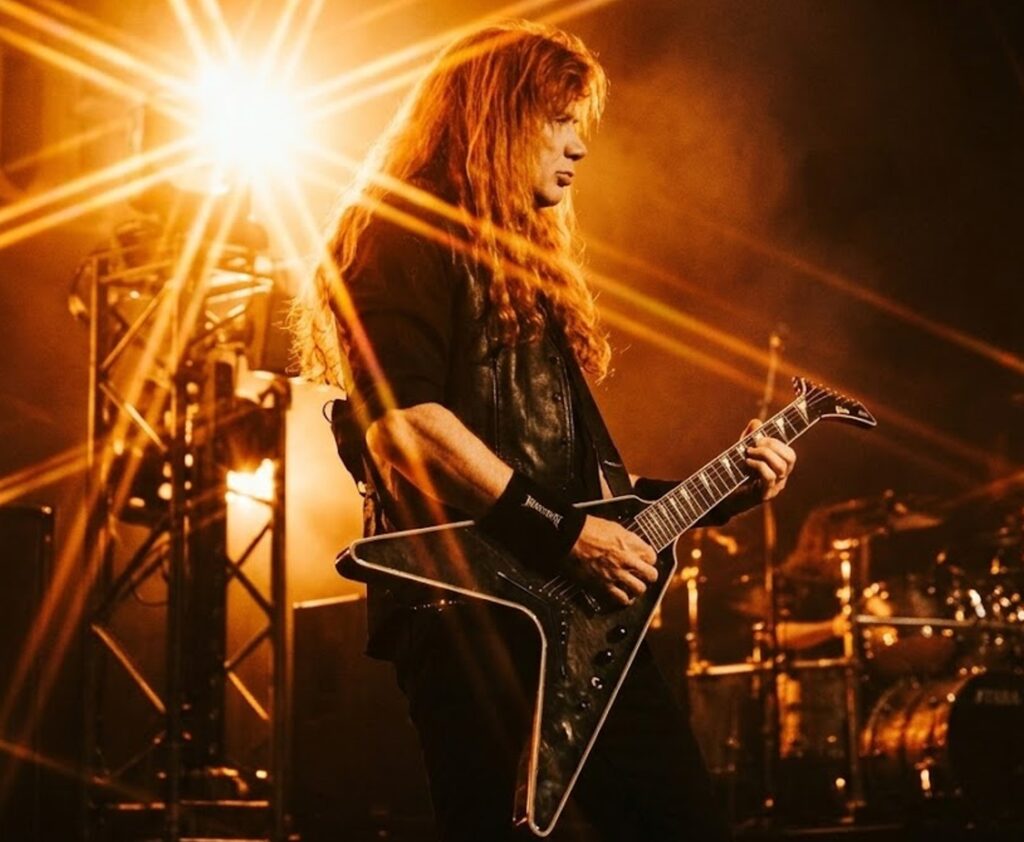
Canada Life Centre was a fitting stage for that kind of conversion. It’s an arena built for big-volume moments, but it doesn’t swallow detail when the band is locked in. That combination is crucial for Megadeth, whose sound lives on precision as much as force. The guitars need to cut cleanly. The drums need to hit like machinery rather than mush. And the vocal lines—sharp, sneering, rhythmic—need enough space in the mix to keep the song’s attitude intact. When “Symphony” hits right in a venue like this, it becomes less like a nostalgia piece and more like a demonstration: this is how you make a crowd move without losing the technical edge that made the band matter in the first place.
One of the best things about the Winnipeg performance is how it sat inside the broader arc of the setlist. By the time “Symphony of Destruction” arrived, the show had already run the audience through multiple sides of Megadeth’s identity—speed, melody, darkness, sarcasm, virtuosity. That matters because “Symphony” thrives when it’s not treated as the only “big” moment, but as a turning point late in the night where everything that came before finally funnels into something unified. It’s a song that can feel almost too familiar on paper, yet in a set structured with intention, it becomes the payoff: the second where casual listeners and diehards are suddenly shouting the same syllables with the same conviction.
That placement also helps explain why this version felt distinct, even compared to other 2020s performances. When “Symphony of Destruction” shows up after a run of intense, technically demanding material, it doesn’t read as a rest break—it reads as a victory lap with teeth. The riff lands like a stamp: simple enough to be immediate, heavy enough to be physical, and sinister enough to keep the mood from drifting into party-rock territory. In Winnipeg, it benefited from that contrast. The crowd had already been pulled through fast passages and dramatic grooves, so when the song’s central hook arrived, it felt like the room collectively recognized the cue to let loose.
There’s also something about Winnipeg audiences that tends to sharpen the “call-and-response” aspect of metal shows. You don’t get the sense people are there to be seen; you get the sense they’re there to participate. That’s exactly what “Symphony of Destruction” demands, because it has built-in crowd architecture—spaces where the band can pull back and let the arena carry the rhythm, and sections where the groove is so straightforward that bodies instinctively sync to it. In a fan-shot document of the night, that communal push becomes part of the performance itself: not an accessory, but a layer in the sound, the way a great crowd can turn an already-famous chorus into something that feels newly earned.
Even the lyrical angle takes on a different shade in 2026. “Symphony” has always been about the mechanics of influence and the way public spectacle can be weaponized. In a modern context—where everyone lives in constant streams of persuasion, outrage, hype, and narratives—the song’s themes land with less abstraction. You don’t need to explain what it’s pointing at; you only need to hear the smirk in the delivery and the stomp of the riff to understand the message. That’s why performances like Winnipeg’s can feel unusually current. The band doesn’t have to update the arrangement or change a lyric. The world did the updating, and the song simply keeps pace.
By the time the performance reached “Symphony of Destruction,” the show’s momentum had the steady, late-night intensity that’s hard to manufacture. That’s often where the best live versions come from: not the earliest song when everyone is still settling in, and not the final notes when energy becomes chaotic, but that sweet spot where the band is warmed up, the mix is dialed, and the crowd has fully committed. Winnipeg hit that zone. The song served as a giant, shared release valve—recognizable enough to unify thousands of strangers, heavy enough to keep the mood feral, and disciplined enough to showcase why Megadeth’s best material still feels razor-edged rather than merely loud.
The fan-shot perspective is part of what makes this moment valuable as a document. Official live releases tend to polish the edges into something cinematic, but crowd footage preserves the raw math of how a room reacts in real time—how quickly the riff triggers recognition, how the arena’s acoustics shape the low end, how the voices in the stands rise and fall in waves. In a performance like this, the “difference” isn’t just in what the band plays; it’s in the environment the song collides with. Winnipeg’s recording captures that collision: the song doesn’t feel isolated on a soundtrack, it feels embedded in a night where people showed up ready to turn a classic into a living, breathing event.
Going back to the official/original presentation highlights why the Winnipeg take hits the way it does. The studio version is famously sleek for a heavy track—tight, punchy, and designed to make the riff instantly memorable without blunting the aggression. That “clean menace” is exactly what later live versions either preserve or lose, depending on tempo, tone, and crowd dynamics. The Winnipeg performance works because it keeps the core geometry intact: the riff remains the spine, the groove remains the engine, and the vocal phrasing keeps the song’s sarcasm and warning signs in focus. Hearing the original immediately before comparing live eras makes it obvious what should never be sacrificed: clarity, tension, and that sense of control barely containing chaos.
Early-’90s live footage shows the song in its original natural habitat—new enough to feel dangerous, popular enough to draw massive reactions, and played by a band still carrying the momentum of a peak era. Watching that period makes the Winnipeg performance more impressive, not less, because it demonstrates how difficult it is to keep a song’s identity consistent across decades. The temptation is to speed it up, over-muscle it, or let it become a lazy singalong. What separates strong modern versions is restraint: trusting the groove, letting the riff do the work, and delivering the vocal lines with the same sharpness that made the track iconic in the first place. Winnipeg’s version belongs in that lineage because it feels purposeful rather than routine.
Mid-2000s performances—especially the big festival-style ones—show another side of “Symphony of Destruction”: the moment when it becomes a global anthem with a stadium’s worth of voices treating it like a chant. Those versions can be thrilling because they feel like controlled mayhem, a crowd so loud it becomes a second band. But they also risk turning the song into pure celebration, losing the sinister undertow that makes it more than a hook. What’s interesting about Winnipeg in 2026 is how it splits the difference. It has the communal lift you want from an arena “Symphony,” but it retains enough bite in the execution that the song still feels like a warning wrapped in a banger, not just a party soundtrack.
Comparing a modern festival performance to an indoor arena night is where Winnipeg’s uniqueness really shows. Festivals are huge and open and chaotic; arenas are enclosed pressure cookers where every riff rebounds off concrete and every chant stacks on itself. In a room like Canada Life Centre, “Symphony of Destruction” becomes more physical—less like a broadcast to a field, more like a shared surge in a sealed container. That environment rewards tightness, because the smallest timing issues become obvious, but it also rewards groove, because the crowd can lock into the pulse like one organism. Winnipeg’s Feb 25, 2026 performance stands out because it captures that perfect arena version of the song: heavy without being muddy, familiar without being lazy, and alive in the way only a genuinely engaged crowd can make it.