Def Leppard’s “Slang” Live In Las Vegas, NV On February 24, 2026 Became A Surprise Highlight Of The Residency
Def Leppard didn’t come to Las Vegas in February 2026 to simply replay the greatest-hits reel. The Colosseum at Caesars Palace is the kind of room that invites spectacle, but it also rewards details—tight harmonies, careful pacing, and those little deep-cut choices that make longtime fans feel seen. On February 24, the residency’s groove was already established: the band sounded settled, comfortable, and sharp, like they’d found the sweet spot between arena muscle memory and the extra focus that comes from playing the same stage night after night. And then “Slang” arrived, not as a novelty, but as a statement—an underdog track suddenly framed like a main character.
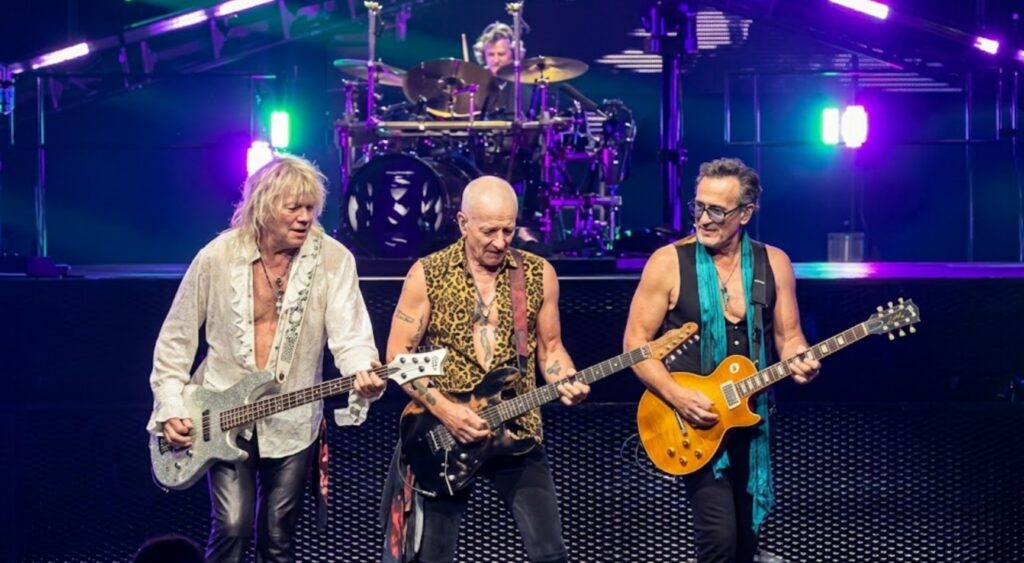
That matters because “Slang” has always carried a complicated reputation in Def Leppard lore. It’s not the glittering Hysteria-era gloss that casual listeners expect, and it’s not trying to be. The song comes from a period when rock bands were forced to respond to a changing world, and Def Leppard—never a group that survived this long by standing still—leaned into a grittier, more immediate energy. In the studio version, “Slang” is lean, punchy, and built on attitude as much as melody. Live, it becomes something else entirely: a groove-driven surge with room for crowd participation, swagger, and that unmistakable Def Leppard sense of lift in the chorus.
The Las Vegas setting gave the song a special kind of spotlight. A residency crowd isn’t always made up of the same type of fan. You’ve got diehards who traveled for multiple nights, locals who can pick a date and commit, and visitors who might only know the radio staples. “Slang” is the kind of track that can split those groups—unless the performance is strong enough to unify them. On February 24, it landed with the confidence of a band that knows exactly what it’s doing: introduce the riff, let the groove lock, and watch the room realize this isn’t an intermission moment. It’s a pulse-raiser.
What makes this particular version feel different is how it benefits from the residency format itself. On a normal tour, bands can spend the first few songs dialing in the sound in each new venue, fighting new acoustics every night. At The Colosseum, Def Leppard had the advantage of consistency—same room, familiar resonance, predictable sightlines, and a production team that can fine-tune the mix across the run. That steadiness helps “Slang,” because the song needs clarity more than sheer volume. The drums have to hit with snap, the guitars need definition, and the vocal stacks—so essential to Def Leppard’s identity—must be present without turning the track into syrup.
There’s also the emotional angle that longtime fans always bring to “Slang.” The mid-’90s era is remembered as a time when the band took a risk, absorbing outside influences while still sounding unmistakably like themselves. In hindsight, that courage is part of the song’s charm. Hearing it in 2026—decades later, in a prestigious Vegas residency—reframes it as proof of longevity rather than a detour. It’s the sound of a band refusing to fossilize. In Las Vegas, a city built on reinvention and showmanship, that message hits harder: “Slang” isn’t a footnote, it’s evidence that Def Leppard has multiple chapters worth celebrating.
Musically, this live take leans into the track’s physicality. “Slang” is a mover—less floaty singalong, more strut and stomp—so when it’s executed with conviction, it makes the whole room feel a little closer to the stage. The chorus is where the payoff lives, because it carries that signature Def Leppard duality: tough-edged guitars underneath, then a hook that opens up and invites the crowd to go with it. On February 24, the balance felt right. The band didn’t rush it, didn’t soften it, didn’t treat it like a novelty. They played it like it belonged in the center of the night, not tucked away as trivia for collectors.
Another reason the moment stands out is what “Slang” represents inside the residency’s broader story. The setlist was built to satisfy the giant hits, but it also made room for curveballs and fan-favorite surprises. Dropping a ’96 title track in that context sends a message: this isn’t just a museum exhibit of the ’80s. It’s a living catalog. And the crowd reaction, especially in a fan-shot capture, becomes part of the arrangement—the cheers rising as recognition spreads, the chorus landing like a communal exhale, the little surges of noise that tell you the room is with them even if not everyone walked in expecting to love this song.
By the time the performance reaches its final stretch, what lingers is how naturally it fits the band’s modern identity. Def Leppard in 2026 is still about melody, still about harmonies, still about that unmistakable sense of uplift—but the band has also learned how to make heavier, leaner material feel at home in the live show. “Slang” benefits from that evolution. It doesn’t sound like an awkward throwback to a trend-chasing era. It sounds like a confident deep cut that has aged into its own strength. In Las Vegas on February 24, it played like proof that the band’s risk-taking years still feed the fire today.
Watching the February 24 performance in fan-shot form highlights exactly why “Slang” can be a stealth showstopper in the right hands. You can hear the room’s reaction shift in real time—from curiosity to recognition to full buy-in—because the groove is undeniable. It’s also a reminder that Def Leppard’s live power has never been just about volume; it’s about precision and polish without losing bite. The camera angle may wobble, the audio may carry the natural arena reverb, but that actually helps: it captures the lived-in atmosphere of a Vegas night where a deep cut suddenly turns into a shared moment, not a private nod to diehards.
Going back to the original “Slang” release makes the Vegas version even more satisfying, because you can trace what stayed constant and what grew over time. The studio cut is tight, direct, and unapologetically different from what people expected from Def Leppard at the time—less shimmer, more grit, and a hook that doesn’t need glitter to work. In 2026, that same DNA becomes an advantage. The song’s structure is built for live impact: a riff that bites, a chorus that lifts, and enough rhythmic swagger to keep the crowd moving. The Vegas performance feels like the band finally getting to present the track in a context where it’s understood on its own terms.
A great comparison point is the 2013 Las Vegas performance from the Viva Hysteria era, because it shows “Slang” in a different kind of Vegas environment—one that’s still theatrical, but framed by a specific album-celebration concept. Hearing that version underscores how the song has always worked live when the band commits to its attitude. What’s changed by 2026 is the sense of ease: the residency format lets the performance breathe, and the band’s modern chemistry gives the track an extra snap. The 2013 take feels like a strong feature inside a themed show; the 2026 take feels like a statement within a broader career-spanning set, proving the song isn’t tied to one era or one narrative.
The 2023 Leadmill performance is another revealing lens, because a smaller, more intimate room changes the song’s personality. In a club setting, “Slang” becomes tighter and more confrontational, like it’s staring straight back at you rather than filling an arena. That intimacy highlights the track’s grit and rhythmic punch—the parts that sometimes get overshadowed when the biggest hits are in the conversation. Bringing that understanding into the 2026 Vegas version helps explain why it lands so well in The Colosseum: even in a grand room, the band plays it with enough bite that it doesn’t float away into arena gloss. It keeps its edge, even while the chorus stays huge.
One more useful comparison is another 2026 residency performance from earlier in the run, because it shows how “Slang” became part of the residency’s identity rather than a one-night novelty. In that context, February 24 stands out not because the band suddenly discovered the song, but because the night’s crowd energy and the show’s pacing gave it a particularly strong lift. It’s the difference between “this is in the set” and “this is the moment.” Residencies create those variations: same room, similar production, but the chemistry changes nightly. On February 24, “Slang” feels like it caught the perfect wave—tight band, dialed-in mix, and a crowd ready to embrace a track that once lived on the margins.