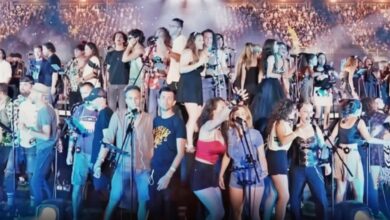
Anthrax Enforces Thrash Justice With “I Am The Law” At Canada Life Place 2026
There’s a special kind of electricity that hits when a classic thrash band walks into a room that’s already loud, already warmed up, already hungry for something fast and mean. On February 28, 2026, at Canada Life Place in London, Ontario, Anthrax had exactly that kind of crowd in front of them, and “I Am the Law” landed like a gavel. The song isn’t just a recognizable chorus or a pit-starter; it’s one of those riffs that flips a venue’s mood from excited to feral in about two seconds. You can feel the difference when a band plays a staple because they have to versus when they play it because it still makes them grin, and this night leans hard into the second category.
Context matters here, because 2026 wasn’t a nostalgia lap for Anthrax—it was a working, moving, full-speed tour rhythm, the kind where every night has to prove something. Sharing bills with heavy hitters tends to sharpen a set, not soften it, and their pacing in Canada had that “no wasted minutes” feel. The London stop had the vibe of a mid-run show where the band is locked in, the crew is smooth, and the band has figured out exactly how to weaponize the room. “I Am the Law” sits perfectly in that environment: it’s aggressive without being complicated for the crowd, it’s bouncy in the verses, and it turns into a communal chant the second the title hits.
What makes “I Am the Law” so evergreen is that it doesn’t rely on trendy production tricks or a delicate mood. It’s built like a machine: that opening figure is instantly identifiable, the rhythm pushes forward like it’s leaning into the downbeat, and the chorus is basically designed for thousands of voices to slam together. In a modern live setting, that construction becomes a superpower. People who know every note get the payoff they’ve been waiting for, and people who only vaguely remember the title still understand the assignment as soon as the band punches into the main riff. That clarity is why it works so well as a live statement, especially in a venue-sized room like Canada Life Place where sound and crowd response can feed each other fast.
The London performance also benefits from the band’s particular personality—Anthrax have always had that slightly mischievous edge, like they’re deadly serious about the music but not precious about themselves. That balance is part of why “I Am the Law” hits differently in their hands than it would for almost anyone else. It’s not grimdark posturing; it’s more like controlled chaos, a big grin behind the aggression. When the band is playing well, the groove in the riff becomes as important as the speed, and the audience reacts not just with pushing and shouting, but with that bounce that happens when the rhythm is irresistible.
A big part of why this version stands out is how cleanly it translates in a fan-shot environment. Some songs lose their punch when the recording isn’t perfect, but “I Am the Law” is almost engineered to survive rougher audio: the riff is bold, the structure is obvious, and the crowd noise becomes a feature instead of a flaw. That night in London, the audience response is practically a second instrument. The pauses feel louder, the chorus feels wider, and even the little transitional moments sound like they’re being pulled forward by the room. It’s the kind of capture where the imperfections actually make it more real, because it sounds like being inside the crowd instead of watching a polished live DVD.
Then there’s the lyrical identity of the song itself—this isn’t heartbreak, it isn’t poetry, it’s a pop-culture battle flag turned into thrash. That’s always been part of Anthrax’s charm, and in 2026 it reads as a reminder that metal can be fun without being soft. The hook is simple and theatrical, and when thousands of people shout it back, it becomes less about the reference and more about the shared ritual. At Canada Life Place, you can feel that ritual kick in early: once the crowd realizes what’s happening, it’s not passive listening anymore. It becomes participation, like everyone in the room knows they’re about to help the band make the chorus feel twice as big.
Placement inside the set helps too. “I Am the Law” works best when the energy is already up, because it doesn’t politely build tension—it detonates it. In London, it plays like a checkpoint moment where the band and crowd confirm they’re on the same wavelength. The pit energy turns from scattered motion into something more unified, and the response becomes rhythmic rather than random. It’s not just people yelling; it’s people yelling in time, which is when a show starts to feel like one giant moving organism. That’s where Anthrax thrive, because their thrash has always had a heartbeat and a sense of swing, even when it’s moving fast.
If there’s a “2026 difference,” it’s maturity without slowdown. The band doesn’t perform the song like a museum piece; they perform it like a weapon they still trust. The tempo feels confident rather than rushed, the transitions are tight, and the crowd response is treated like part of the arrangement. You can hear how the chant sections are allowed to breathe just enough, how the band leans into the parts they know the audience will explode for. That’s the mark of a group that understands what the song does live, and understands how to let a room do some of the work for them without losing control of the momentum.
Watching the London capture after the fact, the first thing that jumps out is how quickly the riff resets the room. Even if the audience has been loud all night, “I Am the Law” has a way of focusing that noise into something directed. The chorus doesn’t feel like a singalong bolted onto a metal song; it feels like the point of the whole experience, because the hook was written to be shouted. In this 2026 setting, the band’s attack has that seasoned snap—tight enough to sound vicious, loose enough to still feel dangerous. That’s a hard balance to keep over decades, and it’s a big reason why this version feels alive rather than archival.
Going back to the original studio cut is almost like seeing the blueprint. The tone is leaner, the edges are sharper in that classic late-80s way, and the whole track feels like it’s surging forward with youthful impatience. Hearing it after the London performance highlights what hasn’t changed: the riff is still the star, the hook is still a hammer, and the structure still makes total sense for a crowd. It also highlights what has changed: modern live Anthrax can make the song feel larger and more communal, while the studio version feels like a direct transmission from the era when thrash was still carving out mainstream attention one sweaty club at a time.
The 1987 live footage captures a different kind of intensity—rawer, more frantic, like the band is still proving they belong at the top of the heap. The energy is youthful and slightly reckless, and the song feels like it’s being played at the crowd rather than with the crowd. That’s not a criticism; it’s a snapshot of a band in that classic thrash era where everything is about speed, sweat, and impact. Comparing it to 2026 is fascinating because the riff lands the same way, but the confidence is different. In London, the band doesn’t need to sprint to sound dangerous; they sound dangerous because they control the room.
By 1991, the live feel shifts again. The performance is still aggressive, but there’s more command in the pocket, more sense that the band knows how to shape a set and steer a crowd. “I Am the Law” becomes less of a statement of identity and more of a guaranteed ignition point—something they can drop into a show and instantly raise the temperature. That’s the same role it plays in 2026, which is why the comparison works so well. The song has basically been a reliable switch for decades: flip it, and the venue goes from loud to frantic. London just shows that the switch still works perfectly.
The Big 4 era adds another layer, because that context turns “I Am the Law” into part of a larger thrash mythology. The song doesn’t just represent Anthrax—it represents that whole lineage of riffs built for pits and arenas. In those performances, the crowd size and the event framing make everything feel monumental, and you can hear the band leaning into the anthem aspect of the chorus. That’s useful for understanding the 2026 Canada performance, because it shows how Anthrax learned to scale the song up without losing its bite. London has that benefit: it feels intimate enough to be rowdy, but big enough to sound like a genuine anthem moment.
Festival performances like Bloodstock 2013 show how “I Am the Law” functions when the crowd isn’t exclusively “your” crowd. That’s where a truly great live song proves itself, because it has to grab attention fast and communicate instantly. The riff does that, and the chant does that, and the song’s swagger makes it feel like an invitation to join the chaos. When you compare that to Canada Life Place 2026, it underlines why the London version works so well: the crowd is clearly there for metal, clearly ready to respond, and the song gives them an easy, irresistible role to play. The chorus becomes the handshake between band and audience.
Wacken 2019 is another great comparison point because it showcases how a huge crowd amplifies the chorus into something almost absurdly massive. It also shows how Anthrax’s delivery evolved: more control, more emphasis on groove, and an understanding of exactly when to let the crowd take over. That’s the same principle you hear in London, just in a different scale. Canada Life Place doesn’t need a sea of people to make the moment feel big; it needs the right song at the right time, played with the right sense of timing. “I Am the Law” checks every box, and in 2026 it still sounds like it was built for nights exactly like that.
The real takeaway from the February 28, 2026 performance is that “I Am the Law” continues to be more than a greatest-hits obligation. It’s a living tool in Anthrax’s set, a piece of thrash engineering that still turns a crowd into a unified shout. Some legacy songs become comfortable; this one stays confrontational in the best way, because the riff demands motion and the chorus demands volume. London proves that the band’s relationship with the track is still active: they know where it hits hardest, they know how to pace it, and they trust the crowd to meet them halfway.
And that crowd did. Canada Life Place on that night sounds like the kind of room where the floor feels busy even during the “in between” moments, where people are already braced for the next eruption. “I Am the Law” doesn’t politely arrive in that environment—it kicks the door open. The performance becomes a little time machine, connecting the comic-book spark that inspired it, the late-80s thrash explosion that made it famous, the big-stage eras that turned it into an anthem, and the present-tense reality of a band that still enjoys watching a room go wild. That’s why this version feels special: it isn’t nostalgia pretending to be current. It’s current, and it still hits.