72-Year-Old Nancy Wilson Of Heart Delivers A Deeply Emotional Eddie Van Halen Tribute In Indiana This March
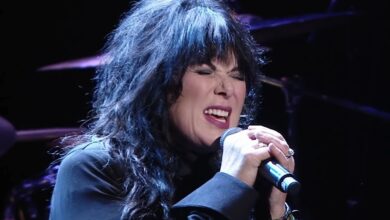
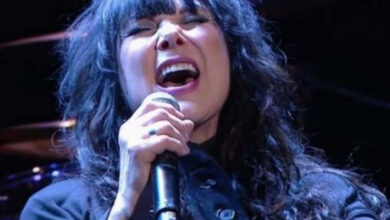
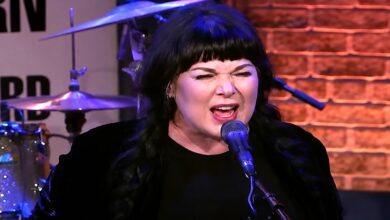
Nancy Wilson’s performance of “For Edward” at Fishers Event Center on March 15, 2026, felt like the kind of moment that only reveals its full weight after the room has already gone quiet. Heart had spent the night doing what Heart has done for decades—filling a hall with songs that carry both muscle and memory—but when Nancy reached for the acoustic guitar and turned toward a tribute to Eddie Van Halen, the energy shifted into something more intimate, reflective, and lasting. This was the final show on that leg of the Royal Flush Tour, and that fact mattered. Final nights tend to pull honesty out of performers, stripping away routine and leaving only feeling. In Fishers, Nancy did not treat the song like a side note or a breather between bigger crowd-pleasers. She played it like a closing thought that had been waiting all evening to be said properly, and because of that, the piece landed with an emotional gravity that made the whole concert feel larger in retrospect.
What made the Fishers performance so compelling was not simply that it happened on the last date of a successful run, but that it arrived after a month of Heart sharpening their 2026 road form in front of audiences across the country. This leg had opened in Duluth, Georgia on February 15 and made its way through a string of American stops before ending in Indiana, giving the show in Fishers the natural tension and release of a finale rather than a regular tour stop. By the time Nancy sat down with the acoustic instrument, she was not playing into a cold room. She was playing into a crowd that had already been lifted, surprised, and drawn into the band’s rhythm for nearly two hours. That matters with a piece like this. Instrumentals can either get lost in a set or suddenly reveal the soul of it, and here it absolutely did the latter. Fishers was not only the end of a route on the calendar; it sounded like the point where a tour’s emotional undercurrent finally rose to the surface.
Part of the performance’s strength came from the way Heart had arranged the night around contrast. The set moved through signature songs, richer atmospheric moments, and classic-rock detours, and by the time “For Edward” arrived, the audience had already been guided into a more attentive state. That is one reason the piece stood out so sharply. It did not have to fight for oxygen inside a loud arena-rock sequence. Instead, it appeared at exactly the right point, after enough motion and power had built up that a solitary acoustic tribute could feel almost startling in its calm. In a Heart show, people naturally expect vocal fireworks, huge hooks, and the full command of a legendary catalog. Nancy gave them something else in Fishers: a pause that did not diminish the scale of the evening but deepened it. Suddenly the concert was not just about Heart’s own endurance. It became about lineage, admiration, memory, and the quiet conversation musicians sometimes have with one another across time.
There is also the story inside the song itself, and that history gives every live performance of it an added dimension. “For Edward,” officially released as “4 Edward,” came from Nancy Wilson’s 2021 solo album You and Me and was conceived as a tribute to Eddie Van Halen after his death. The song was never meant to be a flashy imitation of his style, and that is precisely why it works. Nancy approached the tribute as a personal response rather than a technical challenge, creating something tender, melodic, and emotionally clear instead of trying to out-Eddie Eddie. In a rock culture that often mistakes tribute for replication, that was an unusually thoughtful choice. The piece honors his spirit without borrowing his voice too literally, and that decision paid off in Fishers. What the crowd heard was not a museum piece. It was one great guitarist remembering another in the language she knows best: dynamics, phrasing, warmth, and restraint.
The song’s backstory makes the tribute even more affecting. Nancy has explained that when Heart toured with Van Halen, she once asked Eddie why he never played acoustic guitar, and he told her he did not own one. She gave him one of hers, and he immediately wrote something on it that stayed with her. That story matters because it reframes the tribute not as a distant act of public respect, but as a private memory turned into music. There is an exchange embedded in the song: one musician giving another an instrument, one artist responding with inspiration, and years later the first artist answering with a composition of her own. In Fishers, that narrative gave the performance an almost circular beauty. It sounded like Nancy was returning something that had been emotionally unresolved for years. Instead of making a speech-heavy monument out of Eddie’s legend, she let the guitar do the remembering, which made the tribute feel human rather than ceremonial.
Nancy has also spoken about how she built “4 Edward” around qualities she associated with Eddie Van Halen’s playing: joy, uplift, a major-key brightness, and a blend of classical shape with rock energy. That is a crucial detail because it explains why the song feels so open-hearted rather than mournful in a conventional sense. It does grieve, but it grieves while smiling through the memory of someone whose playing often sounded exuberant even at its most technically overwhelming. In Fishers, that quality came through beautifully. Nancy’s touch was gentle, but the melody never collapsed into sadness for its own sake. There was sparkle in the phrasing, motion in the rhythm, and a kind of affectionate lift in the chord movement. That balance is difficult to achieve in any tribute. Too much reverence and the music turns static; too much flourish and it becomes showy. Here, the balance felt exact. She was honoring his joy, not merely his absence, and that gave the performance unusual emotional color.
What especially separates the Fishers reading from the studio version is the context of the live setlist itself. On this night, the song appeared as a Nancy solo acoustic moment and was reportedly preceded by a lengthy Eddie Van Halen story. That kind of setup can easily turn sentimental or over-explanatory in lesser hands, but with Nancy it seemed to sharpen the audience’s focus rather than dilute it. By the time she began to play, listeners knew they were being invited into a recollection, not just presented with a track from a side project. That framing changes everything. The first notes no longer feel like the start of a tune; they feel like the opening of a memory. In a venue full of people who had spent the evening cheering Heart’s classic songs, that shift to storytelling and then solitary acoustic playing created one of those rare concert moments where an entire room seems to lean inward at once. The performance did not need volume to dominate the night. It needed only attention, and it got it.
Another layer made the Fishers version special: it arrived at the close of a tour leg that had already contained both celebration and wear, both victory-lap energy and the lived-in feel of musicians who understand exactly how to pace a room. Final shows often reveal whether a tour has simply been executed well or actually lived in. This one sounded lived in. There was nothing dutiful about Nancy’s playing. The phrases did not feel recited, and the pauses did not feel planned for effect. Instead, the performance carried the looseness and confidence of an artist who knows the material deeply enough to let it breathe in real time. That is often where acoustic performances become truly memorable—not when every note is pristine, but when the whole thing seems to exist in the moment rather than under glass. In Fishers, “For Edward” became more than a tribute and more than a setlist rarity. It became the emotional hinge of the evening, the point where the concert stopped rushing forward and allowed itself to reflect on what music leaves behind.
Watching the Fishers footage makes that atmosphere even clearer. The fan-shot angle captures something polished live releases often miss: the tension in the room before people fully realize what they are hearing. There is a specific beauty in audience-recorded concert video when the person behind the camera understands the importance of simply staying with the performance rather than chasing reactions, and that is part of what makes this clip effective. It preserves the song as an event rather than as content. Nancy’s body language is composed and inward, and the audience response builds not from instant recognition but from growing absorption. That slow capture matters because “For Edward” is not built to knock the doors open in twenty seconds. It works by patiently drawing listeners into its emotional architecture. On a final-night crowd already primed by the sweep of a full Heart concert, the piece comes off almost like a benediction. The camera does not exaggerate that. It lets the moment reveal itself.
The official audio version tells a slightly different story. In the studio, the piece is cleaner, more contained, and framed as a carefully shaped instrumental statement. You hear the composition itself more starkly there: the melodic logic, the pacing of the build, the way Nancy keeps the arrangement spacious while still giving it contour and emotional rise. It is an elegant recording, and its intimacy was already built into the song from the beginning. Yet hearing that version after the Fishers performance only underlines what live context adds. In the studio, “4 Edward” feels like a private letter. In Fishers, it feels like that same letter being read aloud at exactly the right time, to exactly the right room. The difference is not about one version being better than the other. It is about scale of feeling. The studio gives the song its shape; the concert gives it communal meaning. That is why the live rendition lingers differently after the final note disappears.
An earlier 2025 live performance offers a useful comparison because it shows how the piece has evolved as Nancy has continued to bring it into Heart’s concerts. Earlier readings can feel more like a touching tribute segment within a broader show, whereas the Fishers version carried the accumulated confidence of a piece that had found its place in the set and in the audience’s expectations. That is often what happens when an initially personal composition starts to live onstage for long enough. It stops being merely autobiographical and begins to gather public meaning. The Fishers take had that maturity. Nancy did not seem to be introducing the song to the room anymore; she seemed to be trusting the room to meet it where it already was. That trust changed the pacing, the calm inside the phrasing, and even the emotional temperature of the silence around the notes. It felt less like a feature and more like a tradition taking root.
The Seattle performance from late 2025 adds another angle because it highlights how the song behaves in a larger, more overtly arena-scale environment. There, you can sense the challenge and beauty of presenting something so unguarded in a room built for spectacle. The Fishers version, by contrast, seemed to benefit from the sense of final-night concentration, from the narrative arc of the tour’s closing stop, and from the emotional weather of a set that had already made room for reflection. Comparing the two makes one thing obvious: Nancy Wilson understands that a tribute like this cannot be delivered the same way in every city and still remain alive. She lets the room tell her how much space to leave, how long to hold a phrase, how deeply to lean into the hush. That adaptability is one of the marks of a truly seasoned performer. Fishers did not sound bigger than Seattle in a literal sense. It sounded more inward, and therefore in some ways more powerful.
The Edmonton performance is another revealing companion because it shows the continuity of Nancy’s intent across different dates while also proving that “For Edward” is not some frozen ritual she simply repeats. The bones of the composition remain the same, of course, but the emotional emphasis subtly changes depending on the night. In one performance the tribute may feel more narrative, in another more meditative, in another more like a quiet interruption inside a high-energy set. Fishers stood out because it gathered all of those possibilities into one reading. It had the storyteller’s frame, the reflective pacing, and the larger significance of a final-show statement. That combination is hard to manufacture, which is why the clip resonates. It does not feel like the best version because someone decided it would be. It feels like one of the strongest versions because several strands—tour context, audience focus, Nancy’s comfort with the piece, and the emotion of farewell—happened to align at once.
There is also something especially moving about hearing Nancy Wilson play this song at a point in her career where she has nothing left to prove in conventional rock-star terms. She is not using “For Edward” to demonstrate that she belongs in any guitar conversation. She has been in that conversation for years. What she does here is more difficult than dazzling technique for technique’s sake. She presents confidence without ego, emotion without overstatement, and reverence without flattening the personality of the music. That is one reason the performance lands so strongly with listeners who may not even know the full backstory. You do not need every historical detail to understand what is happening. You can hear that this is a musician choosing vulnerability over spectacle and trusting that sincerity will carry. In a musical culture saturated with over-explained tribute moments and overproduced nostalgia, that simplicity feels almost radical.
It also says something important about the way Eddie Van Halen’s legacy continues to live beyond imitation. Many tributes to him naturally focus on speed, fireworks, tapping, or the larger-than-life side of his myth. Nancy Wilson approached him from another angle. She honored the melodic joy in his sensibility, the spirit of wonder behind the playing, and the personal memory of artistic generosity. That gives “For Edward” a lasting identity of its own. It is not a shadow of Van Halen music, nor is it a generic elegy that could have been written for anyone. It is distinctly hers while remaining unmistakably about him. In Fishers, that individuality became the whole point. The tribute did not reduce Eddie to a style cliché, and it did not reduce Nancy to the role of mourner. Instead, it let both artists remain fully themselves inside the same piece of music, which is a rare achievement for any memorial composition.
By the end of the night, what lingered was not just the beauty of the song, but the way it reframed the entire concert around memory and continuity. Heart’s Royal Flush Tour had spent weeks reminding audiences how durable these songs and these musicians remain. “For Edward” added another truth to that story: durability in rock is not only about power, stamina, or hit-making legacy. It is also about the ability to carry friends, influences, and shared history forward in a way that still feels alive. Nancy Wilson’s Fishers performance did exactly that. It closed a tour leg not with pure triumphalism, but with grace, gratitude, and a guitarist’s form of remembrance. That is why the moment feels bigger than a strong acoustic interlude on a setlist. It feels like the kind of performance people will keep returning to because it catches something concerts only occasionally reveal: not just how artists play, but how they remember.