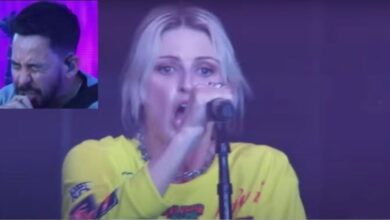
Yungblud Turned Liverpool Into A Rock Opera With “Hello Heaven, Hello” At M&S Bank Arena On April 12, 2026
On Sunday night, April 12, 2026, the atmosphere around Liverpool’s waterfront felt different long before a single note was played. Fans gathered early outside the M&S Bank Arena, forming lines that wrapped around the dockside as anticipation steadily built throughout the evening. This wasn’t just another stop on a tour schedule—it had the energy of a major moment. Inside, the venue slowly filled with a mix of longtime followers and newer fans drawn in by the evolving Idols era, creating a crowd that felt both loyal and curious at the same time. As the lights dimmed for the opening acts, there was already a sense that the night would unfold with a scale and intention that went beyond a routine concert experience.
By the time the support acts had finished and the stage was reset, the tension inside the arena had reached a boiling point. The lighting rig cast long shadows across the crowd, and the hum of expectation turned into a roar with every passing minute. When the final intro visuals began to flicker across the screens, it felt less like the beginning of a gig and more like the opening scene of a film. That cinematic approach would define everything that followed. Yungblud didn’t walk into the spotlight casually—he arrived with purpose, stepping into a moment that had clearly been designed to pull the entire arena into his world from the very first second.
Opening with “Hello Heaven, Hello” was a bold, almost defiant move. In an era where most artists rush to deliver instant gratification, starting with a long, multi-layered track demanded patience and attention from the audience. But Liverpool responded instantly. The song unfolded like a journey, moving through shifting moods and textures, and the crowd stayed locked in, absorbing every transition. It didn’t feel like an opening song—it felt like a statement. By the time the final section hit, the entire arena had been drawn into the performance’s emotional rhythm, setting the tone for everything that followed.
What made that opening so powerful was the way it reframed expectations. Instead of treating the concert as a sequence of hits, Yungblud positioned it as a story. That storytelling approach carried directly into the next run of songs, where the energy sharply pivoted into more immediate, punch-driven moments. Tracks like “The Funeral” and “Lovesick Lullaby” snapped the crowd into motion, transforming the reflective opening into a surge of movement and noise. It was a carefully calculated contrast—one that made the heavier moments hit harder because of the quiet intensity that came before them.
As the set moved deeper into the night, the emotional range of the performance became more apparent. Rather than maintaining a single tone, Yungblud allowed the show to breathe and shift, moving between aggression, vulnerability, and release. Songs like “fleabag” and “Lowlife” created pockets of intimacy within the massive space, moments where the arena seemed to shrink despite the thousands in attendance. It’s a rare ability—to make a venue that size feel personal—and it was clear that the connection between performer and audience was not being lost in the scale of the production.
One of the most striking turning points came with “Changes.” The atmosphere shifted almost instantly as the first notes rang out, and the crowd responded with a kind of reverent silence before gradually joining in. It wasn’t just another song in the set—it felt like a pause, a moment to reflect within the chaos of the show. In a performance built on high energy and theatrical movement, this was the emotional center, grounding everything in something more human and fragile. You could feel the weight of it ripple through the arena.
From there, the show rebuilt its momentum with careful precision. Tracks like “I Need You (To Make The World Seem Fine)” and “Fire” reignited the crowd without losing the emotional depth that had just been established. This balance between intensity and introspection became one of the defining features of the Liverpool performance. It wasn’t about maintaining constant volume or speed—it was about shaping the experience so that each rise and fall carried meaning. The crowd wasn’t just reacting; they were being guided through something that felt intentionally constructed.
Visually, the production played a major role in amplifying that experience. The lighting design shifted constantly to match the tone of each song, moving from stark, minimal setups to full-scale bursts of color and motion. Large screen projections added another layer, creating a sense of depth behind the performance rather than simply decorating it. At times, the stage looked almost stripped back, focusing attention purely on the music. At others, it expanded into something far more theatrical, turning the arena into a fully immersive environment.
Midway through the set, there was a noticeable shift in the crowd’s energy. What began as excitement had transformed into full engagement. Every chorus was shouted back, every quiet moment met with attentive silence. This wasn’t passive attendance—it was participation. The audience had become part of the performance, feeding energy back into the stage in a way that made each song feel bigger than it would have on its own. It’s that kind of interaction that elevates a concert from good to unforgettable, and Liverpool had clearly reached that level.
The later part of the main set leaned heavily into the identity of the Idols era, and that choice paid off. Rather than retreating into safer, older material, Yungblud doubled down on the newer songs, trusting that the audience would follow. That confidence was rewarded with one of the loudest reactions of the night. It showed that the connection wasn’t limited to nostalgia—it was rooted in where the music is now. That’s a rare and important distinction, especially in venues of this size.
As the main set came to a close, there was a brief pause that felt almost necessary. The lights dropped, the band stepped away, and the crowd’s noise swelled into a unified demand for more. When Yungblud returned for the encore, the energy had somehow climbed even higher. It’s a familiar structure, but in Liverpool it didn’t feel like a routine formality—it felt like a final act that still had something to prove.
“Ghosts” and “Zombie” brought the emotional intensity back to the surface, each song hitting with a renewed sense of urgency. There was a visible connection between stage and audience during these moments, a shared understanding that the night was reaching its final stretch. Rather than fading out, the performance surged forward, building toward its closing moments with purpose and clarity.
Ending with “Suburban Requiem” felt like a deliberate choice to close the story rather than simply end the show. The song carried a sense of finality that matched the scale of the evening, allowing the performance to resolve in a way that felt complete. As the last notes rang out, there was no rush to leave the stage. Instead, the moment lingered, giving the crowd time to absorb what they had just experienced.
Walking out of the arena, there was a noticeable shift in mood among the audience. People weren’t just talking about individual songs—they were talking about the experience as a whole. That’s the mark of something that resonates beyond the setlist. Liverpool didn’t just get a performance; it got a fully realized live narrative, one that balanced spectacle with sincerity in a way that felt increasingly rare.
What made this night stand out wasn’t just the scale or the production, but the intention behind it. Every decision—from the opening song to the final encore—felt purposeful. Nothing was thrown in for convenience, and nothing felt out of place. It was a show built on trust: trust in the material, trust in the audience, and trust in the idea that a modern rock performance can still be ambitious without losing its emotional core.
By the end of the night, it was clear that this wasn’t simply about filling an arena. It was about transforming it into something more—something immersive, something expressive, something memorable. Yungblud didn’t just perform in Liverpool on April 12, 2026. He created a moment that felt larger than the venue itself, one that lingered long after the lights came up and the crowd began to drift back into the night air along the docks.