The Riff Metallica Found Inside Elton John’s Piano Part
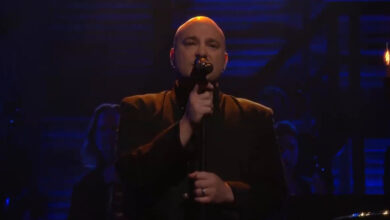
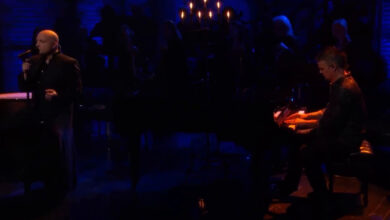
The opening of “Funeral for a Friend” has a scale that makes it feel bigger than the instrument it began on. At the Gershwin Prize concert in Washington, D.C., on March 20, 2024, Metallica used that quality to their advantage. They played Elton John and Bernie Taupin’s two-part opener from Goodbye Yellow Brick Road in front of the men who wrote it.
Listen for the move into “Love Lies Bleeding.” The band gives the opening enough time to build, then the guitars put their own weight behind the melody. Hetfield’s delivery adds a rough edge, but it is the guitar arrangement that makes the familiar tune feel like it belongs in a Metallica set. A listener under the band’s video singled out exactly that: the way Hetfield turns piano melodies into riffs.
The audience shots give the performance a second payoff. Elton and Bernie are there to hear what another band found in their work. The guitar transition is the reason to rewind; Elton getting to his feet is the reason to let the video play to the end.
The challenge of opening with an instrumental
“Funeral for a Friend” asks a band to establish a mood before anybody has a lyric to sing. The original on Goodbye Yellow Brick Road gives the instrumental plenty of room to make its own impression. A tribute performance has to decide how much of that rise to keep and where the instruments should come forward. Metallica leaves the listener time to recognize the shape. The introduction sounds like it is leading somewhere before you can hear what happens when it gets there. That is a useful quality to preserve in any arrangement of the medley.
The contrast is easier to follow if you play the Elton John recording first. Notice how the introduction sets the scale and how it gathers momentum before the second part of the opener arrives. Then play the tribute and follow that broad change again. You can hear the difference made by a band built around electric guitars, bass and drums. You can also hear why fans could recognize the force of the original through those changes. A familiar melody gives a group room to make the texture and rhythm around it feel personal.
Where the guitars change the weight
The most rewarding spot to compare is the move into “Love Lies Bleeding.” Listen for when the rhythm becomes more explicit and the guitar part begins to dictate how the rest of the arrangement feels. A recurring figure can carry the movement across the change and still give the vocal room to work. In the tribute, the guitars give the section more physical weight. Even if you know how the medley proceeds, that additional pressure makes the arrival of the second section feel larger than the simple recognition of the song could on its own.
Watch the performance
Metallica’s official Gershwin Prize footage
There is a good reason listeners singled out what Hetfield’s riffs do to a song so closely associated with Elton’s piano. Changing which instrument pushes a melody forward changes what listeners notice in it. The guitar lets an accent arrive with a sharper edge, while the rhythm section decides how much weight to put behind the next measure. In this performance those details give the second half a harder drive. The memorable aspect is how readily the core of Elton John and Bernie Taupin’s song survives the move into that familiar Metallica sound.
Keep an eye on Elton and Bernie
The occasion explains why the audience shots feel consequential. Elton John and Bernie Taupin were the people being honored at the Library of Congress Gershwin Prize concert, and Metallica were there as guests playing a piece of their work. Watching the two songwriters hear the new arrangement is its own thread in the performance. The camera lets you consider what it might be like to hear a melody that familiar coming back with a very different sound behind it. The reaction is visible without having to assign either songwriter an unspoken thought.
There is a useful order for watching the clip. Give the band your attention at the transition, then stay with the picture when it goes to the audience. When Elton gets up to applaud, you have already heard the decision that makes the arrangement interesting. His response is a payoff to that decision. It helps the film show both sides of a tribute: people on the stage figuring out how to carry a piece of music, and one of the people who made it getting to hear where they took it.
Why this belongs next to a Metallica live cut
It is worth following the tribute with the band’s performance of “Devil’s Dance.” The songs are quite different, but the second recording brings out some of the same decisions about timing and weight. That song depends heavily on letting a low repeating figure hold the listener in place. In the Elton medley, similar attention to repetition and accent gives an unfamiliar guitar setting a coherence of its own. This is a good way to hear which parts of the tribute belong to the original material and which choices are recognizably part of Metallica’s approach.
The three clips make for a satisfying comparison. Elton’s album version gives you the scale, momentum and shape of the original. The Gershwin Prize performance gives you a new set of sounds occupying that shape. The Metallica live cut gives you a clearer sense of the band’s stage language. Come back to the moment between the two halves of the medley after hearing all three. You can hear the original tune still doing its work while the band changes the things around it. The balance is more obvious there than in any single big note.
A concert tribute can send people back to two catalogs, and this performance has a reason to do that. Elton’s music gives the group a strong run-up to the main song. Metallica takes that run-up seriously enough that the later riffs feel earned. At the end, you can watch the songwriter stand and still have a musical reason to go back to the beginning.
Related videos
Elton John’s original Funeral for a Friend / Love Lies Bleeding
Metallica performing Devil’s Dance live