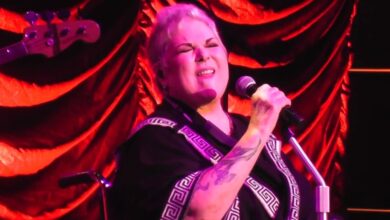
How Ann Wilson and David Draiman Share the Chorus in the Official “Don’t Tell Me” Video
The official video for Disturbed’s “Don’t Tell Me” puts Ann Wilson and David Draiman close enough for you to watch the effort behind a word. An open mouth, a held look and the moment a singer lets a phrase fall away all register in the tight framing. When the voices come together, the song takes on a new weight. The cameras keep each face easy to read, and the studio mix lets you pick out both singers in a single phrase.
The song appeared on Disturbed’s 2022 album Divisive. Wilson brought a voice generations of rock fans knew from Heart into a song built around Draiman’s performance. By the time Disturbed released the official clip in January 2024, the recording already had a life of its own. The video gave viewers a way to see the different reading each singer brings to the same music. The close-ups make the timing of their mouths and the expressions around their eyes part of the experience.
Draiman has a firm attack on the opening words. You can hear the edge of a consonant before the note takes its full shape, because the backing leaves room around his voice. Wilson’s part brings a different color into that space. Her vowels have a bright center and enough grain to stand out when the accompaniment grows. Each singer establishes a sound you can recognize quickly. The chorus pays that off by bringing the two familiar sounds within reach of each other.
Try following only Wilson through the first big shared passage. The lift in her voice is easy to find when the melody holds on a vowel. On a second pass, stay with Draiman and notice the weight he puts at the start of the words. You can hear more of one singer for a moment even while both are present. That small shift in attention can make the same chorus feel as if a different person is driving it.
The close-ups give you a place to direct that attention. When the edit returns to a face, the motion of the mouth can tell you which sound belongs there. The music continues through the cut, so you can still follow the other voice while somebody else is on screen. That’s an enjoyable way into the video once you know the song. You can follow the picture and the sound together, then let your ears wander from one part to the other.
The biggest change is easy to hear by the end of the first shared section. A word that began with a sharp edge can open into a pitch that both voices carry. Part of its energy comes from how much of each original sound is still audible. The lead-up matters here. By letting both singers show you the weight they put on the quieter lines, the recording gives you the information you need to notice their differences once they come together.
Watch the performance
Why the chorus holds both voices
The video gives the recording a sense of nearness. Small changes around Wilson’s eyes and a tightening in Draiman’s mouth would be easy to lose in a wider shot. Here those details give the lead-up to a sustained note some tension and let you see it relax as the line ends. It suits a song that spends so much time moving between restraint and release. A big pitch change is only one of the things the performers have to make visible.
Draiman and Wilson approach the shape of a line differently. His voice puts a lot of information into the front of a phrase. Wilson can let a vowel expand after the word is already clear. When they work over the same melody, the two tendencies can give a single line a strong beginning and an audible tail. Somewhere inside that stretch, each voice has a little more room to come forward. Following those shifts is more rewarding than trying to decide which singer is louder.
The working relationship grew partly out of a cover. In Disturbed’s note accompanying the video, Wilson recalled that she and her husband enjoyed the band’s version of “The Sound of Silence.” She was interested in the idea of singing with Draiman on a piece that meant a great deal to him. Draiman spoke about his admiration for her singing. Their comments make the openness of the recording easy to understand. Both voices get a chance to establish themselves and to react to what the other is doing.
The arrangement gives the chorus a heavier setting while the voices continue to move in and out of focus. The instruments establish the sound around the notes. The shifts in texture inside each word come from the people singing it. Wilson can let the edge of a phrase open out, and Draiman can keep a sense of forward movement under it. You can still make out the identity of each sound when the track grows large enough to have the scale expected from Disturbed.
The ends of the lines are an especially good place to hear the result. A word that comes in with force has something different to offer as it runs out of breath. You can hear the weight pass from the leading syllable into the sustained part, then pick up a trace of the other part before the next entrance. The video helps the viewer find those tiny changes. A face can be gone by the time the line is over, yet the sound of that singer can stay with you.
The chorus will give you the large emotional movement on the first play. Go back to one line that stood out and follow it until both singers have let it go. It’s a short experiment, and the song has enough room in the mix for it to work. One voice will sometimes be easier to recognize where you expected to hear the other. The excitement of this pairing lives in those small crossings as much as it does in the size of the notes.
Two more versions
The official album audio gives you the same studio performance with the focus entirely on sound. After seeing whose face the video cuts to, try finding both singers through the same held part of the chorus. The texture at the end of the line is easier to catch when your attention stays with the note after the first attack.
At Knotfest in Brisbane, Lzzy Hale takes the guest part and gives it a more sharply defined first attack. Draiman still has room to carry his part as the lines come together. It’s a useful companion to the official video because the melody stays familiar while the change in the guest voice makes Wilson’s sustained sound in the studio easier to recognize.