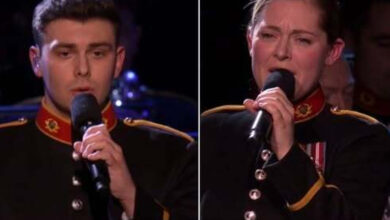
Hear How Myles Kennedy and David Draiman End a Line Together in Houston
David Draiman and Myles Kennedy have very different voices. At their Houston-area performance of “The Sound of Silence,” an easy way to hear what those voices do together is to follow the end of a line. Draiman gives the lower notes a dark core and Kennedy lets a higher sound stay open above them. The two voices are identifiable right through the release.
Kennedy is a guest in an arrangement many fans already knew from Disturbed’s recording. The original cover uses Draiman as a single focal point and gradually builds an instrumental world around him. In the live pairing, the guest voice changes what happens within the vocal itself. The sound opens up from above as the backing continues to build beneath both men.
The louder passages make the difference obvious by ear. Draiman can carry a long note with a firm, focused sound. Kennedy’s line has a brighter edge, which keeps it audible without his having to carve out the same space. Hold attention on both for a few seconds and you can follow the harmony even as the stage sound widens.
A harmony can bring a second set of consonants into a passage. If the length of a word or the moment its last consonant closes is out of step, the word can sound smeared. Here the shapes of the two lines stay close enough for the text to remain clear. Neither voice has to lose its individual character for the phrasing to line up.
The original Simon and Garfunkel recording makes the joining of voices sound intimate. Disturbed’s arrangement makes room for a much larger finish. Kennedy’s presence brings the actual sound of two singers back to the foreground, now under the demands of a heavy live arrangement with a very long climb.
It’s easy to remember the Houston clip for its final scale and overlook how patiently the singers establish it. The opening gives the melody space and the higher line changes the color gradually. Listening to the quiet portion again after the ending makes the full distance traveled much easier to hear.
Watch the performance
What makes the higher harmony work
Kennedy’s task is to give the familiar tune a new top edge while keeping its direction easy to follow. Listen for places where Draiman hangs onto the center of a note. Kennedy can stay audible in a slightly different part of the sound, then shape the next vowel with him. The texture grows without the melody splintering into competing rhythms.
On a long phrase, the moment the two singers turn a word over matters almost as much as the note they chose. Together they can carry a vowel for a while and then come off it cleanly. Even when the backing instruments are gathering strength, that common release lets the start of the next line read as a separate event.
One rewarding listen is to choose one voice per pass. Following Draiman alone gives the song its familiar path, especially if you’ve spent time with Disturbed’s studio version. Following Kennedy makes the upward tension easier to catch and reveals just how often his part leaves the tune’s center intact.
Why a bigger ending starts quietly
For much of the song the vocal has a relatively open setting. That leaves space for a breath and a change of attack to register. By the time the full sound arrives, the audience has learned what the individual notes feel like in the room. The growth then has a starting point that’s more specific than simply quiet versus loud.
Draiman’s solo performances depend on his ability to move from conversational scale to something huge while maintaining the song’s seriousness. With Kennedy onstage, that dynamic has an additional piece. A vocal line that once expanded from within can now acquire a distinct sound above it. That layer is what makes the Houston rendition feel so wide.
Return to the final sustained phrases for the best demonstration. The room is already loud and the audience already knows the musical destination. The duet gives you something new to pay attention to anyway. The two colors stay present on the very last words, right down to the instant the singers let the sound leave the stage.
Hear the texture change from one phrase to the next
The first pass through the Houston clip naturally follows the melody. On a replay, move your attention down to Draiman’s voice after a joint entrance. A steady lower note gives the ear a place to stay while the higher note gives a particular word its new color. It helps explain why Kennedy’s presence can feel obvious even when you aren’t actively following which note he sings.
The exercise works in the other direction, too. Track the brighter sound through one line and wait for its release. When that high color disappears between phrases, you can hear how much of the gathered sound comes from the backing and how much is being created at the microphones. The alternating textures make the degree of agreement between the singers especially audible.
That’s a different kind of pleasure from waiting for the biggest instant in the cover. The scale of the finish is easy to remember. The note-to-note decisions are easier to overlook because the singers make them in the course of an intelligible word. A second listen makes room for both things.
The same comparison can be made at a quieter volume. The effect of a clap or a swelling instrument drops away, while the higher and lower parts still have different edges. Those edges tell you where the voices are in relation to each other. The precision remains audible when the sheer volume ceases to be the attention-grabber.
Two more versions
Disturbed’s performance on Conan gives the entire vocal arc to Draiman and uses a strong orchestral setting to widen the ending. Comparing its long final notes with the duet reveals how much of the breadth in Houston comes from Kennedy’s upper part.
The official Disturbed recording lets you hear the build in studio detail. Draw your ear toward the stable low vocal and the way the arrangement gathers around it. Those features remain recognizable on the live duet even when the texture has gained a second singer.