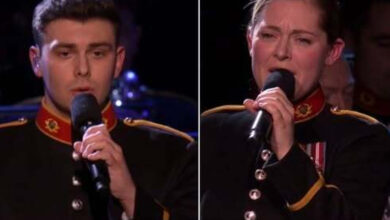
The Close-Up That Changes Ann Wilson and Disturbed’s ‘Don’t Tell Me’
A close-up makes a quiet phrase in Disturbed’s “Don’t Tell Me” feel like the middle of a conversation. The official black-and-white video gives David Draiman the first stretch of the song. By the time Ann Wilson appears, the viewer has already spent long enough with him to hear her entrance as an answer.
There is an advantage to letting one singer go first for that long. The first verse has time to establish the distance between what a person wants to say and what comes out. Draiman’s familiar weight is still in the bottom of the vocal. The measured scale of the delivery puts attention on how he gets from one word to the next.
Wilson has a way of bringing the sense of a long line with her almost immediately. Her consonants are clear, and her vowel sound stays distinct from Draiman’s when it grows stronger. Two familiar rock singers could easily turn a joint appearance into a succession of climaxes. Their early restraint gives the small turns a chance to register.
The monochrome treatment does some of the same work as the opening arrangement. With fewer competing colors and a great deal of attention to the face in frame, a slight shift of expression becomes legible. It is useful to notice how differently the track opens up if you watch Wilson’s first lines and then close your eyes for the chorus.
Both voices are associated with heavy arrangements that can fill a room. The common ground here is a ballad built for long phrases and a gradual lift. When the singers finally share a melodic passage, the contrast in their tone remains audible. The overlap adds information to what the song has already told you.
“Don’t Tell Me” appeared on Disturbed’s Divisive. The official video offers an unusually direct way back into the duet. A listener who knows Wilson from Heart and Draiman from Disturbed’s heavier catalog can enter from either side and hear the same exchange take shape.
Watch the performance
One melody and two points of view
Try playing the opening verse and Wilson’s entrance back to back. Draiman tends to let the strength of the note gather while he is already on it. Wilson can make the span of a phrase feel longer through the speed at which she opens it out. The effect is especially clear when the lines are still separated by enough space for each voice to settle.
When they sing together, they don’t have to equalize the surface of their sound. The brighter part of Wilson’s voice keeps coming through. The center of Draiman’s baritone stays firm underneath. Even when the two approach the same destination, the path each takes to get there supplies the small variations that make the duet worth hearing again.
A vivid detail is the way a phrase from one part of the song acquires weight once the other singer is there to carry a related phrase. The repeat means something a little different. The melody has a history inside the track by that point, even on a first listen.
How the video keeps the scale human
The black-and-white image is particularly effective once the sound expands. A larger chorus could have invited a more elaborate visual set piece. The film keeps returning to the performers, so there is room to hear the strength of a line and see the concentration behind it in the same passage.
The electric arrangement matters here, too. After an opening whose open edges pull the ear to the words, the backing gains enough weight to put the voices under real pressure. They maintain their clarity through the larger sound. When that sound drops back, each voice still carries the particular character it had at the start.
At the center is a small change. A voice that spent the early part of the recording alone can suddenly share a few words with someone else. That change is easy to hear in the chorus precisely because the first verse has allowed the listener to learn the sound of one person working through the melody first.
Where to listen on a second viewing
Try giving the first verse one pass to hear only the consonants. A short attack can give a word a great deal of weight even when the note that follows stays fairly soft. Draiman’s line depends on smaller stresses like these, and they establish the scale of the exchange well before the second singer arrives.
Wilson is working with the same opening the listener has just heard, which means even a slight difference in how she reaches the center of a note has a reference point. As the lines stretch, her sound can acquire a sharper edge without moving instantly to full volume. The change lets the song carry two kinds of intensity inside the same arrangement.
When the voices come together, listen for a vowel with time to settle. A voice heard alone can be described as warm or bright, but those qualities are relative in a recording. Put Wilson’s tone next to Draiman’s at the same moment and you get a much more specific picture of where each one puts the pressure.
Then do one more pass with the official audio below. Leaving the frame behind for a few minutes makes the gain in vocal color easier to place. The close-ups supply faces and gestures when you return to the main video. Those details feel especially effective once the sound of the exchange has had time to become familiar.
Two more versions
At Welcome to Rockville, Wilson and Draiman gave the exchange a stage and a festival audience. Follow the space left around the entrances as they face a room full of people instead of the close camera. The live setting makes the patience of the studio performance easier to recognize.
The official Divisive audio offers a straightforward listen to what the record itself does. Take away the visual cuts and follow the two timbres when they overlap. Wilson’s upper color and Draiman’s darker center still give the shared sections their sense of movement.