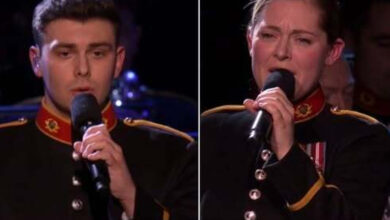
The Moment Wembley Becomes a Second Voice for Emily Armstrong
Emily Armstrong enters an already moving song in Linkin Park’s Wembley performance of “The Emptiness Machine.” Mike Shinoda has made the tune recognizable during the opening. The audience knows the shape of what is coming. When Armstrong comes in, the difference in register makes the next stretch of the song sound wider before the chorus even lands.
Wembley Stadium is big enough that hearing the crowd becomes part of hearing the performance. In Linkin Park’s recording of the June 2025 show, the audience has a distinct edge of its own. It swells into the words, with hundreds of nearby voices in the foreground of a response much larger than any individual singer.
The audience interaction is especially striking because the song belongs to the From Zero era. The hook had far less time to become familiar than some of the band’s older choruses. The London crowd gives it the treatment reserved for songs people know well enough to start singing in the middle.
Armstrong’s lead keeps an identifiable center through the roar. The sound has a worn edge when she bears down on the high phrases, and that edge makes a useful landmark amid the crowd voices. You can hear the lead pushing through at the same time as the audience joins in.
Shinoda’s role is easy to miss if you get straight to the loudest part. The opener establishes a more conversational level and sets out some of the phrasing that the singing will have to grow from. The step between the two voices is a large part of why the stadium chorus has somewhere to go.
Fans bring their own memory of Chester Bennington and earlier Linkin Park shows. At Wembley, you can hear people making room for a new shared experience in the band’s catalog. The clearest example is a chorus that has a recognizable lead and a second sound attached to it, made by the audience itself.
Watch the performance
Follow the crowd into the chorus
Start with the sound just below Armstrong’s lead rather than the highest note that reaches the microphone. For a few seconds there’s a clear edge between what comes from the stage and what comes from the audience. The difference gives the crowd time to be heard as a particular sound before the two merge.
The song has a refrain that lets people take part from several different places. Someone can pick up the melody early, or come in later on a familiar line and still feel the pull of the whole thing. A stadium recording makes those entrances sound like a loose wave of voices. You can hear participation accumulating across the chorus.
Armstrong’s task is to keep the line moving even when there is a great deal of sound back from the room. The strong front of a phrase helps. It tells the listener where the next word sits even if the rest of the line is already surrounded by other voices and distorted guitars.
How a new song joins a long-running live tradition
A Linkin Park audience has long had space to participate in the music. Clear vocal contours and the turns between different deliveries give people several places to join a song. “The Emptiness Machine” carries that quality into a record with a new set of voices, and Wembley lets you hear how quickly listeners recognized an invitation in the chorus.
The shots of the room supply one kind of perspective. The sound gives another. Run the change into the chorus with your eyes off the video and you can hear the crowd as a second entrance, gathering just after the melody has made its shape plain. The response gives the song a texture that a studio recording can only suggest.
Then return to the early part of the performance. The gap between Shinoda’s start and the sound of Wembley at full voice is the real distance the recording travels. The audience’s part works because the song lets everyone hear the route to the chorus before it gets there.
Why the chorus sounds larger the second time through
A useful replay begins before anyone in the audience has a chorus to sing. Notice how much definition a single voice can give a large stadium at the opening of the song. The register still leaves room for the guitars, and the words have a shape that someone in the stands can understand from the first few phrases. The audience already has a point of reference before it makes the room louder.
As the refrain arrives, the most audible shift can be a change in the width of the sound rather than the strength of a single note. A lead vocal comes from one point in the mix. Thousands of people scattering sound through the stands create a broader, rougher surface. Armstrong’s phrasing cuts through that surface because the forward motion of the line remains clear.
There is a practical way to separate these events. Listen once for when the lead hits the first word of the refrain. Go back and listen for when you first hear several nearby audience voices forming the same contour. The two entrances can register as distinct sounds even when they happen close together. That closeness makes the chorus feel like an exchange rather than a recorded track with a wide shot attached.
The Wembley performance gains something when heard next to the studio recording because the crowd’s participation is actually available to compare. The studio version gives the hook a fixed shape. The stadium version gives it a local sound that changes as people find where to enter. That is a musical detail, and the clip lets the listener hear how ordinary concertgoers helped make it.
Two more versions
Linkin Park’s September 2024 Los Angeles-area performance captures the song at its live introduction. Hear how clearly the transition between Shinoda and Armstrong already reads. The room is on a different scale, so the vocal handoff stands out before Wembley supplies its vast additional chorus.
The official music video leaves the refrain in its studio setting. The relationship between the vocal lines and the drums is cleanly exposed. That is the shape the Wembley audience learned, then filled out on its own when it sang the song back.