Ann Wilson’s ‘Janie’s Got a Gun’ Performance Puts Heart’s Enduring Power in Focus
Ann Wilson’s voice is the immediate attraction in Heart’s Hollywood Bowl performance of “Janie’s Got a Gun,” but the moment belongs to both Wilson sisters. With Nancy on electric guitar beside her, Ann turns Aerosmith’s familiar song into an expression of the partnership that has defined Heart for decades.
The performance took place on October 29, 2026, during the opening night of California, Dream On: Aerosmith & Friends in Los Angeles. The event brought guest musicians together around Aerosmith’s catalogue before the band’s own closing set. For Heart, it was an opportunity to interpret a major rock song outside their own repertoire.
The sisters performed “I Never Loved a Man (The Way I Love You)” before moving into “Janie’s Got a Gun.” Their second selection carries a darker narrative and a sharply recognizable atmosphere. Its power comes from the tension between controlled storytelling and the release of its more emphatic passages.
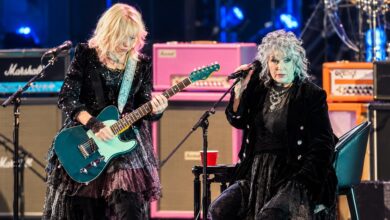
Ann, who was 76 at the concert, sings from a seated position in Todd Norris’s audience recording. Nancy stands to her left with a turquoise electric guitar. The footage keeps the stage environment visible around them, allowing viewers to follow the performance as a shared piece of live music rather than an isolated vocal highlight.
That setting also brings Ann’s recent history into focus. After cancer treatment interrupted Heart’s touring plans, she returned to performing in 2025. In a subsequent interview with Good Morning America, she described music as a positive force during her treatment and discussed the freedom she found in returning to the stage as she was.
At the Hollywood Bowl, the result is a performance that invites listeners to hear both determination and musical judgment. Ann’s recognizable tone anchors the song while Nancy’s guitar gives it another point of movement. The sisters remain at the center of the arrangement, bringing their own character to music strongly associated with Steven Tyler and Aerosmith.
Why the performance is connecting with fans
Viewers discussing the performance have focused on Ann’s age as well as her voice. One praised her ability to sustain high notes, while another urged listeners to appreciate artists who are still performing. Ann was 76 at the concert, and the enthusiasm reflects an audience that values the distinctive character she brings to the microphone today.
The clip’s appeal extends beyond its strongest vocal moments. A listener can watch Nancy working through the guitar part, see Ann shape a phrase, and take in the relationship between the two. Their familiar presence beside one another gives the cover a continuity that a guest appearance by a single singer would not have.
There is also a difference between returning to an old recording and encountering a new live interpretation. “Janie’s Got a Gun” already has an established identity, but hearing another distinctive lead voice changes where the ear settles. Ann’s delivery brings attention back to the song’s story and to the expressive choices that make a cover more than a reproduction.
The Aerosmith recording behind the cover
Aerosmith’s original, released on Pump, remains the natural point of comparison. Steven Tyler’s phrasing and the recording’s carefully built atmosphere helped define the song. Heart retain its recognizable foundation while giving listeners a different vocal perspective on its dramatic turns.
A partnership heard across different stages
Heart’s Kennedy Center rendition of Led Zeppelin’s “Stairway to Heaven” offers another example of the sisters working inside a famous song without losing their own musical identity. The setting and scale differ from the Hollywood Bowl performance, but the enduring attraction is similar: a familiar composition carried by Ann’s voice and Nancy’s musicianship.
The Hollywood Bowl appearance adds another chapter to that story. It brings the Wilson sisters into a celebration of Aerosmith while reminding viewers why Heart’s own audience remains so devoted. The song supplies the occasion; the sisters’ continuing musical connection supplies the reason to watch again.