Brian May’s Voice Deserves Another Listen in His Duet With Andrea Bocelli
Brian May’s guitar is so recognisable that it tends to draw the eye even when he has just done something with his voice. His opening lines in the Teatro del Silenzio duet with Andrea Bocelli give you a reason to listen in the opposite order. Start with the singer. The guitar will have its own space later. You can hear May setting up the way the entire performance will feel well before he plays an instrumental answer.
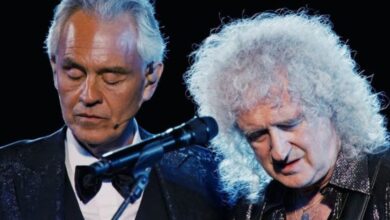
The show was part of Bocelli’s thirtieth-anniversary celebration in Tuscany in 2024. May was his guest for “Who Wants to Live Forever,” a song he wrote for Queen almost four decades earlier. It’s a large tune to bring out in an outdoor theatre, and the company of a world-famous tenor might make a singer want to begin at full strength. May enters with a warmer, more conversational sound. It suits the first lines.
There is a precedent in Queen’s recording. May opens the song vocally before Freddie Mercury comes in. People often remember the breadth of what Mercury gives it, and justifiably so. Go back to the first part and hear the smaller sound that gives the later voice room to have that effect. That is the piece of the arrangement that May brings so naturally to the duet.
Queen listeners also have other chances to hear him sing. His lead vocal on ’39 is part of the character of that recording. There’s a similar quality when he sings the beginning of “Who Wants to Live Forever” in Tuscany. He gives the words a directness that works at a smaller volume, then leaves enough to the next voice for the arrangement to grow.
The range of May’s work helps explain why an opening like this can be easy to overlook. As well as writing and playing in Queen, he has worked in astrophysics. He and Claudia Manzoni contributed stereoscopic imagery to NASA’s OSIRIS-REx science team. Those accomplishments can fill an introduction on their own. The duet offers a less familiar way to appreciate what he brings to a room through a song.
Watch the opening in the live video and listen for how much of the performance’s character is already in place by the time Bocelli enters. The Queen recording and the band’s account of working on Highlander give the same song two useful points of reference.
By the time May’s guitar comes forward, you’ve heard him start the ballad with a voice that belongs in the centre of the arrangement. His touch as a guitarist is still there. In this performance the singing is every bit as good a reason to come back.