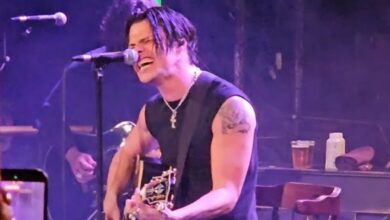
YUNGBLUD & The Smashing Pumpkins’ “Zombie” Duet Wins Over Listeners
When “Zombie” emerged in 2025, it didn’t arrive as a song chasing immediacy or shock value. Instead, it unfolded slowly, like a confession that had been held in too long. From the first moments, the track positioned itself as something deeply human—soft, aching, and unafraid to sit with discomfort. Rather than relying on aggression or tempo, it leaned into emotional weight, allowing silence and space to do as much work as melody. That choice alone set it apart in a landscape crowded with urgency.
At its core, the song reflects YUNGBLUD’s growing shift toward introspection. By this stage in his career, he had already built a reputation for fearless honesty, but “Zombie” feels different—less confrontational, more exposed. The writing doesn’t posture or perform pain; it documents it. There’s a sense that the narrator isn’t asking to be understood so much as asking not to be abandoned while breaking apart internally.
The emotional foundation of the song traces back to a personal family experience, inspired by watching a loved one endure physical trauma and the psychological aftermath that followed. That context reshapes the title entirely. “Zombie” is not used as a metaphor for monstrosity or fear, but for survival without recognition—being alive while feeling erased. This perspective gives the lyrics a quiet dignity, framing grief as something that lingers long after the visible wounds heal.
Musically, the arrangement mirrors that emotional restraint. The verses are intentionally sparse, allowing the vocal to sound almost unprotected, while the chorus opens outward with cinematic force. One of the most striking elements is the orchestral layer, recorded with the London Philharmonic Orchestra, which adds a mournful gravity to the song. The strings don’t overwhelm the track; they hover, reinforcing the sense of fragile endurance that defines the song’s atmosphere.
The visual world surrounding “Zombie” reinforced its seriousness. Casting Florence Pugh in the music video signaled that this was not intended as a disposable release. The imagery focused on internal collapse rather than spectacle, matching the song’s emotional tone beat for beat. Together, the audio and visual components formed a unified narrative about vulnerability, identity, and the quiet violence of emotional disconnection.
Within the broader scope of YUNGBLUD’s album Idols, the song functions as a turning point. The record explores how identity is shaped, distorted, and reclaimed under pressure, and “Zombie” stands as one of its most emotionally exposed chapters. It’s the moment where performance gives way to confession, anchoring the album’s themes in lived experience rather than abstraction.
Before its official release, the song made its first impact in an intimate live setting in London. Introduced without heavy framing, it immediately changed the energy in the room. Audiences didn’t react with noise or movement at first—they went quiet. That response became a defining trait of the song’s live life, proving that its power didn’t depend on production scale but on emotional clarity.
The song’s evolution took a decisive turn with the release of a reimagined version featuring The Smashing Pumpkins on January 1, 2026. The collaboration didn’t feel like a crossover designed for reach; it felt like a dialogue. By bringing the song into the sonic world of The Smashing Pumpkins, “Zombie” gained a darker, more nocturnal texture without losing its vulnerability.
For YUNGBLUD, working with Billy Corgan represented more than a feature—it was a direct line to one of his formative influences. That reverence is audible in the restraint of the performance. Rather than trying to dominate the track, the collaboration deepens it, layering experience over immediacy. The guitars become more sculpted, the atmosphere heavier, and the emotional contrast sharper.
The timing of the collaboration also carried symbolic weight. Connections between the artists reportedly formed around the orbit of Black Sabbath’s farewell-era celebrations in Birmingham, an event steeped in rock history and generational transition. Against that backdrop, “Zombie” reads as a handoff—modern vulnerability meeting legacy introspection, both acknowledging that pain does not belong to one era alone.
From the perspective of The Smashing Pumpkins, stepping into another artist’s song marked a deliberate engagement with the present rather than nostalgia. Their contribution doesn’t overwrite the original; it reframes it. The band’s signature balance of beauty and distortion amplifies the song’s emotional stakes, transforming it into something both intimate and expansive.
Industry recognition followed, including a Grammy nomination for Best Rock Song, but awards feel almost incidental to the song’s purpose. “Zombie” resonates not because it fits a category, but because it articulates a feeling many listeners struggle to name. Its success highlights a shift in modern rock—toward emotional transparency as a form of strength rather than weakness.
What ultimately defines “Zombie” is patience. It doesn’t rush resolution or offer easy catharsis. Instead, it allows discomfort to exist fully before offering any sense of release. This structural choice is why both versions—original and collaborative—remain effective. The song doesn’t demand attention; it earns it by staying honest.
In the end, “Zombie” stands as a conversation across generations. YUNGBLUD brings the urgency of someone naming pain in real time, while The Smashing Pumpkins add the gravity of artists who have lived with similar ghosts for decades. Together, they transform the song into something larger than either could alone—a piece that feels personal enough for solitude, yet vast enough to fill arenas without losing its soul.