Freddie Mercury’s Final Night At Knebworth 1986 Becomes One Of The Most Legendary Farewells In Rock History
On August 9, 1986, Freddie Mercury stepped onto the stage at Knebworth Park wearing his now-iconic yellow military jacket, unaware that the night would be remembered as one of the most defining moments in rock history. The air was electric long before he appeared, charged by the anticipation of a crowd that had gathered in overwhelming numbers. What unfolded that evening would become more than just another stop on a successful tour—it would quietly mark the end of an era.
That summer, The Magic Tour had already carved its path across Europe, leaving behind a trail of unforgettable nights and roaring crowds. Queen had reached a level of mastery that few bands ever achieve, operating with the precision of seasoned veterans and the fire of a band still hungry to prove something. Each city had witnessed something extraordinary, yet there was a sense that Knebworth carried a different kind of weight.
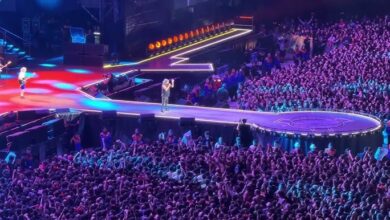
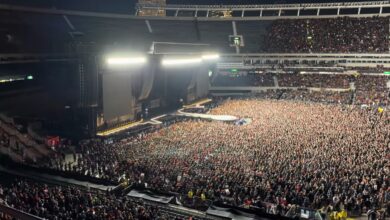
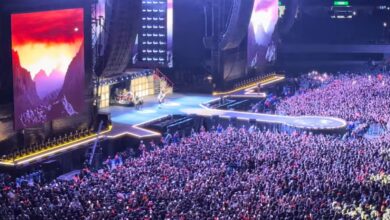
More than 120,000 fans filled the open-air grounds, stretching far beyond what the eye could comfortably take in. The sheer scale of the audience turned the concert into something almost mythic, as if an entire generation had gathered in one place to celebrate the music that had shaped their lives. The evening sky hung over them like a vast ceiling, amplifying every sound, every cheer, every heartbeat.
The show opened with “One Vision,” a fitting choice for a band that had always thrived on unity and shared energy. As the first notes rang out, the crowd responded instantly, their voices merging into a single force that matched the band’s intensity. It didn’t feel like a performance being delivered to an audience—it felt like something being built together in real time.
Freddie Mercury commanded the stage with a presence that seemed almost effortless. He moved with purpose, with flair, with an instinctive understanding of how to connect with every individual in that massive crowd. Every gesture, every glance, every step carried meaning. He wasn’t just performing songs; he was orchestrating an experience.
There was a remarkable balance in the way he carried himself that night—part showman, part storyteller, part conductor. He teased the audience, encouraged them, challenged them, and rewarded them. With a simple motion of his hand, he could transform thousands of voices into a unified chorus. It was a power he had refined over years, yet it still felt spontaneous, alive, and unpredictable.
As the set unfolded, song after song arrived with renewed urgency. “Bohemian Rhapsody” carried its theatrical weight with breathtaking precision, while “Radio Ga Ga” turned the crowd into a sea of synchronized claps. “Crazy Little Thing Called Love” brought a lighter, more playful energy, proving the band’s versatility in the middle of an otherwise monumental performance.
“We Will Rock You” hit with primal force, its rhythm echoing through the massive field like a heartbeat shared by every person present. And when “We Are the Champions” followed, it felt less like a closing anthem and more like a collective declaration. The audience wasn’t just watching history—they were participating in it.
At one point, Freddie stepped forward and allowed the crowd to take over completely. With his arms spread wide, he listened as tens of thousands carried the melody without him. It was a rare moment of stillness in an otherwise high-energy show, and it revealed something deeper about his connection with the audience. He didn’t need to dominate the moment—he knew when to let it breathe.
Behind him, the band operated in perfect harmony. Brian May’s guitar soared with both precision and emotion, delivering solos that cut through the night air. Roger Taylor provided a thunderous backbone, while John Deacon anchored everything with quiet, steady control. Together, they created a sound that was both massive and intimate.
There was no sense of fatigue, no hint that this was the end of anything. The performance carried the same vitality and intensity that had defined Queen at their peak. If anything, it felt like a band still ascending, still evolving, still discovering new ways to connect with their audience.
The closing moments came without ceremony. As “God Save the Queen” played over the speakers, Union Jacks waved across the crowd, and the atmosphere shifted into something reflective yet still energized. The audience lingered in the feeling, reluctant to let it go, unaware that they had just witnessed something that would never be repeated in quite the same way.
Freddie did not pause to deliver a farewell speech. There were no grand declarations, no attempt to frame the night as historic. He simply exited the stage, leaving behind a performance that spoke entirely for itself. It was a quiet ending to a night that had been anything but quiet.
In the years that followed, Queen would continue in different forms, finding new ways to keep their music alive. Yet that night at Knebworth remained untouched, preserved in memory as the final time Freddie Mercury stood before a massive live audience with that unmistakable voice and presence.
When Freddie Mercury passed away in 1991, the meaning of that concert deepened. What had once been just another legendary performance became something more—a final chapter that no one had realized they were witnessing in real time.
Today, the Knebworth performance stands as a testament to what live music can achieve at its highest level. It was not defined by spectacle alone, but by connection, by emotion, by the unspoken understanding between artist and audience. Freddie Mercury didn’t need to say goodbye that night. The music carried that message long before anyone knew they would need to hear it.