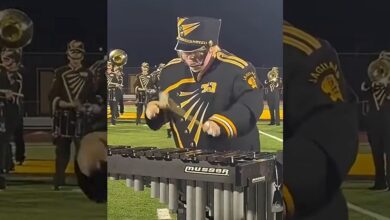
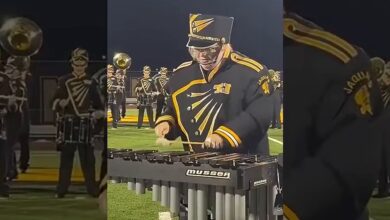
A Parade Made Layla Clark Want to Join the Band. The Instrument Was a Surprise.
The first time the Thomas Jefferson Jaguars made an impression on Layla Clark, she was watching them pass in a parade. Seeing the band from the street made her want to join. She told the Pittsburgh Post-Gazette that she asked to play drums and ended up in mallet percussion. The move put her in front of an instrument she had not originally set out to learn. Years later, a phone camera captured her using it to play one of rock’s best-known guitar figures.
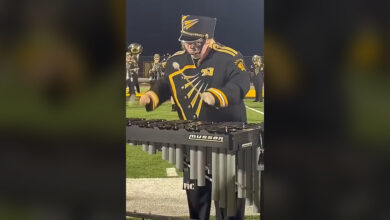
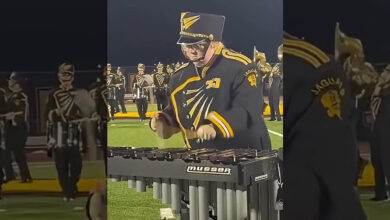
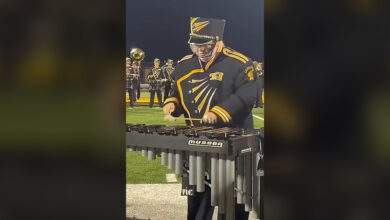
The footage of AC/DC’s “Thunderstruck” makes the end of that story easy to recognize. Clark is standing in black and gold behind a marimba. As the opening pattern starts, the returning notes make the song identifiable before the rest of the school band arrives. What the clip leaves out is the ordinary school experience that put her there. She got to join an activity, meet an instrument and spend enough time with it for it to become something she liked doing.
A viewer reacting to a CBS Pittsburgh interview put that wider idea in four words: band, music, theater, clubs. The point works without treating every school activity as a route to a viral moment. Someone who attends a rehearsal can find out whether they like the sound, the work and the people around them. That is an experience a student cannot have through a list of choices alone. Clark’s account gives the comment an unusually concrete example.
Drums and mallet percussion belong in the same broad family, but the jobs a beginner might picture can feel quite different. A marimba has a set of tuned bars laid out so the player can make a melody. You move your hands between physical pitches, and the attack of the mallet is part of how each note speaks. It is easy to understand how a student might have come looking for one kind of percussion and found a different kind of musical challenge worth staying with.
Clark told Axios that she had been playing for about five years. That gives a sense of how far apart the parade and the widely shared performance were. A viewer can recognize the skill on a first watch. Learning it happened over stretches of time that a short recording cannot reproduce. The band gave Clark a setting to keep returning to the instrument while she developed a way of playing that was her own.
The show is a useful reminder that a school band can give students more than one way to contribute. Clark and the other mallet players carry the recognizable opening. Musicians across the field have to be ready for the places their own parts belong. Some of what they do is easy to hear. Other work stays out of the center of the picture, even though the opening would have far less impact without the group ready to meet it.
The moment a role becomes visible
The camera puts the marimba close enough to follow individual strikes. That is one reason the clip travels. A listener can work out what Clark is doing even if they have never been at a marching-band show. The other end of that experience belongs to the person learning a part. A few clear seconds of playing are possible because the band has a place for the instrument, a reason to use it and musicians who can give it a context.
In another setting, the skill at the front of the field might have looked less dramatic. A player practicing the figure slowly is still learning something important. A bandmate getting an entrance right for the first time might only be noticed by the people nearby. The performance lets a much bigger audience hear what happens when those smaller successes meet. That connection is easier to appreciate if you know that Clark herself once saw the band from outside.
The viewer’s mention of theater and clubs makes sense beyond music. A school production relies on people doing jobs an audience will see and others it will hear or never notice. Clubs offer their own ways to try a role before a student has to decide whether it suits them. Band works that way here. The activity that attracted Clark in a parade was broader than the particular instrument she had imagined playing.
Watch the people waiting for the next entrance
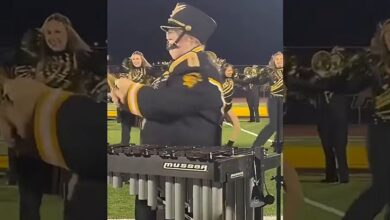
On a replay, look across the frame before the sound fills out. The people away from the marimba are taking care of the other parts of the same event. The wide recording against Ringgold makes that distribution of work much easier to see. The close view makes Clark’s role recognizable, and the wide one supplies the setting in which the role makes sense.
That first invitation matters because students rarely know in advance which part of a new activity will hold their attention. A parade can make the whole group look appealing. Rehearsal brings that interest down to something practical: which sound you want to make, what you need to learn, and who you will be playing beside. The unexpected assignment was a way for Clark to discover something more specific than her initial plan. Without the chance to try it, the marimba could have remained an instrument she only heard from the outside.
Clark’s opportunity began when a school band gave her something specific to try. The story kept going when she found a reason to return, practice and perform with the Jaguars. The tune that made it to millions was an outcome of those choices. The point of the viewer’s list is that another student might discover a different interest in a different room. The camera never has to be there for that opportunity to matter.