The Mallet Move a Percussionist Noticed in Layla Clark’s ‘Thunderstruck’
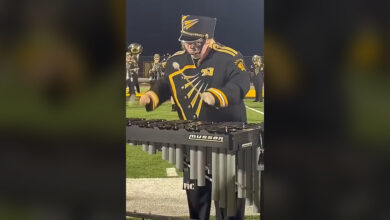
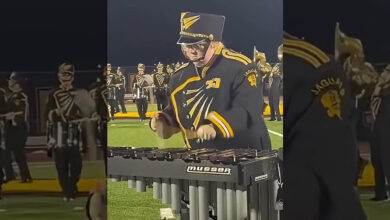
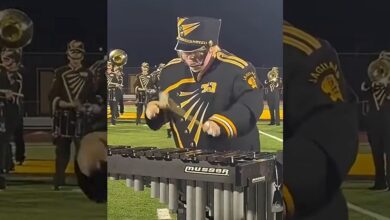
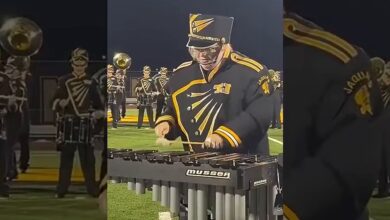
An experienced percussionist singled out a demanding part of Layla Clark’s “Thunderstruck” performance that most listeners have no reason to name. She keeps the pattern stable through enough repetitions that the difficulty starts to disappear. In the video, two mallets keep returning to a set of wooden bars in front of the Thomas Jefferson Jaguars. Watch them immediately after a note sounds. The next move is already under way.
The comment, posted under a recording of the performance, came from a viewer who described themself as an old percussionist. Their praise centered on maintaining the pattern, not merely being able to play it once at speed. That distinction is audible. A single quick pass can catch the eye. Repeating the same phrase evenly allows an audience to settle into the pulse and recognize the figure as soon as the notes come around again.
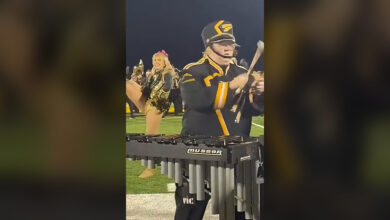
The marimba makes the comparison with Angus Young’s guitar especially revealing. On a guitar, the pitches are organized along strings and frets. Clark has to strike separate surfaces spread out in front of her. The distances vary. One note might need a small turn of the wrist, while another sends a hand farther across the instrument. The timing has to sound even to the listener while the movement itself is changing.
A strike also has a beginning the audience can hear. That crisp attack tells you when the note arrives in a way that can be easier to pick out than its tail. If one lands late and the next comes early to catch up, the melody might remain recognizable but the pattern will start to feel unsettled. Clark’s opening maintains its forward movement across those little changes in distance.
Following the rebound makes part of the technique visible. The mallet has to leave the bar cleanly, and the player still needs enough control over that movement to reach the next note in time. An unnecessarily high stroke adds travel. A very tight one can leave little room to change direction or shape the sound. The clip gives the viewer a chance to see economical movement in a passage that feels energetic.
Try looking at the bars for a short stretch instead of tracking Clark’s face. One hand completes a strike while the other is ready to take up part of the pattern. The next attack comes so quickly that it can seem the hand is always in motion. When the phrase repeats, look for the nearest returning note. Its consistency is a better clue to the work than the visual impression of speed alone.
A pulse the whole band can enter on
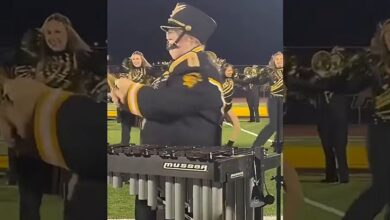
Clark said that five mallet percussionists played the opening. In the narrow view, she is the musician you can follow most readily. The sound that reaches the microphone has the section’s work in it, and a clean section makes each return feel like part of one phrase. The timing involved is personal and collective at once. A player has to get the next note under control, and all five have to fit the note into the same pulse.
That is especially noticeable in an exposed entrance. Other instruments cannot smooth over uncertainty in the rhythm while they are waiting to come in. The mallets have to establish enough of a pulse that the full band has somewhere to arrive. This puts a musical purpose behind the technique. The stability the percussionist heard is what gives the rest of the Jaguars a clear part to answer.
Sound recorded from the stands will never give a separate track for every mallet. A listener can still compare two things that remain clear in the clip. Clark’s hands make small, repeated movements over the bars, and the opening does not change its pace when one reach becomes larger than another. The visual pattern and the sound support each other without requiring us to assign each individual note to a single player.
What to listen for on a second pass
Put the picture aside for a few seconds and listen to the point where the riff seems to reset. Then replay the same stretch while watching the mallets leave the bars. The first pass gives you a sense of the timing. The second shows you the setup for the next attack. The space after each note turns out to be one of the most informative parts of the performance.
There is a reason good timing can be easier to hear than to describe. The listener knows where a repeated note is supposed to arrive before it does. The player has to cover the distance that makes it arrive. When that work is consistent, the audience senses a stable pulse even if it could never name the pitches or count the subdivisions. The more evenly the figure is repeated, the more room the listener has to hear the expression and the entrance around it. That is one reason the old percussionist heard a difficult job where other people heard an exciting opening.
A wider view makes the consequence of that control audible in another way. Once the field fills with sound, the repeating figure still gives the audience a reference. The mallets had already made the pulse clear enough that the larger entrance sounds like the next step rather than an interruption. Keeping an opening that settled is the hard part the comment was pointing to. Clark and the Jaguars make it easy to hear, even when they make it look effortless.