How Layla Clark Turned ‘Thunderstruck’ Into a Marching-Band Showstopper
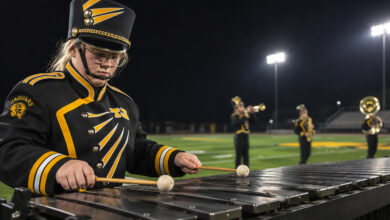
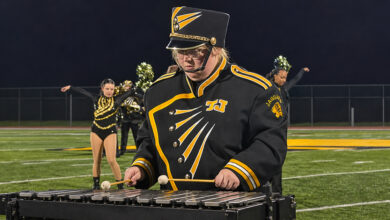
The surprise in Layla Clark’s “Thunderstruck” performance arrives before the marching band reaches full volume. A tune associated with an electric-guitar opening is carried by mallets instead, making a familiar musical figure look unexpectedly physical. The camera gives the hands as much importance as the melody.
Clark, a percussionist with Thomas Jefferson High School’s marching band in western Pennsylvania, has become the focus of a viral recording shared on Christina Clark’s YouTube channel. The clip puts an individual player in the foreground, then lets the larger ensemble change the scale of the performance.
The opening is compelling because its repeating figure leaves so little room to disappear into the background. Each return to the pattern gives the listener another chance to hear its shape. Watching the mallets move makes that repetition visible, turning coordination into part of the spectacle.
That does not require treating the performance as a flawless technical exercise. Its appeal lies in the momentum of a musician carrying an exposed part while the listener waits for the arrangement to expand. It is a different kind of tension from hearing the original recording through headphones.
When the other players enter, the repeated line acquires a much bigger setting. The contrast is the point: the opening invites close attention, while the ensemble entrance releases some of that anticipation into a broader sound. Clark remains the visual center of a performance built by a group.
The recording has attracted both rock listeners and people who recognize the demands of percussion playing. Their responses make a useful starting point for hearing the arrangement itself, beyond the quick label of a viral cover. Listen first to the figure, then to what happens around it.
A riff that can survive a change of instrument
Recognition does much of the early work. The outline of “Thunderstruck” is familiar enough that the change of sound registers immediately. Mallet percussion brings a different attack and decay from a guitar, so the listener hears both the recognizable song and the distance from its usual presentation.
That difference gives the arrangement its own purpose. Simply reproducing the surface of an AC/DC recording would offer little reason to look again. Here, a keyboard-percussion part turns the opening into a sequence of visible targets and movements. The sound and the physical action explain one another.
There is also an effective change in scale. At first, attention can settle on the relationship between a player, two mallets and the bars in front of her. As the ensemble enters, the ear begins following a much larger musical picture. The recording gains energy through that shift.
Why percussionists noticed
In the comments reviewed beneath the upload, viewers identifying themselves as percussionists repeatedly pointed to consistency and control. Others praised the coordination needed to keep the pattern moving. Those responses identify what makes the close view so engaging: listeners can follow the sound and the physical effort together.
Several listeners also noticed her enjoyment of the moment. That matters to the performance as much as the discussion of difficulty: concentration is absorbing to watch, and the release of that concentration gives the clip a human ending. The audience is responding to a person as well as a musical part.
Calling it a one-person achievement would miss the arrangement’s larger payoff. Clark establishes the focus, while the students around her supply the expansion. The most rewarding way to hear the recording is to follow that exchange rather than to separate the featured player from the band.
Hear the song in two other settings
AC/DC’s official video provides the guitar-led reference. Comparing the openings makes the school-band version’s change of texture especially clear.
2CELLOS offer another instrumental reworking, placing the recognizable material in a different physical and musical setting. It makes a useful companion to Clark’s performance because the identity of the song remains audible through another change of instrumentation.
Clark’s clip succeeds on the same basic principle: a good arrangement can make recognition and surprise happen together. The audience knows the tune, but the way it reaches them creates a fresh reason to pay attention.