Why Layla Clark’s ‘Thunderstruck’ Cover Has Percussionists Talking
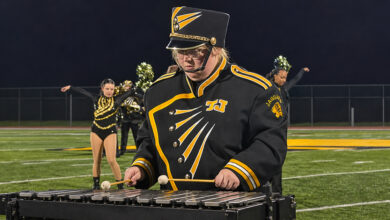
The first thing AC/DC fans recognize is the riff. The first thing percussionists notice is the control. Layla Clark’s performance of “Thunderstruck” with the Thomas Jefferson High School marching band has drawn an enthusiastic response on YouTube, where listeners are looking past the novelty of hearing a guitar part played with mallets.
Clark, a senior mallet percussionist at the western Pennsylvania school, carries the rapid opening figure before the arrangement expands around her. The recording on Christina Clark’s channel brings viewers close enough to follow that exposed part, making the individual player an immediate focal point within a larger school-band performance.
One of the most prominent comments comes from a viewer identifying themselves as an older percussionist. The listener praises the sustained consistency of the pattern, explaining that keeping it controlled over an extended passage is a demanding task. That comment had approximately 11,000 likes when checked for this article.
Other responses pick out different aspects of the same musical challenge. Former drum-line players praise the execution, while listeners point to coordination, timing and concentration. Their reactions give the clip another layer: a familiar rock opening becomes an opportunity to notice the work of a musician whose part might otherwise be overlooked.
The emotional payoff matters to viewers too. A comment celebrating Clark’s smile near the end had attracted roughly 6,300 likes at our check. Alongside the technical appreciation, the discussion carries the pleasure of watching a young musician take on a prominent role and seeing other people recognize the achievement.
This recording comes from a halftime performance that the school district has identified as taking place last season. Its online reach has grown well beyond the original football audience. The interest now includes rock listeners, people with marching-band experience and viewers simply delighted by an unexpected instrumental approach to an instantly recognizable song.
What musicians hear in the opening
A repeating musical figure can be deceptive. Once listeners recognize it, their attention may move to the tune itself, but the player still has to maintain its shape. In this arrangement, the opening puts that responsibility in clear view. Each attack contributes to a continuous line, and the pattern has to remain part of the ensemble as other players enter.
The comments are audience observations, rather than a formal technical assessment. Their recurring themes are nevertheless specific. Listeners discuss consistency across a long passage, the precision of the strikes and the coordination needed to sustain the part. The praise is directed at what Clark is doing, as much as at the surprise of hearing AC/DC in a school-band setting.
One viewer sums up the admiration by writing, “To maintain those patterns so consistently over that much time shows a very high level of control.” Another group of comments focuses on the pleasure of her expression afterward. Taken together, those responses capture both the discipline behind a performance and the enjoyment it can communicate.
The band is part of the payoff
Clark provides the opening focal point, but the arrangement gains its larger effect when the other musicians join. The change in scale gives the audience a clear musical progression: an identifiable figure develops into a full ensemble sound. That progression helps a short recording tell a complete story without requiring viewers to know anything about percussion technique.
It also makes the performance a celebration of the group around the featured player. A successful entrance depends on the relationship between parts, and a marching band gives a rock song a different palette of sounds. The recognizable riff supplies a connection for AC/DC fans; the ensemble offers a reason to stay with the version after that initial recognition.
The response does not establish that AC/DC attended the event or watched this particular recording. The applause scene in the accompanying social card is an illustrative collage. The documented reaction discussed here comes from viewers commenting beneath the YouTube upload.
Two contrasting versions of the same song
AC/DC’s official video is a useful companion to this performance. Hearing the electric-guitar opening in its original setting highlights what listeners recognize immediately, even when the line is transferred to another instrument.
2CELLOS’ instrumental version offers a second comparison, showing another way musicians can carry a familiar rock identity into a different instrumental setting. It is a separate recording, included as a related performance alongside the school band’s interpretation.