Why ‘Thunderstruck’ Keeps Going When Layla Clark Pushes Up Her Sleeves
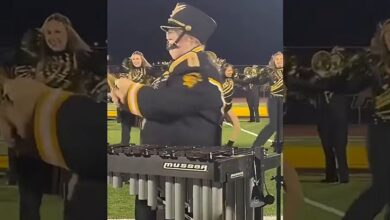
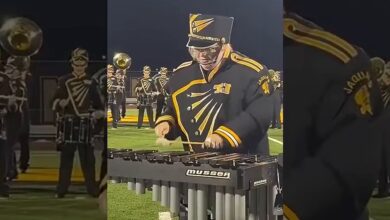
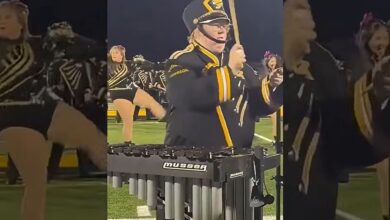
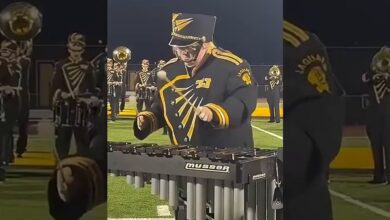
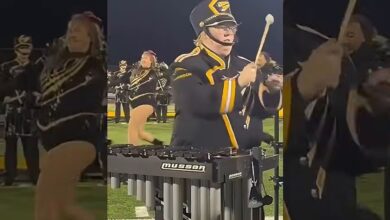
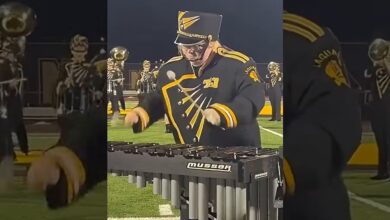
A viewer pointed out a small moment that can slip past on the first watch. Clark adjusts her sleeves and the sound of the riff carries on. The camera is close enough to follow what her hands are doing, which makes it a particularly good place to separate what you see from what you hear.
Clark told the Pittsburgh Post-Gazette that there were five players in the mallet section playing the opening together. The phone is aimed at her instrument. It doesn’t give the other students the same visual prominence, but it still picks up the sound of the performance around her.
The sleeve adjustment is a reason to listen for the group. You can follow Clark’s movements before and after it, and through the brief interruption you still have a rhythmic figure to hold onto. The close-up starts to sound less like a single instrument on an empty field.
That changes the way the full band entrance feels as well. The piece is already a group effort before the arrangement gets louder. The camera gives you one set of mallets to watch, and your ears can follow what the other players are adding.
What the camera shows and what the ear hears
Part of the appeal of a close-up is that it turns a fast, complicated action into something the viewer can try to track. You can see where the sticks go, which movement is next and how little time there is before it has to happen. That attention also makes small gestures look like breaks in the action. A player can appear to ease off for an instant while the musical idea continues at the same speed. The eye wants to resolve the apparent contradiction. The sound gives you a good reason to listen beyond the player closest to the camera.
Clark’s account of the arrangement supplies the missing context. In her Pittsburgh Post-Gazette interview, she described the opening as a part played by five mallet percussionists. On video, the sound arrives as a combined performance. We can follow the motion of the player in front of the lens more readily than we can assign each audible attack to a particular set of hands. It is tempting to treat every sound in a tightly framed clip as hers. Knowing the opening was a shared part gives you a more useful way to hear it.
Musicians who double a line spend much of their time making that line behave as one. They work on where the notes begin, how strongly they are played and how the part sits against the pulse. A slight mismatch can blur the front of the sound. Clean agreement makes the phrase read as a single musical shape, even when several players are responsible for it. Those are general features of ensemble playing, and they help explain why an audience could hear a smooth riff while seeing only one fraction of the work on screen.
The sleeve detail is a viewer’s reading of the clip. The footage is a fair prompt for the question of why the riff sounds uninterrupted, but it is a poor way to pin a particular note on a particular player. A phone microphone gathers the sound that reaches it. It doesn’t mark the instruments or give you separate tracks you can solo. In a recording this short, the best evidence for the arrangement is the account from the people who played it, paired with what you can hear when the whole group is in motion.
Follow the phrase on the replay
For one pass through the footage, follow the loudest attacks and notice which ones make the pattern easy to recognize. On another, give your eyes a break from the hands in the middle of the picture. If the camera shows more of the front ensemble, look for the players whose movements fall into the same repeated pulse. The view may still leave details out, but the listening exercise gets you closer to what a section does. You begin to hear the movement as a part that several people have to deliver together.
That matters when the rest of the band enters. The recurring figure has already taught the listener where to expect the pulse. The wider ensemble can introduce fresh sounds while the line retains its shape. At a stadium, with sound arriving from different parts of the field, that kind of clear musical handoff is valuable. In a close recording it can feel like a reveal. What looked like a person and a set of bars becomes the front edge of a performance with more players, colors and activity than the first few seconds let you see.
An alternate angle is useful for precisely that reason. The camera farther back will usually sacrifice detail about the mallets and give you a better idea of how the players and the field fit together. The close view lets you appreciate the individual movements. The wider view makes it easier to understand the relationship between the section that starts the piece and everyone who comes in later. Even when neither recording identifies every part, putting the perspectives together gives a fuller account of why a brief clip can sound bigger than the image in its opening moments.
The next time the sleeve catches your eye, listen through that moment and well into the next phrase. Ask how the pulse changes once your attention moves to the other players, or how much more of the ensemble you can hear now that you know to look for it. The gesture is an invitation to play the clip again. What makes that second watch rewarding is the realization that the riff has a collective sound. Clark gives you a close view of the precision it takes, and the section lets you hear what that precision becomes when it is shared.
The same distinction comes up in live rock videos. A camera trained on the guitarist can make a passage look like a solo effort until you listen for a bass player holding the bottom of the phrase or a drummer shaping its accents. Here, some of that supporting work is done by musicians playing the opening figure itself. Watching for that difference adds context to the video and gives the audience a way to appreciate the players who are less easy to spot in the frame.