The Space the Jaguars Gave Layla Clark Before the Band Came In
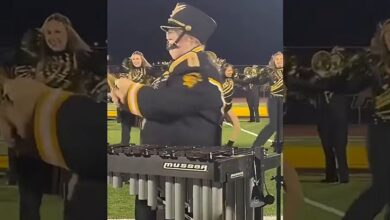
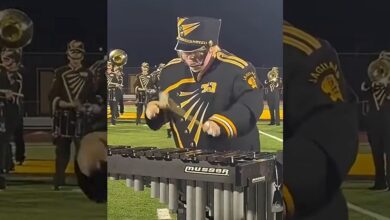
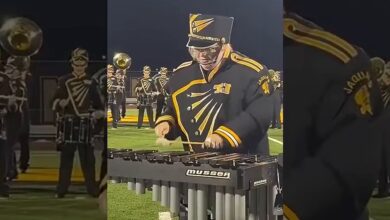
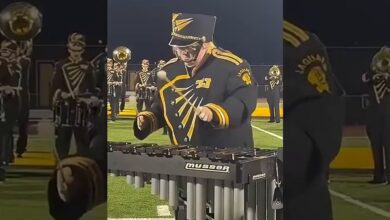
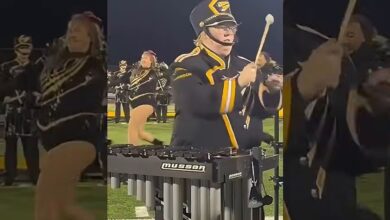
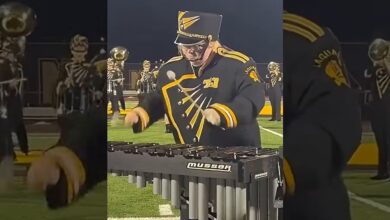
Most of what makes this opening work happens before the rest of the arrangement comes in. Clark’s mallets are the first thing you notice in the close-up, and the familiar riff has enough room around it to reach the stands. A viewer recognized that space as an opportunity somebody gave her.
At rehearsal, the mallet section had initially stopped when the other instruments stayed quiet. Clark told the Pittsburgh Post-Gazette that the percussionists had thought something was wrong. Director James Mirabella told them to keep going. Giving the part room was the arrangement.
The close camera angle makes the decision look like it was all about one student. Clark explained that five mallet players were involved in the opening. They had to trust the shared pulse before the rest of the band could come in around it.
Listen once for the riff and then listen for the answer. The entrance sounds big because the arrangement has already asked the crowd to focus on something small. Clark makes the first part clear enough for that contrast to work.
The rehearsal decision you can hear in the silence
The opening has a stretch where the other musicians could have been playing but aren’t. That stretch is easy to overlook because the repeating line keeps your attention moving. It’s also the part of the arrangement that makes the riff feel exposed. There is little around it to distract from the timing or the tone. If the players speed up or a note arrives late, everybody else can hear it. Giving the section room was therefore a form of trust as much as it was a choice about sound.
Clark’s account of the rehearsal makes that trust more concrete. She told the Pittsburgh Post-Gazette that the mallet players heard nobody else come in, assumed they’d made a mistake and stopped. Mirabella wanted them to keep playing. The confusion is easy to imagine from the musicians’ side: when a group expects company, continued silence can feel like a missed cue. From the audience’s side, the same quiet turns out to be one of the strongest features of the opening. It leaves the pattern exposed long enough to be recognized.
The decision also changes the way the students have to listen. An exposed passage can feel different when there’s no louder instrument to hold time above it. A group playing together needs its own sense of pulse, and it needs enough confidence to carry that pulse until everyone else is ready to enter. Clark pointed out that five players were involved. The steady timing in the close-up is a visible piece of an agreement that was happening among several people at the front of the field.
You can hear a related decision in the AC/DC recording, where the guitar announces the song before the full arrangement comes up around it. The Jaguars use a different sound to create the same kind of opening. Giving the part to mallets changes the texture. Leaving it room to speak preserves the suspense. People who know the song can spend a few seconds anticipating what will happen when the rest of the band enters, and people who don’t know it can still hear that the arrangement is building toward something.
An opening that still belongs to the group
The viewer’s line about making the whole field pay attention picks up on a real feature of the performance. Other people can be visible and moving, and the arrangement can still give you a single thing to listen to. The camera has an advantage here: it can hold one instrument in focus. On the field, the musicians have to make that focus happen through timing and contrast. The marimba keeps drawing your ear back to it until the ensemble is ready to change the scale of the sound.
That makes the band’s entrance worth listening for as its own event. It could sound like a new piece if the opening had already used every available instrument. Instead, it sounds like an answer to something that was there before it. The mallets give the band material to build on, and the later entrance lets the audience hear that material in a fuller setting. The size of the group matters most at the point when the arrangement finally lets you hear it.
There is a practical difference between handing someone an opportunity and making an arrangement that can hold it. The latter has to let the featured players make a recognizable statement, give them enough time to do it, and leave a clear moment for the rest of the ensemble to arrive. The rehearsal story suggests the students had to learn what the director meant by that space. The performance shows why it was there in the first place. The quiet makes the audience notice a part that might otherwise have passed inside a much louder sound.
Try watching the opening once with your eyes on Clark and once with your eyes farther back. The first pass shows a player staying busy throughout the riff. The second shows people sharing a field with a part they are waiting to join. You can see the space the arrangement gives the mallets even before you hear the answer. The distinction is one of the reasons this short clip is useful to anyone curious about what a school-band arrangement is actually doing.
The moment when the other musicians arrive puts the original viewer’s compliment into perspective. Clark and the mallet players had the audience’s attention. The whole band then had something to do with it. Keeping both moments in the same viewing makes it possible to appreciate the decision as an act of arranging and the opening as a performance in its own right.