Before Millions Saw Layla Clark Play, She Was Learning the Riff on Smaller Bars
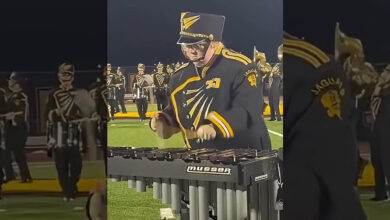
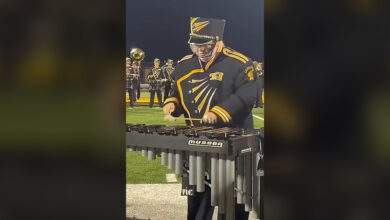
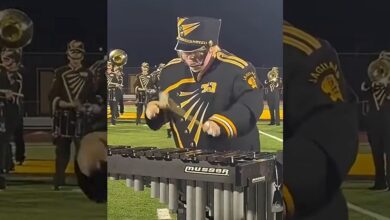
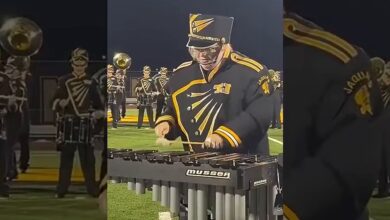
An online viewer noticed how abruptly the audience seemed to arrive for Layla Clark. There had been hours of practice, then millions of people were watching. The order is right even if the impression of an overnight rise compresses events. The clip was recorded during Thomas Jefferson High School’s 2025 marching season. Its wider online audience found it later. Clark had already learned the opening, rehearsed it and played it on the field.
Her mother told the Pittsburgh Post-Gazette that much of the practice took place at home on a mini glockenspiel. That gives the unseen work a scale you can picture. The small bars are close together and the place for a strike to land is tight. On a marimba, the notes can occupy more space and sound very different. The player can know the movement of the phrase by heart while still needing to adjust where the mallets travel.
The video starts well past the point where a musician is still working out the sequence. The riff is going by in a steady stream. The audience hears a returning pitch that makes the figure recognizable, with other notes moving around it. It takes only a short listen to understand why AC/DC fans recognized the song. It takes longer to see what is being repeated, and what the next small movement asks of a player.
Clark told CBS Pittsburgh that it took a long time to learn the passage. Her comment and her mother’s description provide a more useful way into the video than a guessed count of practice hours. A small instrument allows a player to work on where the notes fall and what the pattern feels like from one end to the other. The field adds different demands. The pace has to hold while people around the player are preparing to make their own entrances.
The part is particularly exposed at the places where it starts again. Learning the order of the pitches is necessary. Learning where to go at the end of one pass so the next starts on time is another job. Every hesitation there changes the impression of the rhythm. By the time a listener can recognize the pattern and anticipate its return, it can be easy to overlook how much timing information is packed into that small transition.
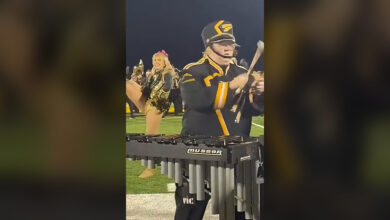
Clark described the opening as a part played by five mallet percussionists. The hours at home explain how one student got the figure under her hands. Rehearsal has to make it work among people. If the attacks are very far apart the line loses its clarity, and the rest of the band has less to listen to when it is time to come in. The exposed beginning gives you a chance to hear how steady the shared part has become.
The difference between a close-up and a season
A short recording can make a band’s progress look more sudden than it was. The audience is shown the part where a particular arrangement has already found its shape. Before that moment came the ordinary work of coming back to the same phrase, learning to keep it in time and making it fit with the rest of the show. There is no reason for a camera to be present at most of those moments.
The wait between the recording and the response is another part of that compressed timeline. At the game, the performance belonged to a school and to the people sitting in its stands. When the clip reached other listeners, it gave people who had never seen the Jaguars an immediate point of entry. A very famous guitar riff and a clear view of the percussionist were enough to bring the rest of the setting to mind.
Pay attention to the moment just before the band gets louder. The mallets have already given listeners a repeating shape to hold on to. It stays recognizable as other sound is added. That is one audible payoff of being ready. A player who has the movement settled can keep the entrance consistent while the ensemble changes what the audience hears around it.
Where the preparation shows up
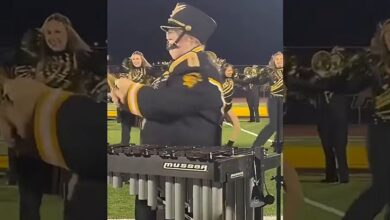
The interview is useful after the performance because it lets Clark put the work back into the story. The wider field recording gives that work an ensemble context. One view follows her hands. Another makes it possible to see more of the group responsible for the result. The small glockenspiel detail sits behind both, in the period when there was still time to repeat a phrase and make the next try more even.
The viewer was right to notice the contrast between practice and attention. The attention grew quickly once the video travelled. The control in the playing had to build in another way, one note and one rehearsal at a time. The next replay gives the listener a chance to hear a little of that earlier work without needing anyone to tell them how many hours it took.
Keep that scale in mind when you replay the first few notes. The miniature instrument gave Clark a place to work at home. The marimba and the larger ensemble gave the result a public sound. The point of the story lies in the distance between those two places, which a short clip manages to close in seconds.
There is a second payoff in watching the transition to the whole band. That is where the preparation has to serve other musicians. The opening that once fit on a small instrument at home becomes the beginning of a much wider sound. The camera is close enough to show the strokes, and the field is big enough to show what those strokes make possible.