What a Percussionist Heard in Layla Clark’s ‘Thunderstruck’ Cover
Layla Clark’s performance of AC/DC’s “Thunderstruck” has given rock listeners a familiar riff to recognize and percussionists a demanding passage to discuss. Among the responses, a viewer posting as @misterbum1 offered a pointed assessment: “As an old percussionist, I can tell you that what she did is hard as hell.”
The comment goes on to praise the consistency of the repeating pattern. That is a useful way into the recording. Once the opening sounds familiar, it is tempting to listen ahead to the band’s entrance. Looking at Clark’s hands instead reveals how much of the performance depends on keeping the same figure moving.
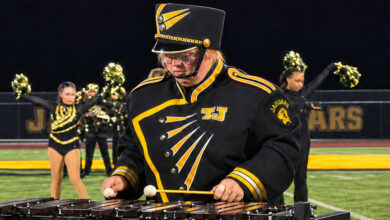
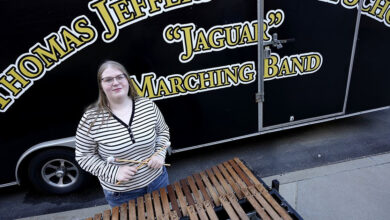
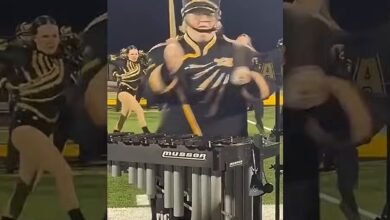
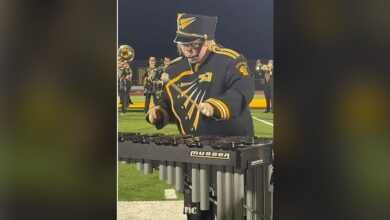
Clark is a percussionist with the Thomas Jefferson High School Jaguars in western Pennsylvania. KDKA Radio reported on November 6 that the widely shared footage was recorded by her mother during the 2025 marching band season. Clark was a junior at the time; the renewed attention has arrived during her senior year.
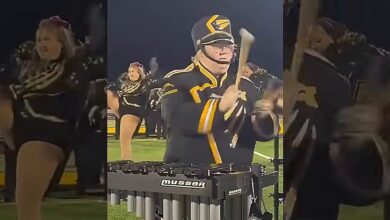
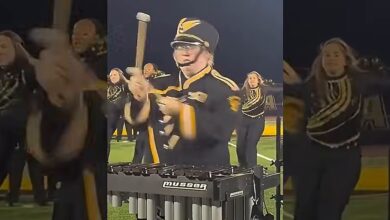
The camera stays close to the bars and mallets, with other performers visible behind her. Each strike gives the line a distinct attack. The sound is different from Angus Young’s electric guitar, yet the contour is clear enough for an AC/DC listener to identify the song almost immediately.
Other responses in the same comment discussion pick out coordination, timing and concentration. A viewer identifying themselves as a former drum-line player praises the execution, while another focuses on the hand-eye coordination. Together, those reactions explain why the appeal extends beyond the surprise of hearing a rock riff in a school-band arrangement.
The detail to follow is the continuation. Clark keeps returning to the figure as the performance develops around it. The opening has to hold together long enough to lead somewhere, and the larger sound of the Jaguars gives those repetitions their destination. Watch the hands first, then listen for what changes when the other instruments arrive.
Why the repetitions draw musicians’ attention
The older percussionist’s comment is an audience response, based on the experience the writer describes. Its emphasis is specific: sustaining a pattern over time. That observation directs attention to something a short excerpt can obscure. Starting a recognizable line is only the beginning of the job; the player must continue delivering it while everyone listening becomes more familiar with its pulse.
In Clark’s close-up, the movement stays readable. The mallets lift, return to the bars and prepare for another cycle. There is a physical rhythm alongside the musical one. Because the passage repeats, viewers can compare one return with the next without needing to read a score or know the names of the notes.
The recording also leaves the opening exposed. Before the fuller arrangement arrives, the repeated strikes occupy the foreground. That space is part of what makes the praise understandable: the audience can hear the line clearly and see the work behind it. The school setting adds scale, with the players on the field waiting to turn an opening figure into an ensemble performance.
The band’s entrance completes the idea
The close-up makes Clark the immediate focus, but the arrangement depends on the relationship between that part and the group around her. When the ensemble fills out the sound, the effect comes from the change in scale. A line that began with two mallets now has a much broader musical setting.
A separate recording from the Jaguar Marching Band channel shows “Thunderstruck” within its October 31, 2025 halftime program against Mars. The upload lists “Crazy Train,” “Thunderstruck,” “Back in Black” and “Hey Baby.” It offers a wider view of the band, rather than another angle on the exact short recording above.
Meet the musician behind the recording
CBS Pittsburgh’s report follows the attention back to Thomas Jefferson High School and includes an interview with Clark. It gives viewers a chance to hear from the student behind the playing, complementing the performance footage with a local account of the response.
That shift in perspective is useful after watching the opening repeatedly. The phone clip concentrates attention on a pair of hands; the report returns it to a student and her school. The admiration in the comments then feels more specific, directed toward someone whose work viewers have had a chance to notice.
Hear the guitar figure that started the comparison
AC/DC’s official “Thunderstruck” video provides a final companion to the school recording. Listen to the space around the opening guitar line, then return to the sound of Clark’s mallets. The change in instrument makes the attack of each note different, while the recognizable figure remains the connection between them.
For the commenter who identified as a percussionist, the achievement lay in maintaining that figure. For everyone else, the close-up makes the idea easy to follow. Keep watching beyond the first recognizable notes, and the sustained control becomes part of the attraction.