“Way to Represent the Pit”: Why Two Mallets Caught a Percussionist’s Eye
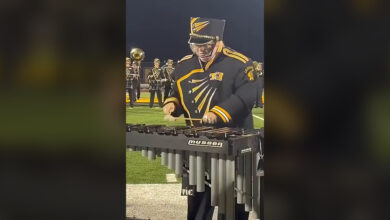
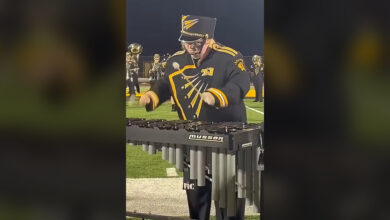
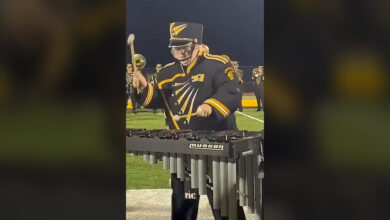
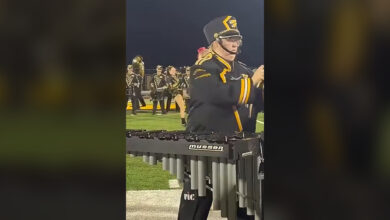
A former percussionist watching CBS Pittsburgh’s report on Layla Clark paused on a detail that a casual listener might overlook. Clark is getting through the opening figure of “Thunderstruck” with two mallets, one in each hand. The viewer, @meggrow, signed off by cheering for the pit. The comment showed 115 likes on November 9.
The pit is another name for a marching band’s front ensemble. Its players can work at instruments that stay in place while other members move across the field. In Clark’s close-up, you see what that stationary position makes possible: both hands can travel across a row of bars, striking the notes that recreate Angus Young’s guitar line.
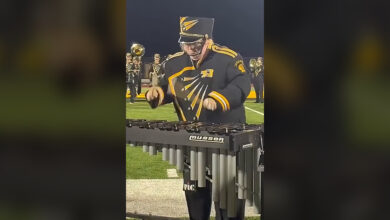
Two mallets give Clark two points of contact. The useful thing to watch is how she positions them between notes. One strike has barely landed before the other mallet is on its way to the next bar. Because the camera sits close to the instrument, the movement is as easy to follow as the rhythm.
From the front ensemble’s position, a featured passage can be both visible and surprisingly isolated. The mallet players are out in front of the people marching the show, and the rest of the field is waiting for its musical entrance. In that opening, a strike that lands a little late has plenty of space around it to be heard.
The two hands also divide up a physical job. One can be settling on a bar while the other gets ready for the next note. In a close recording those movements can look like a blur. Pick one hand and follow where it returns. It is easier to see the pattern once you watch each mallet as a separate line of movement.
The camera follows Clark closely, but the part belonged to a section. Clark told the Pittsburgh Post-Gazette that five players carried it together. Similar notes have to start together for the riff to sound clear from the stands. The pair of mallets that drew the commenter’s attention is one part of that larger job.
What the pit does on a football field
The Mars halftime recording gives you a wider angle on the pit during a full program. Listen for what happens when the front of the field gives up some of the space it has in the opening. Once more instruments enter, the initial figure still tells the listener where the music is going.
The front ensemble during the Mars halftime show
The Ringgold postgame recording offers a second field-show comparison from the same marching season. You can look for the stationary instruments near the front and the sections occupying the rest of the field. The separation is physical, but the sections still have to perform to the same pulse.
Another view of the Jaguars against Ringgold
The former percussionist’s sign-off works as a small piece of recognition. The mallet part is often easier to hear than it is to see from a seat high in the stands. In the viral footage you can see the two sticks doing the work. In the wider shows you can hear how that work reaches the rest of the ensemble.