Miley Cyrus and Her Band Bring New Fire to Led Zeppelin’s ‘Black Dog’ at Glastonbury
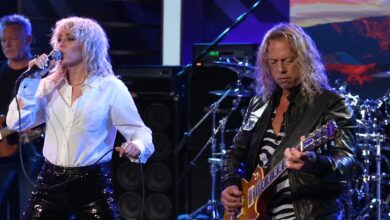
Miley Cyrus’s “Black Dog” performance at Glastonbury rewards a second listen to the musicians around her. Her voice is the immediate attraction, but Led Zeppelin’s arrangement depends on the whole group: the pauses, the returning riff and the weight of the rhythm section give the singer something substantial to work against. The cover’s appeal grows when attention moves between those parts.
The performance came during Cyrus’s Sunday appearance on the Pyramid Stage. Glastonbury’s official programme placed her between Kylie Minogue and Vampire Weekend, while the festival’s own retrospective highlighted the rock-and-roll character of her set. Within that broad festival setting, “Black Dog” brought an established rock language into the repertoire of a singer with a much wider pop audience.
The song makes the band’s contribution unusually easy to notice. A vocal phrase arrives in open space, then the instruments answer with the familiar figure. Each return needs a shared sense of timing. The musicians have to preserve that stop-and-start tension while making the track feel forceful enough to fill a large outdoor stage.
Cyrus brings a distinct vocal texture to those exposed phrases. The grain in her voice gives the song a different colour from Robert Plant’s original recording, while the arrangement keeps its recognisable shape. Her phrasing becomes part of a conversation with the instruments, with the end of each line setting up the band’s next entrance.
Guitar and bass supply the mass of the reply, but the effect depends on how clearly the figure lands. “Black Dog” can sound direct even when its rhythm is pulling at the expected accents. A successful cover has to retain that character, giving listeners the weight of a familiar riff without smoothing away the detail that makes it distinctive.
The drums complete that relationship by giving the returning figure a foundation. Taken together, the instrumental parts explain why this is a performance to hear as a group effort. Cyrus supplies the vocal presence; the band makes the spaces around it count. The Glastonbury recording below brings those exchanges into focus.
John Paul Jones’s account of writing “Black Dog” helps explain the demands on any band covering it. In a Guitar World lesson, the Led Zeppelin bassist described adding an extra beat to the main phrase before Plant’s next vocal entrance. He also discussed a bridge figure whose repeated phrase shifts its position against the beat.
Jones recalled that his original accent pattern proved difficult for the musicians to follow together. The band made the downbeats clearer while keeping the riff’s unusual movement. That history puts the backing players’ work in context: the song’s swagger is built on decisions about rhythm, and a live interpretation has to make those decisions feel natural.
His lesson also addressed tone. Jones said he used a pick to give the bass recording its bright, growling edge and later used an eight-string bass in live performances. Those observations concern Zeppelin’s own approach, but they underline a wider point about the composition: the sound beneath the vocal is an active part of the song’s identity.
“Black Dog” first appeared as the opening track on Led Zeppelin’s fourth album. Jimmy Page’s official discography records sessions at Headley Grange and Island Studios with engineer Andy Johns. The track announced the album through a combination of vocal exposure and instrumental weight, a balance that remains central when another singer and band take it on.
Cyrus’s version offers a clear reason to share the credit. The pleasure lies in the interaction: her voice creates anticipation, the musicians answer, and the next pause starts the exchange again. Listening to the band as carefully as the singer turns the cover into a more complete performance, with every part contributing to the familiar song’s impact.
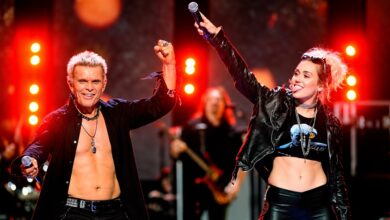
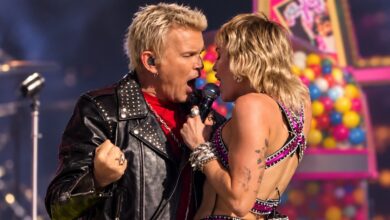
For comparison, the first related video features Cyrus performing “Black Dog” at the iHeartRadio Music Festival in Las Vegas. It is a separate appearance from the Glastonbury set and provides another setting for the same exchanges between her vocal delivery and the band.
The second companion returns to Led Zeppelin’s own “Black Dog” performance at Madison Square Garden in 1973. The official film places Plant, Jimmy Page, Jones and John Bonham together inside the arrangement, giving the Glastonbury cover a historical counterpart and bringing the original band’s interplay back into view.