Fueling the Night: Metallica Ignite Over 40,000 Fans in One of Their Most Explosive Performances of 2025
On the night of 6 December 2025, Etihad Park didn’t feel like just another concert venue tagged onto a Formula 1 weekend. It felt like a pilgrimage site for every metal fan who had waited over a decade to see Metallica return to the UAE. Hours earlier, the air had been filled with the scream of engines at Yas Marina Circuit; now, that same desert sky hummed with a different kind of power as thousands in black shirts poured through the gates, sunburned, sweaty, and absolutely ready for noise.
As darkness settled over Yas Island, the grandstand chatter melted into a low roar. Screens replayed highlights from the day’s track action, but the real anticipation had shifted to the massive stage at the far end of Etihad Park. You could hear snatches of different languages as fans traded stories: people who had seen Metallica back in Dubai years ago, kids catching them for the first time, tourists who’d picked up concert access with their Grand Prix tickets and were about to discover what a real metal crowd felt like at full volume.
When the lights finally dropped, the transition from post-race fatigue to full-blown adrenaline was almost comical. One second people were checking their phones and sipping water; the next, a tidal wave of screams rolled from front to back. The giant screens flickered to life with stark, grainy visuals, and the first rumble from Lars Ulrich’s drums cut through the night like a warning siren. Then the opening riff of Creeping Death exploded over Etihad Park, instantly transforming the after-race concert into a thrash metal arena where the only thing that mattered was the next downbeat.
Creeping Death as an opener felt like Metallica planting a flag: this wouldn’t be a safe, “corporate” F1 show. The riff hit like a freight train, and the crowd responded in kind, fists punching the air, voices roaring along with the “Die! Die!” chant as if this were some sweaty indoor club instead of a massive outdoor venue. James Hetfield stalked the front of the stage with that familiar half-grin, half-snarl, clearly feeding off the noise. For fans who had come straight from the grandstands, it was like swapping one kind of speed for another, trading lap times for downstrokes.
For Whom the Bell Tolls followed like a heavy, grinding engine shifting into a deeper gear. The opening bass line rolled out over the desert air, thick and ominous, while blue and white lights swept across the crowd in slow arcs, almost like searchlights. Closer to the front, bodies leaned into the groove, while further back, you could see whole pockets of people moving as one, hands high. It was the perfect bridge between pure thrash aggression and that anthemic, stadium-sized punch Metallica have honed over decades on the road.
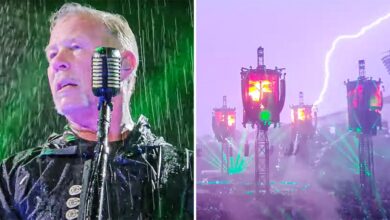
By the time Fuel arrived as the third song, Etihad Park felt like it had been primed specifically for that opening line. There’s something wildly appropriate about hearing “Gimme fuel, gimme fire, gimme that which I desire” in a place that had spent the entire day worshipping horse power and speed. As James barked the words into the mic, jets of flame erupted from the stage in tight, synchronized blasts, turning the front rows into a wall of heat and light. For a split second, it felt as if the entire Grand Prix weekend had been building to that exact eruption.
Fuel didn’t just sound fast; it looked fast. The lighting rig strobed in razor-sharp cuts, chasing the tempo of Lars’s drums, while Kirk Hammett’s guitar lines seemed to carve through the air like a car switching lanes at impossible speed. The pyro came in waves—vertical flames, bursts from the sides, an almost cyclonic effect every time the chorus hit. People who had been pacing themselves after a long day at the circuit suddenly forgot about pacing anything. Heads banged harder, voices got rougher, and the word “after-race” stopped feeling like a footnote and started feeling like a dare.
In the Golden Circle, where fans had paid extra to be pressed as close to the band as possible, Fuel played out like a baptism by fire. You could see faces lit up in orange and white every time the flames roared, eyes squeezed shut, mouths wide open as they shouted the lyrics back at the band. Sweat, sand, and the lingering scent of exhaust from the track all mixed into a strange, uniquely Abu Dhabi perfume. People who’d secured those upgrades suddenly understood what “premium views” truly meant: not just watching, but feeling every kick drum and blast of flame first-hand.
Fuel also marked a subtle shift in mood. The early songs had carried the weight of expectation—Metallica’s first UAE show in twelve years, a Grand Prix weekend headliner, all eyes on whether these four men still had that dangerous edge. After Fuel, that question felt ridiculous. The band sounded locked in: James’s rhythm playing razor-tight, Rob Trujillo’s bass punching through the mix, Kirk darting between crunchy riffs and high-flying melodies, Lars driving everything from the back with that unmistakable, slightly unhinged swing. The show moved from “can they still do this?” to “how far are they going to push this?”
From there, the set grew into a guided tour of Metallica’s different eras, all framed by the peculiar magic of a desert-night crowd. The Memory Remains turned Etihad Park into a massive choir, with the audience taking over the Marianne Faithfull lines in a raw, sandpaper-throated chant that seemed to hang above the ground long after the band stopped playing. In those moments, it felt as though Metallica were less a visiting act and more like the house band for the entire Middle East, playing to a region that had claimed them as its own after years of waiting.
The mood deepened with tracks like The Unforgiven, where the stage lighting cooled into deep blues and purples, and the guitars opened up into more spacious, melancholic textures. Couples who had been jumping shoulder to shoulder during Fuel now swayed closer together, while old-school fans closed their eyes and let the lyrics sink in. You could feel the emotional whiplash of the set: one moment, engines and flames; the next, memories, heartbreak, and the strange comfort of songs that have outlived entire phases of people’s lives.
Wherever I May Roam landed with particular force in a place built around travel and transience. Under the glare of the spotlights, Yas Island was full of people who had flown in from other countries, fans who lived in Dubai or Riyadh or Doha, expatriates who have always carried their fandom in suitcases and playlists. The sitar-tinged intro floated out across the park, and suddenly the song’s theme of restless movement felt deeply connected to the reality of those standing in the sand—people whose sense of home is spread across continents, but who, for one night, found a shared address in a guitar riff.
The newer material threaded through the set didn’t feel like obligatory additions. Lux Æterna, built around a ferocious tempo and sharp, almost punk-like energy, injected a shot of fresh blood into the crowd. Phones that had briefly gone up for ballads disappeared back into pockets as people reverted to pure physical response: jumping, shouting, losing themselves in the wall of sound. Rather than disrupting the flow, the newer songs felt like extensions of what Fuel had ignited earlier in the night—a reminder that the engine of this band still runs hot.
As the concert pushed deeper into the set, the emotional center of the night shifted toward the slower, more introspective songs. Nothing Else Matters arrived like a moment of collective exhale. The opening arpeggios rang out clear over Etihad Park, and suddenly thousands of tiny lights—phones, lighters, screens—rose into the air, turning the venue into a field of white stars against the black sky. After the flames and fury of Fuel and the surrounding onslaught, this quiet, almost fragile song felt like Metallica placing a hand on the crowd’s shoulder and saying, “We see you. We’ve been where you are.”
Then there were the inevitable warhorses: One, with its stark visuals and machine-gun drum patterns, transformed the stage into a battlefield of lights and shadows, while Enter Sandman closed the night in fully communal mode. By the time that final riff hit, people who had never seen each other before this weekend were singing into each other’s faces like old friends. It didn’t matter whether you were in the Golden Circle, halfway up the hill, or leaning against a barrier at the back; you knew you’d just witnessed the kind of show that rewires your memory of a place.
What made the night special wasn’t just the songs or the production, but the context. This was the culmination of the Abu Dhabi Grand Prix music program, the last big blowout after days of high-speed spectacle. For fans, it was a payoff for long waits and long flights; for the band, it was a chance to turn what could have been a corporate obligation into something that felt like a genuine, sweat-soaked celebration. Fuel, sitting near the top of the set, became the hinge of that transformation—the moment where the concert stopped being “a big event” and started being a shared, burning memory.
As people filed out of Etihad Park, some still humming riffs, others checking how badly their voices had been shredded, the conversation inevitable drifted back to the same point: Fuel. The sheer shockwave of that song—fire, speed, and that perfect collision between motorsport and metal—had branded itself into the night. Over time, fans might blur the exact order of the setlist or forget small details. But they would remember that scream of “Gimme fuel!” under the Abu Dhabi sky, the rush of heat on their faces, and the sense that, for a few relentless minutes, everything about this city, this weekend, and this band snapped into perfect alignment.