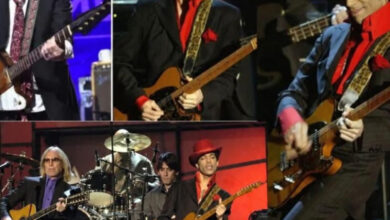
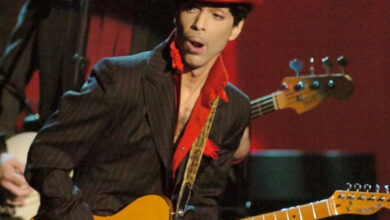
The First Bend in Prince’s Rock Hall Solo Is Worth a Second Listen
Watch the closing solo from the 2004 Rock & Roll Hall of Fame ceremony with the volume up and your eyes off the screen. The first thing Prince gives you is a note that seems to lean into another note. The change in pitch is small enough to follow and slow enough to make you wait for the answer.
A bend is one of the simplest ways a guitarist can change the shape of a note. Push the string sideways after picking it and the pitch rises. What matters here is the timing: how quickly it climbs, how long it hangs, and whether it eases back down before the next phrase begins.
That is why the first bend is a better place to start than the fastest part of the performance. The opening leaves a mark on your ear. Later, when the notes arrive close together, you can still hear where the phrases are headed because Prince keeps returning to tones he can sustain.
Put the 1968 Beatles recording alongside the tribute and the same song reveals a different way to use lead guitar. Eric Clapton’s part slips around George Harrison’s singing and adds tension without taking over the verse. The Rock Hall arrangement gives Prince a longer stretch after the vocals, where he can build, stop, and start another phrase without a singer coming back in over him.
The rhythm is just as important. The drummer and the other guitars keep the chord changes coming at a steady pace. Listen for the beat during one of Prince’s longer notes. The band is still moving, so the note feels like it is hanging over a song in motion.
The quickest way to hear the difference is to compare two short stretches: the opening of Prince’s lead and the louder run a little farther in. In the first, the pitch and space give you the shape. In the second, the faster playing lets him fill in that shape and then pull away from it again.
Hear the original recording again
Start with Harrison’s vocal and listen to where Clapton puts the guitar behind it. The lead gets space of its own, but the song keeps finding its way back to the voice. At the Rock Hall, Prince takes that same expressive quality into the last part of the tribute. By the time the guitar leaves his hand, the music has already made its point.