When Christmas Meets Metal: The Anthem That Redefined the Season
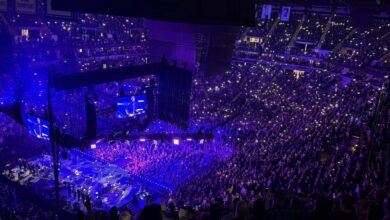
Snow was already piled high against the sidewalks outside the venue, the kind of heavy winter blanket that makes every light look softer and every sound feel sharper. Inside, though, the air felt closer to a storm than a lullaby. Fans in battle jackets and Christmas sweaters crowded together under a ceiling of hanging snowflakes and LED stars, waiting for one particular moment in the set. They hadn’t just come for another metal show—they’d come to see what happens when one of the most famous classical themes in history is reborn as a Christmas metal epic.
Orion’s Reign had built a reputation for treating holiday music like a cinematic battlefield, taking familiar carols and scoring them as if they belonged in a fantasy war film. Their Christmas releases had become a seasonal ritual for many fans: symphonic power metal arrangements of “Carol of the Bells,” “Joy to the World,” and even “All I Want for Christmas Is You,” all supercharged with choirs, strings, and double-bass drums. Tonight’s show felt like the culmination of that tradition, a full celebration of their winter catalogue turned into a live, roaring spectacle.
The stage itself looked like something between a cathedral and a frozen citadel. Icy blue lights washed over towering arch structures, while projected snow fell endlessly across a backdrop of stained-glass windows depicting armored angels and burning comets. At the front of the risers, guitar stands waited beneath flickering candle props, and a drum kit sat elevated on a small platform, ringed in frosted LED strips. The setup didn’t hint at subtlety; it promised a Christmas that arrived with thunder instead of sleigh bells.
When the house lights finally dimmed, a recorded choir swelled through the speakers, singing a slow, haunting motif that felt almost sacred. One by one, members of Orion’s Reign stepped into the light—leather, chains, long coats, and that unmistakable aura symphonic metal bands carry when they intend to turn a stage into another world. The opening songs were a tour through their winter repertoire: surging metal takes on familiar hymns, an original Christmas piece or two, and towering orchestrations that made the crowd feel like they were sitting inside the soundtrack to some epic holiday saga.
Between songs, the band took a moment to talk about how this seasonal project had grown unexpectedly important to them. What started as a single heavy Christmas track had evolved into a whole series, a playlist that fans now played every December instead of traditional carol albums. They spoke about wanting to honor the emotion embedded in these old melodies while also giving metal fans something that felt like home—a reminder that winter could be both reflective and explosively loud at the same time, and that the two moods weren’t actually opposed.
The anticipation for “Canon Rock” built almost unconsciously throughout the set. The crowd knew it was coming, and every time a new song started, you could feel the collective question ripple through the room: is this it? Some fans wore shirts with the single’s artwork, others had discovered the track through social media, where the combination of orchestral heft and electric guitar had been circulating in Christmas playlists for years. They knew the original roots in Pachelbel’s Canon and the bombastic Trans-Siberian Orchestra style, but this version—this collaboration—had its own unique gravity.
Then the lights fell into darkness, leaving only the faint glow of digital candles at the back of the stage. A solitary violin tone emerged, playing the first simple notes of the famous Canon melody, soft and almost fragile. For a few seconds, it felt like the entire arena was holding its breath. The strings were soon joined by a choir pad, building layer upon layer of harmony, turning the gentle figure into something that felt huge yet still reverent. The melody everyone recognized had never sounded quite so ominous and beautiful at the same time.
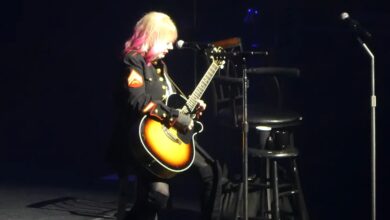
A single spotlight cut through the dimness at stage left, and there stood Minniva, wrapped in dark, flowing stagewear that matched the winter theme without burying her in clichés. Fans who knew her from her YouTube channel and countless metal covers cheered instantly, recognizing the Norwegian vocalist who had become something of an underground legend among symphonic and power metal fans. This wasn’t just a studio guest appearance being mimed live; this was a full partnership, a singer with her own following stepping into a shared universe the band had created.
She began with a wordless vocal line, gliding over the Canon theme instead of stepping on it, letting her tone rise and fall like a winter wind threading through cathedral arches. The band entered slowly around her—first keyboards laying down a cushion of orchestral strings, then the bass joining in, followed by the guitars tracing harmonized lines around the familiar progression. By the time the drums thundered into the mix, the gentle classical theme had fully transformed into a stampeding symphonic metal anthem, and the audience roared in approval.
What made the performance so gripping wasn’t just the heaviness; it was the careful respect for the structure of the original Canon. Instead of abandoning its gradual build, Orion’s Reign used each repetition of the chord progression as a new stage in the story. One cycle emphasized the choir, another the blazing lead guitars, another the sheer power of double-bass kicks hammering beneath string runs. Through it all, Minniva moved between delicate, almost angelic tones and full-throated metal belting, shifting the emotional weight of the piece each time she opened her mouth.
At one point, the band peeled everything back to almost nothing—just piano, a soft choir pad, and Minniva’s voice barely above a whisper. She sang a line that merged imagery of winter, light, and defiance, turning what could have been a straightforward instrumental showpiece into something personal and human. The crowd, so loud seconds before, fell nearly silent, the Canon pattern gliding underneath her like a river. Then, with almost no warning, the drums crashed back in, the guitars exploded into harmonized leads, and she soared on top of it all, reclaiming the melody as something fierce rather than fragile.
Visually, the moment was just as overwhelming. Snow machines released a thin, shimmering fall of artificial flakes above the front rows, catching in spotlights like drifting shards of glass. The screens behind the band showed animated stained glass cracking open to reveal stars, comets, and streaks of light that seemed to push outward into the room. Every time the Canon progression cycled, the imagery shifted—first winter forests, then burning candelabras, then a storm of golden notes swirling in a blizzard. It felt less like a backdrop and more like a living extension of the music.
As the performance neared its peak, the band shifted into a faster, more aggressive variation on the Trans-Siberian-style arrangement. Lead guitar tore into a virtuosic run, darting in and out of the Canon theme while the rhythm section pounded like war drums beneath a Christmas choir. Minniva’s lines interlocked with the guitar melody, echoing phrases, stretching notes, and occasionally dropping into powerful, sustained vowels that made the room vibrate. It was classical, metal, and cinematic scoring all at once, fused into something that didn’t feel like a compromise between styles but a natural evolution of them.
The final section felt like a celebration more than a performance. The crowd clapped along in unison as the Canon progression cycled through its last towering repetitions, the band riding that familiar chord pattern like a cresting wave. Minniva pushed her voice into one last ascending line, holding a note that seemed impossibly long over the cascade of drums and guitars. When the song finally hit its last, emphatic chord, the lights went white, the snowfall intensified, and for a few heartbeats there was a stunned pause before the audience detonated into applause and shouts.
In the aftermath, as the sound slowly receded and the band took their bows, it was clear that “Christmas Canon Rock” had done more than just reinterpret a famous piece of music. It had created a shared emotional space where people who loved classical composition, cinematic soundtracks, and unashamedly heavy metal could all stand together and feel the same surge of energy. Fans wiped tears, laughed, and shook their heads in disbelief. Some raised their phones to the sky, still recording, as if hoping to catch just one more lingering fragment of sound.
The rest of the night carried a different kind of warmth after that performance. Every subsequent song felt lit from within by the glow of what had just happened—a reminder that metal, at its best, isn’t about volume for its own sake, but about capturing feelings too big for ordinary language. As Orion’s Reign closed their set with another thunderous winter anthem and Minniva joined them one last time for a climactic chorus, it was obvious that “Canon Rock” had become more than a seasonal highlight. It was the emotional anchor around which the entire evening revolved.
Walking back out into the cold night air, fans pulled their scarves tighter but seemed reluctant to leave entirely, lingering around the venue doors, humming fragments of the Canon theme under their breath. Some spoke excitedly about first hearing the track online years before, others about discovering Minniva’s voice through her many metal covers, and still others about how Orion’s Reign had turned Christmas music into something they could finally call their own. For all of them, the concert had taken a familiar melody and etched it into memory in a new, indelible way.
And somewhere in that mixture of snow, streetlights, and fading adrenaline, the spirit of the night settled in: Christmas not as something quiet and distant, but as something alive, electric, and defiant. “Christmas Canon Rock” had taken a centuries-old progression, dressed it in steel and fire, and still somehow preserved its sense of wonder. That was the real magic of the performance—not that it made classical music heavy, but that it made heavy music feel timeless, like it had always belonged to winter’s soundtrack.