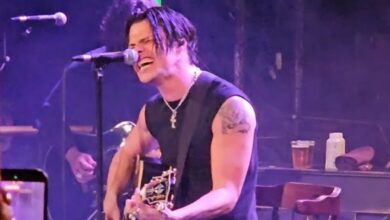
Yungblud Unmasked: The Acoustic “Zombie” Performance That Hit Harder Than the Original
Yungblud’s acoustic version of Zombie begins in near-silence, with only a single guitar and the faint scrape of fingers on the strings. Before he even sings a word, you can feel this will not be just another unplugged rendition of a fan favorite. It feels more like someone cracking open a private journal, inviting listeners to lean closer and witness a confession rather than a performance. That first chord seems to pull the whole room inward, as if everything else fades until only the song remains.
Zombie was already one of the most vulnerable tracks in his catalog, originally released with sweeping production and emotional weight that hinted at deep personal turmoil. Inspired by watching a loved one slowly fade into someone unrecognizable, the song blends grief, fear, and the raw terror of losing yourself in the process. But when he strips away the orchestration and stands alone with his guitar, the meaning becomes sharper, more intimate — like hearing the story from his own mouth rather than through a studio filter.
The visuals of the acoustic session are as minimal as the music itself. Instead of dramatic storytelling or a cast of characters, the camera remains glued to Yungblud, capturing every shift in expression and every flicker of emotion that crosses his face. Without sets or distractions, the entire narrative unfolds in his eyes, in his shoulders, and in the trembling notes he chooses not to smooth over. What was once a cinematic experience becomes a human one.
The opening verse lands with a softness that somehow cuts deeper than any full-band arrangement. The simplicity reveals the lyrics in a new light, exposing layers of meaning that were previously overshadowed by lush production. His voice sits low, almost conversational, as if he is still figuring out how to articulate the ache behind the words. The repetitive guitar pattern mirrors intrusive thoughts looping in the mind, echoing the very state the song describes.
When the chorus arrives, it does not explode — it tightens. Instead of swelling into dramatic heights, it focuses inward. His voice strains slightly, not out of technical reach but emotional pressure, and those imperfections become the most gripping part of the performance. The chorus feels less like a grand anthem and more like a quiet plea directed at someone he may never reach, turning a familiar hook into something startlingly personal.
The word “zombie” itself takes on a new texture in this setting. In the studio version, it can sound stylized, metaphorical, almost theatrical. Here, it feels like a diagnosis whispered in fear. He stretches the word as though it carries the weight of everything he is afraid of becoming, highlighting how deterioration — emotional or physical — can feel both gradual and sudden. It becomes the centerpiece of the acoustic version’s emotional gravity.
Throughout the performance, his body language becomes another instrument. There are moments when he curls into himself, shoulders narrowing, as if trying to hold something together. His eyes close at certain lines, not for effect but instinct, like someone trying to steady themselves before revealing a truth. These small movements enhance the intimacy, making it clear this is not an act but a reliving of something painful.
The middle section is perhaps the most devastating. Here, the lyrics sink into their heaviest themes: the fear of fading away, of becoming unrecognizable even to oneself, of letting down the people who matter most. In the acoustic version, he lowers his voice as though entering a sacred space, allowing small silences to linger between phrases. These pauses transform into emotional echoes, almost like rooms holding old memories.
This performance fits seamlessly into the emotional arc of his recent body of work. Zombie comes from an album shaped around identity, self-confrontation, and rebuilding the pieces of a fractured self. Hearing it acoustically feels like witnessing the moment before healing begins — the raw inventory of wounds that must be acknowledged before any recovery is possible. It represents the most unfiltered version of his artistry.
The decision to release an acoustic rendition after the song’s success suggests a deeper intention. Rather than chase bigger, louder interpretations, he offers something quieter and more dangerous — vulnerability. It is a way of asking whether the song still stands when stripped of everything except honesty. The answer becomes clear as the performance unfolds: it might hit even harder this way.
There’s a quiet dialogue between him and the listener throughout the song. Zombie becomes not just a reflection of his pain, but a mirror for anyone who has ever felt hollow, lost, or unsure of who they are becoming. It is a song for people who have watched themselves change in ways they did not choose, and who are trying desperately to hold onto a sense of self. The acoustic setting turns that shared ache into a moment of solidarity.
Fans who encountered this version for the first time immediately noticed how different it felt. Many commented on hearing lyrics they had overlooked before, as if the acoustic arrangement brought the emotional core closer to the surface. Others described the experience as hearing Yungblud singing directly into their own lives — a private performance filled with the kind of authenticity that only emerges when an artist stops performing and simply speaks.
The acoustic version also showcases his vocal evolution. Early in his career, his singing was defined by a chaotic, rebellious edge — the kind of rawness that came from youth and urgency. Now, the chaos has matured into control, allowing him to guide the emotion rather than be overwhelmed by it. On this track, he balances fragility and power with precision, walking the line between breaking and holding on.
By the time the final chorus arrives, the performance feels like a quiet storm nearing its end. There are no dramatic key changes or soaring harmonies — just a deepening of feeling. He gives a little extra weight to certain words, a subtle shift that makes the listener feel the exhaustion of someone who has carried too much for too long. The last chord lands softly, and the silence afterward feels like necessary space to breathe.
What remains after the music fades is a sense of having witnessed something honest and unguarded. The acoustic Zombie is not just a reinterpretation of a song; it is a revelation of the wound beneath it. In making himself vulnerable, Yungblud opens a path for others to recognize their own pain and sit with it without shame. It is a reminder that even in the quietest moments, music can be a lifeline.
In the end, this acoustic performance transforms Zombie from a cinematic ballad into a deeply personal confession. It stands as one of Yungblud’s most emotionally resonant recordings, proving that sometimes stripping a song down reveals far more than building it up. It becomes a moment not of spectacle but of truth — and that truth lingers long after the last note disappears.