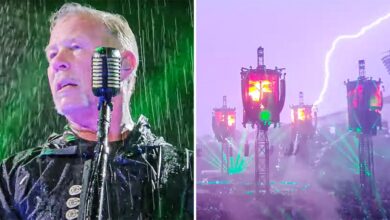
Megadeth Unleashed “Symphony Of Destruction” In A Thunderous Finale At Centre Vidéotron, Quebec — March 6, 2026
By the time Megadeth arrived in Québec City on March 6, 2026, the Canadian leg of the band’s 2026 tour had built a steady momentum that turned every show into a major metal event. The night at Centre Vidéotron carried particular weight because it marked the final stop of that Canadian run, a stretch that had moved through multiple cities before ending in front of a packed Québec crowd. When Dave Mustaine and the band stepped on stage that evening, the atmosphere inside the arena was already electric, fueled by fans who knew they were witnessing the closing chapter of that portion of the tour. The lineup also featured Anthrax and Exodus as special guests, creating a thrash-heavy evening that felt like a celebration of an entire genre rather than just a single band’s performance.
The show itself unfolded with a tightly structured set that mixed newer material with classic Megadeth staples. Songs like “Hangar 18,” “Sweating Bullets,” and “Tornado of Souls” built the foundation of the evening before the band reached one of the most anticipated moments of the night: “Symphony of Destruction.” Positioned deep into the setlist, the song arrived after more than an hour of relentless thrash energy. This placement was no accident. It created a dramatic payoff moment when the crowd, already warmed up and fully engaged, could unleash its collective voice during one of the band’s most recognizable choruses. In live metal concerts, timing often determines how powerful a song feels, and in Québec that timing turned “Symphony of Destruction” into one of the defining highlights of the evening.
“Symphony of Destruction” has long been one of Megadeth’s most famous songs, first released in 1992 as part of the album Countdown to Extinction. Over the decades it has evolved into a centerpiece of the band’s live performances. The song’s heavy mid-tempo groove gives it a different kind of power compared with Megadeth’s faster thrash classics. Instead of relying purely on speed, it thrives on tension, space, and the iconic riff that instantly triggers recognition from fans. When the band launches into the opening notes, audiences around the world react almost instinctively. Québec was no exception. The moment the riff began echoing through Centre Vidéotron, the crowd’s roar revealed just how deeply the song remains embedded in metal culture more than thirty years after its release.
Live versions of “Symphony of Destruction” also tend to reveal the relationship between the band and its audience. Unlike some songs that demand technical attention from listeners, this track invites direct participation. Fans often shout along with the chorus and even chant the band’s name between riffs, a tradition that has existed in Megadeth concerts for decades. The Québec performance carried that same communal energy. Thousands of fans responded to the rhythm and shouted lyrics with the kind of unity that only legendary songs can generate. In that moment, the performance stopped being just a band playing on stage and instead became a shared experience between musicians and audience, a massive wave of sound moving back and forth across the arena.
Another factor that made the Québec rendition memorable was the band’s stage presence. Dave Mustaine has spent more than four decades refining the identity of Megadeth, and that experience shows in how he commands the stage today. Rather than relying on elaborate theatrics, the band’s performance style focuses on precision and intensity. Guitar lines cut sharply through the mix, the rhythm section locks tightly into the groove, and Mustaine’s vocals deliver the song’s political bite with unmistakable authority. In “Symphony of Destruction,” that approach works especially well because the song’s structure leaves room for every musical element to stand out clearly. The Québec performance highlighted that balance, giving the song a powerful yet controlled atmosphere.
The setting also played an important role in the performance’s impact. Centre Vidéotron is one of the largest entertainment venues in Québec City, built to host major concerts and sporting events. When a heavy metal band like Megadeth performs in a venue of that scale, the sound and visuals combine to create an immersive experience. Lights sweep across thousands of fans while the band’s riffs bounce off the arena’s architecture. In the case of “Symphony of Destruction,” the slower, pounding rhythm filled the space with a heavy pulse that felt almost physical. Each chord echoed through the building, giving the song an even larger presence than it would have in a smaller venue.
Another reason the Québec performance stands out is the historical context surrounding Megadeth’s 2026 tour. The band had announced plans to wind down their career through a farewell run of concerts and new material, meaning many fans viewed these shows as rare opportunities to see the group perform its classic songs live one more time. That added emotional weight to every moment of the concert. When “Symphony of Destruction” appeared in the set, it carried decades of memories for longtime listeners who had followed Megadeth since the early thrash era. The song no longer felt like just another track in the show. It felt like a symbol of the band’s enduring influence in heavy metal history.
The Québec crowd clearly understood that significance. Throughout the song, fans reacted with the kind of enthusiasm usually reserved for the final moments of a concert. Hands were raised, voices shouted the lyrics, and the atmosphere reached the kind of intensity that turns live music into something unforgettable. For a band that has spent decades performing across the world, those reactions remain one of the most important measures of success. Megadeth has always thrived on the connection between stage and audience, and “Symphony of Destruction” continues to be one of the strongest bridges between the two.
Even when watching fan-shot footage from the Québec show, the power of the performance is easy to feel. Audience recordings often capture details that official productions miss, including the raw reaction of the crowd and the immediacy of the moment. The camera shakes as fans jump and shout, and the sound of thousands of voices singing together sometimes overwhelms the instruments. Those elements help recreate the atmosphere of the arena, reminding viewers that heavy metal concerts are not passive experiences. They are collective eruptions of energy where band and audience push each other to higher levels of intensity.
Looking back at the original studio recording of “Symphony of Destruction” makes the song’s lasting impact even clearer. When it first appeared in the early 1990s, it helped propel Megadeth into a wider mainstream audience while still maintaining the aggressive edge that defined thrash metal. The track’s combination of heavy riffing and memorable structure allowed it to cross boundaries between metal subgenres and even reach listeners who were not deeply involved in the thrash scene. That balance between accessibility and intensity explains why it still works so well in modern concerts decades later.
Comparing the Québec performance with earlier live versions reveals how the song has evolved over time. In the 1990s, Megadeth often played it with a faster, more aggressive tone that matched the raw energy of the era. Today the band performs it with slightly more emphasis on groove and precision. That change reflects both the maturity of the musicians and the massive venues they now play. Rather than racing through the song, they let the riff breathe and allow the audience to participate fully in the chorus. The result is a version that feels heavier and more commanding even if the tempo remains similar.
One of the fascinating things about “Symphony of Destruction” is how it adapts to different environments. Festival performances often transform it into a massive sing-along moment where tens of thousands of fans chant the chorus together. Arena shows like the one in Québec create a slightly different atmosphere, focusing more on the weight of the music itself. The walls of the venue amplify the rhythm and make every guitar stroke feel more powerful. In that setting the song becomes almost hypnotic, drawing the audience deeper into its groove with each repetition of the riff.
By the time Megadeth finished their Québec performance and moved toward the closing songs of the night, the impact of “Symphony of Destruction” was still echoing through the arena. Moments like that remind fans why certain songs survive for decades while others fade away. It is not only about catchy riffs or famous choruses. It is about the emotional and cultural connections that form around the music. “Symphony of Destruction” carries the history of Megadeth, the evolution of thrash metal, and the shared experiences of millions of fans who have heard it performed live across generations.
In the end, the Québec City performance demonstrated why Megadeth continues to command respect within the metal world. Even after decades on the road, the band still delivers the kind of powerful live moments that define the genre. The March 6, 2026 show at Centre Vidéotron captured that spirit perfectly. When the opening riff of “Symphony of Destruction” echoed through the arena and thousands of voices joined in, it proved once again that some songs are more than music. They are living pieces of metal history that grow stronger every time they are played.