Adam Lambert Ignites a Four-Way Queen Showdown on The Voice Australia
The room feels different before a single note is sung. On The Voice Australia, the Blind Auditions are supposed to be about strangers walking into the unknown, but this moment flips the script: the coaches step into the spotlight first, setting the tone like a curtain-raiser before the real story begins. You can sense the audience bracing for impact, because when a show opens with a Queen medley, it’s not background music. It’s a declaration that tonight is going to be loud, theatrical, and built for goosebumps.
Adam Lambert stands at the center of it, and that detail alone changes the stakes. He isn’t just any pop star invited for a cameo—he’s widely known as Queen’s modern frontman, so the songs don’t sit on his shoulders like a costume. They sit like a home. The moment he starts the medley, it has that sharp, confident edge Queen songs demand: bigger than polite television, bigger than safe arrangements, meant to hit the chest and make people look at each other like, did this just become a stadium?
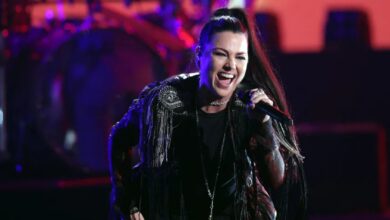
Then the performance turns into something even better than a solo: it becomes a four-way collision of personalities. One by one, the other coaches join in—LeAnn Rimes, Kate Miller-Heidke, and Guy Sebastian—until it feels like the stage has become its own little universe of different vocal colors. The chemistry matters here, because a medley can easily feel stitched together, but when voices enter in sequence like characters arriving in a scene, the song stops being a montage and starts being a narrative.
The first section leans into pure rhythm and swagger. We Will Rock You is built on the simplest human instrument—stomp and clap—and that’s why it works anywhere, from arenas to TV studios. Even through a screen, you can almost feel the floor under the audience vibrating with that primal beat. The arrangement doesn’t need to overcomplicate it. The point is momentum. The point is to make the room participate before anyone even thinks about technique.
What sells it is the way the coaches don’t just sing “at” the crowd—they perform “with” the room. You get the impression of a live exchange: eyes scanning the audience, bodies moving with the pulse, the music pushing forward like a wave. And because this is The Voice, the show is built on listening, so the sound mix gives those big chorus moments a clean clarity that makes every harmony land. It’s polished TV, but the energy feels unruly in the best way.
There’s also a subtle game happening inside the performance: four artists sharing a legacy song without turning it into a competition, while still letting their identity show. Each voice has its own accent—genre, tone, phrasing—so the medley becomes a showcase of contrast. It’s the musical version of four strong personalities agreeing to share a spotlight, then proving they can do it without shrinking. That balance is rare, and it’s why the moment sticks.
As the medley drives forward, you can feel it approaching the pivot point—when the stomp-and-clap bravado has to transform into something more emotional. That transition is where performances like this either break or become unforgettable, because We Are the Champions isn’t just a chorus people shout at games. It’s a victory song with a bittersweet core, and the arrangement has to make space for that shift from muscle to meaning.
A guitar solo acts like the glue between the two songs, stitching the swagger of the first anthem into the uplift of the second. That bridge matters because it resets the emotional temperature without killing the momentum. It’s the musical equivalent of a camera cut that suddenly changes the scale of a scene—same story, bigger frame. By the time the second song arrives, the audience is already carried forward, ready to receive something less aggressive and more soaring.
LeAnn Rimes takes a prominent lead as the medley moves into We Are the Champions, and it works because her voice naturally brings a clean, powerful emotional clarity. Instead of trying to imitate Freddie Mercury’s exact phrasing, she leans into the song’s message—resilience, pride, the ache behind triumph. That’s what makes the handoff feel authentic: the song becomes about the moment and the room, not about doing impressions of rock history.
Guy Sebastian and Kate Miller-Heidke weave in with their own lines, and the effect is like watching a relay race where every runner has a different style but the baton never drops. The performance becomes a shifting spotlight: one voice steps forward, another answers, and suddenly the chorus feels like a group victory instead of a single proclamation. That’s the magic of good ensemble singing—no one disappears, and nobody forces dominance. The song expands because it’s shared.
And then Adam comes back in a way that reminds you why viewers associate him with Queen in the first place. The performance doesn’t just ask, “Can he sing these songs?” It answers with stage presence—movement, conviction, and that fearless willingness to go big without apologizing for it. Queen music requires audacity. If you hold back, it looks timid. When Adam steps into the moment with full force, the medley stops feeling like a TV opening and starts feeling like a real concert scene.
What’s interesting is how the show context changes the meaning of the performance. The Blind Auditions are usually about unknowns chasing a dream, and here you have established artists modeling exactly what that dream looks like: command of the stage, connection with the crowd, and musical storytelling that lands instantly. It’s like the coaches are quietly saying to every nervous contestant backstage, this is the scale you’re stepping into—don’t shrink. Bring your whole self, because the room can handle it.
That’s why the audience reaction feels so alive. Queen songs already come with built-in communal energy, and when four coaches trade lines and lock into harmonies, the studio energy turns into something closer to a sports arena atmosphere—loud, collective, physical. Even if you’ve heard these songs a thousand times, the arrangement makes them feel freshly activated, like an old engine roaring back to life because the fuel is real enthusiasm, not nostalgia alone.
Online, moments like this spark arguments the way only big, beloved songs can. People don’t just say “great performance”—they pick favorites, debate who owned which line, and talk about why certain voices cut through the mix the way they do. That kind of comment-section chaos is actually a compliment, because it means the performance made people feel invested. A forgettable medley gets polite applause. A memorable one triggers loyalty, obsession, and replay value.
The best part is that it doesn’t try to be complicated. It chooses two anthems that naturally belong together—We Will Rock You flowing into We Are the Champions—and lets the simplicity do the heavy lifting. It’s a reminder that “epic” isn’t always about adding more notes or more tricks. Sometimes epic is just commitment: a beat everyone can feel, a chorus everyone knows, and four voices willing to meet the moment with full volume and real personality.
In the end, the medley works as both entertainment and a statement of identity for that coaching panel. Adam Lambert brings the Queen association and theatrical heat. LeAnn Rimes brings vocal strength and emotional precision. Guy Sebastian brings a pop-soul polish that sits comfortably in big hooks. Kate Miller-Heidke brings a unique tonal character that keeps the blend from becoming generic. Together, they turn a familiar pair of songs into a scene people remember as an opening that felt larger than the show itself.