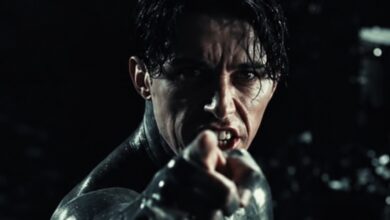
Bring Me to Life: Evanescence and Jacoby Shaddix Ignite Los Angeles in a Defining 2025 Moment
December 13, 2025 in Los Angeles didn’t feel like “just another concert night.” It had that end-of-year electricity where people arrive already loud, already ready, like the city is daring the show to live up to the hype. Inside the Kia Forum in Inglewood, the crowd carried a mix of generations and moods—older fans who remember exactly where they were when early-2000s rock ruled the radio, and newer listeners who discovered the band through the aftershocks of streaming, edits, and live clips that never stop circulating.
Evanescence stepping onto a stage like that always changes the temperature. There’s a specific kind of anticipation that forms when an audience knows a voice is about to cut through the noise, not float above it. Amy Lee has always had that ability: to make an arena feel like a single room for a few seconds, then widen it back into something massive with one lift of a phrase. The band’s presence carried confidence, not nostalgia—more like, “We’re here now, and we’re not asking permission.”
The first wave of the set reminded everyone what Evanescence does best: drama without artificial gloss, weight without sloppy edges. Guitars hit with purpose, drums stayed tight, and the overall sound felt built for a space that big—big enough to feel cinematic, controlled enough to feel sharp. It wasn’t the vibe of a band trying to recreate old magic. It was the vibe of a band that knows the old magic still works because the core is real, and real always lands harder than “perfect.”
Los Angeles crowds can be famously demanding, but they’re also famously honest. When they feel it, you hear it immediately. You could feel the room settling into that rhythm where everyone stops treating the show like an event and starts treating it like a moment. People who came to scream were screaming, but even the loudest fans had those stretches of quiet focus—watching Amy’s phrasing, waiting for the next lift, reacting to tiny changes in dynamics like it actually mattered.
And that’s the key: it did matter. Because this night wasn’t only about classics. It was about Evanescence proving, in front of a packed crowd, that they’re not a museum piece from the 2000s. The performance carried bite. The energy wasn’t “we’re happy to be here,” it was “we’re still dangerous.” That’s the kind of confidence you don’t fake. You either have it, or you don’t, and this set had it in every transition.
As the show moved forward, fans started to sense the setup for something special. The room’s behavior changes when people suspect a surprise. You see phones rise in clusters. You see people turning to friends like, “Wait—are we about to get it?” And when you’re talking about “Bring Me to Life,” you’re talking about one of those songs that doesn’t just play—it triggers a memory. It’s a time machine. It’s an anthem. It’s a crowd-control button.
When the opening of “Bring Me to Life” hit, the reaction wasn’t polite excitement. It was instant ignition. The first notes created that classic arena effect where the crowd becomes its own instrument, a wall of voices arriving before the chorus even opens. The energy shifted from “watching a band” to “participating in a ritual.” That’s why this song still hits so hard live: it belongs to the audience as much as it belongs to the band, and everyone in that room knew it.
Then came the extra punch: Jacoby Shaddix joining the performance. Even if you’ve seen guest spots before, this one carries a specific kind of impact because it connects two worlds that share the same DNA—early-2000s intensity, radio-era swagger, and that raw, almost athletic delivery that makes a chorus feel like a surge. The moment he appeared, the building reacted like it recognized the collision immediately.
The chemistry worked because it wasn’t staged like a novelty. It felt natural—like the song opened a door and he simply walked through it at the exact right time. His presence added grit and urgency, and it sharpened the song’s edge without overpowering Amy’s control. That balance is rare. When it’s wrong, it feels like a guest trying to steal the spotlight. Here, it felt like the song got bigger, not messier—like the performance leveled up in real time.
Amy Lee’s delivery that night is the part that shuts down the “they’re not in their prime anymore” talk. This wasn’t someone leaning on crowd help to survive a chorus. This was command. The vocals landed with power and accuracy, but more importantly, they landed with intention. She didn’t sing the song like a throwback. She sang it like it still means something now, like the message still has teeth, like the emotion still has a pulse.
And the band behind her played like they understood exactly what the room needed. Tight stops, clean hits, and a sense of momentum that never drooped. “Bring Me to Life” can easily become a singalong that turns sloppy in a huge venue, but this felt controlled—like the band kept the rails firm while the crowd ran wild. That’s the sweet spot: chaos in the audience, precision onstage, and the two feeding each other.
For the crowd, the highlight wasn’t just hearing a famous song. It was the feeling of witnessing something that looked effortless while still sounding massive. You could hear that “we’re all in this together” roar during the hook, the kind of collective singing that makes the air feel thicker. People weren’t recording because they wanted proof they were there. They were recording because they could tell it was going to be one of those clips that travels fast.
The guest moment also hits deeper because it’s a reminder of how connected that era of rock really was. Evanescence and Papa Roach aren’t just two names on old playlists—they’re bands that shaped a time when emotional intensity and heavy riffs were allowed to live right next to radio hooks without apology. Seeing Jacoby step into that space felt like a bridge between scenes, between fanbases, between decades, all landing in one chorus.
When the song reached its peak, the whole venue felt like it was shaking in a way that had nothing to do with volume and everything to do with unity. This is the part people describe as “goosebumps,” because it’s physical. It’s not a thought. It’s a body reaction. You could feel the crowd’s energy push back toward the stage, and you could feel the stage push right back, like a loop that kept amplifying itself.
After it ended, there was that split-second silence that always follows a truly big moment—where people aren’t sure whether to scream, laugh, or just breathe. Then the reaction hit, and it hit hard. Not just applause, but that roar that sounds like relief, like celebration, like people realizing they just got something they’ll remember. “Bring Me to Life” didn’t just close a chapter in the set; it stamped the night.
And the lasting story from December 13, 2025 is simple: Evanescence didn’t show up to cash in on history. They showed up to prove they still own the room. Amy Lee sounded like a force, the band played with precision, and the Jacoby Shaddix moment turned a classic into an event. In a year packed with live music, this stood out because it wasn’t nostalgia—it was power, present tense, and impossible to ignore.