Six Months After Ozzy’s Passing, the Grammys Became a Night of Mourning, Memory, and One Unforgettable Tribute
On February 1, 2026, the 68th Grammy Awards at Crypto.com Arena in Los Angeles had the usual award-show electricity, but there was a very specific kind of hush hovering over the rock corners of the night. Everyone seemed to understand that this wasn’t going to be a clean, celebratory “rock segment” where guitars show up, make noise, and vanish. Ozzy Osbourne’s death in July 2025 had left a crater in the culture, and the Grammys weren’t treating it like a footnote. From the moment the broadcast began building toward its tribute beats, the room felt primed for something heavier than applause. Even before any trophy was handed out, you could feel the audience bracing for emotion.
Sharon Osbourne’s presence alone changed the temperature in the building. When she appeared, it wasn’t the typical red-carpet glamour moment where the camera hunts for reactions and the crowd moves on. People clapped like they were holding a person up, not simply acknowledging a celebrity. Reports from the night describe her appearing alongside family, including Kelly and Jack, with attention also landing on the rare public appearance of Ozzy’s daughter Aimee at the ceremony. The story wasn’t about outfits or poses; it was about what it means to show up when grief is still fresh enough to sting. In an arena full of winners and nominees, Sharon’s courage read as its own kind of headline.
What made the night so emotionally volatile was the way it braided two timelines together: the Grammys’ polished stage and the raw memory of a stadium farewell in Birmingham. The performance that would soon be honored wasn’t a studio creation engineered for radio. It was a live capture tied to a real-world moment: “Changes (Live From Villa Park / Back to the Beginning),” associated with Black Sabbath’s farewell event at Villa Park on July 5, 2025. That detail mattered. It meant the song carried the imprint of a crowd, a city, and a goodbye. You weren’t listening to a concept. You were listening to an artifact of a farewell that had already made fans cry in real time.
“Changes” is a deceptively simple song until you’re forced to sit inside it. It’s not a riff showcase; it’s a slow emotional reveal. That’s exactly why it became the perfect vessel for a generational handoff. The Grammys weren’t rewarding distortion or speed here; they were rewarding restraint, vulnerability, and the nerve it takes to perform a quiet ballad in front of a massive audience. Coverage around the Villa Park moment described how the stadium seemed to freeze while the performance unfolded, turning a huge venue into something that felt intimate. When a rock crowd goes silent, that’s not boredom. That’s respect.
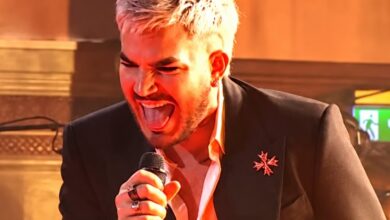
By the time the Grammys reached the Best Rock Performance announcement, the category felt less like a competition and more like a checkpoint in a shared mourning process. The winning credit wasn’t just YUNGBLUD alone; it explicitly recognized collaborators, including Nuno Bettencourt and Frank Bello, and other musicians associated with the performance’s lineup. That team aspect helped explain why the moment resonated: it wasn’t a lone artist trying to “borrow” Ozzy’s legacy. It was a collective of players building a respectful frame around a song that needed to be handled gently. The award, in other words, celebrated not just a vocal, but a whole decision to treat the material with care.
Then came the pivot that made people stop thinking about trophies entirely. Multiple reports describe YUNGBLUD using his acceptance moment to pull Sharon Osbourne into the spotlight with him. It’s the kind of move that can feel performative if it’s done for cameras, but this read differently because it tracked with the emotional groundwork that had been laid before the broadcast. The narrative wasn’t “look who I’m standing with.” It was “this belongs to him, and to you.” The crowd reaction mattered here too: the applause wasn’t the wild roar of a personal win; it was the release of a room acknowledging a family’s loss in public.
Behind the scenes, the tone was reportedly even more personal. People coverage described YUNGBLUD sharing a quiet ritual with Sharon before the ceremony, lighting a candle for Ozzy. That small image is almost too symbolic to be real, but it’s exactly the kind of private gesture that explains why the onstage moment landed. If you’ve already done something sincere away from the spotlight, you’re less likely to treat the spotlight like a stage trick. The candle story made the acceptance speech feel like the continuation of a real night of remembrance, not a scripted beat.
The Grammys also built a separate emotional wave through the In Memoriam segment, and this is where the room reportedly cracked open. Accounts of the broadcast describe the tribute transitioning into a performance of Black Sabbath’s “War Pigs” featuring Post Malone with an all-star backing group that included names like Slash, Duff McKagan, and Chad Smith. The pairing itself told a story: different generations, different scenes, one shared debt to Ozzy’s impact. “War Pigs” is already a song that carries moral weight, and placing it inside In Memoriam turned it into something like a public funeral procession with amplifiers.
Cameras don’t create tears out of nothing, and this was one of those nights where the emotion didn’t need editing. Footage and coverage focused on Sharon, Kelly, and Jack visibly crying during the tribute performance. It wasn’t dramatic reality-TV grief; it was the kind of grief that shows up when a song suddenly becomes a photograph you can hear. The point wasn’t that celebrities got emotional on camera. The point was that a family watched the world sing their loved one back into the room, and for a few minutes, the arena seemed to carry them. That’s what made the tribute feel communal instead of voyeuristic.
What made this whole sequence special was how the Grammys let rock be tender without apologizing for it. Rock tributes often lean into volume as a substitute for meaning. Here, the meaning was the engine. You had “War Pigs” bringing the thunder, but you also had “Changes” representing a softer kind of devastation. Together, they told a fuller story of Ozzy: not just the larger-than-life icon, but the human presence that made people feel seen, weird, accepted, and unafraid to be different. It’s easy to praise a legend’s catalog. It’s harder to show what the legend did to people’s lives.
And that’s where YUNGBLUD’s role became more than “young artist covers classic song.” In reporting about his win and acceptance, he’s framed Ozzy as a personal north star, someone who influenced his identity and artistic confidence. That angle matters because it explains why this tribute wasn’t nostalgic cosplay. It was mentorship echoing forward. The Grammys, for once, didn’t treat the rock generation gap as a novelty. They treated it as inheritance. When the person accepting the award is clearly still processing loss, the speech stops sounding like an industry thank-you list and starts sounding like a kid trying to say goodbye properly.
There was also a very modern, very human detail in the way the night’s story circulated afterward: people didn’t just read about it, they watched the clips immediately. The official Grammys channels posted the acceptance, and entertainment outlets amplified the Sharon-onstage moment because it played like a short film: the trophy in one hand, the grief in the other. That instant replay culture can cheapen emotions, but here it seemed to spread them. Viewers who didn’t watch the full broadcast still encountered the moment in a feed and felt that catch in the throat that doesn’t require context. The clip carried its own truth.
The Birmingham origin of the performance also added a layer of mythology. A stadium in Ozzy’s home city, a farewell concert atmosphere, and a ballad that forces vulnerability—those ingredients make a live recording feel like a document, not just a track. Coverage of the Villa Park moment emphasized how unusual it was to see a massive crowd stilled by a quiet song, and that contrast is exactly what the Grammys ended up awarding. This wasn’t a “rock is back” narrative built on trends. It was “rock still matters” built on emotion. That’s a much harder argument to fake.
Even the credited collaborators underscored how this was built as a tribute, not a vanity project. When you see an award given to a performance that’s explicitly a collaboration, it signals that the scene came together around the moment rather than around a single personality. The story becomes less about who “owned” the spotlight and more about who helped hold it steady. In a year where award shows are often accused of feeling detached from reality, this sequence felt stubbornly real: a family grieving, a younger artist honoring, a room listening, and a genre remembering what it does best when it’s honest.
That’s why people described it as one of the most emotional moments of the night without sounding like they were exaggerating for clicks. The emotional power didn’t come from one tearful camera shot; it came from the architecture of the evening. A public tribute in In Memoriam. A separate award honoring a live performance tied directly to Ozzy’s final-era story. Sharon Osbourne stepping into the building and letting the world see that grief and pride can exist at the same time. And YUNGBLUD, trophy in hand, refusing to treat the win like a victory lap. It wasn’t just a Grammy moment. It felt like a communal goodbye with a heartbeat.