Ilia Malinin’s Gala Return Turns Disappointment Into One Of Milano Cortina’s Most Powerful Moments
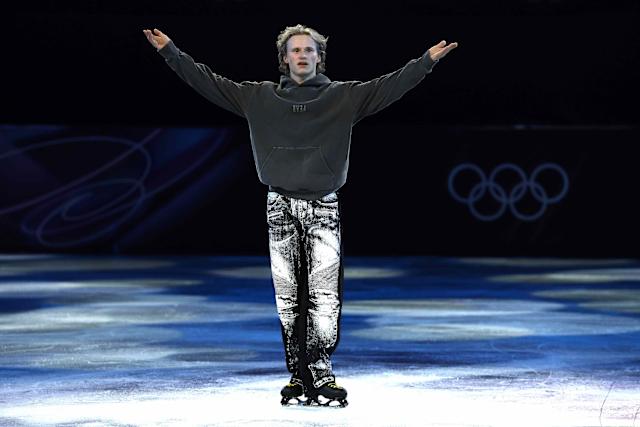
Ilia Malinin’s appearance at the Milano Cortina 2026 Winter Olympics Exhibition Gala on February 21 marked one of the most emotionally charged moments of the entire Games. Just days after a difficult men’s singles competition that ended far from the podium, Malinin returned to the ice under very different circumstances. There were no medals at stake, no scores to chase, and no technical expectations hanging over him. What mattered instead was expression, presence, and the opportunity to skate freely after the pressure had finally lifted.
The context surrounding the gala mattered deeply. In the men’s individual event, Malinin had entered as one of the most anticipated skaters of the Olympics, widely discussed for his technical ceiling and quad-heavy arsenal. The free skate, however, did not unfold as planned. Two costly falls disrupted his program, and despite flashes of brilliance, the errors pushed him down to eighth place. The silence that followed the scores contrasted sharply with the expectations that had preceded the event.
Rather than withdraw or retreat quietly after that disappointment, Malinin chose to reappear with purpose at the exhibition gala. These gala events are traditionally lighter, more expressive showcases where skaters are encouraged to step outside competitive constraints. For Malinin, it became a chance to reset the narrative, not through words or interviews, but through movement. The performance allowed him to present himself without the rigid framework of judging panels and point values.
His music choice immediately set the tone. Skating to “FEAR” by NF, Malinin aligned his performance with a track known for exploring internal pressure, anxiety, and self-confrontation. The song’s intensity provided a sharp contrast to the classical or lyrical selections often seen in gala programs. From the opening beats, the performance felt grounded in personal emotion rather than spectacle, signaling that this skate was about mindset as much as athleticism.
Malinin’s costume reinforced that message. He appeared in a gray hoodie with the word “FEAR” printed upside down across the chest, paired with dark pants instead of traditional figure skating attire. The choice was widely interpreted as a deliberate departure from polish and pageantry. It visually echoed the themes of the music and underscored a sense of vulnerability, as if he were stepping onto Olympic ice stripped of armor rather than dressed for battle.
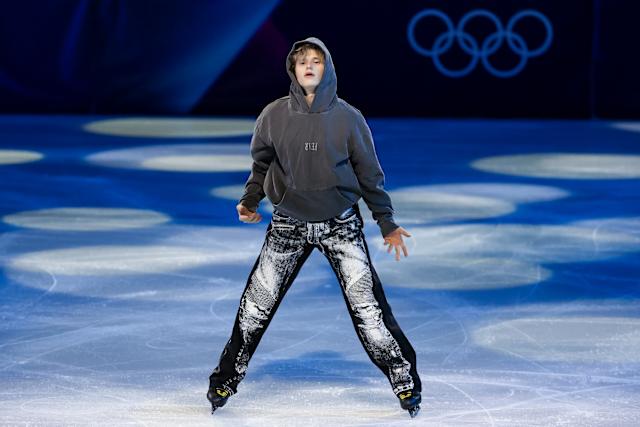
From a technical standpoint, the gala routine emphasized control and intention rather than risk. Malinin opened with a strong jump element, immediately establishing confidence, and continued with clean transitions that highlighted edge quality and musical timing. Without the burden of maximizing base value, he skated with noticeable freedom, allowing the choreography to breathe and the music to guide his pacing rather than racing through elements.
What stood out most was how deliberately the performance was structured. Certain movements mimicked the act of pushing away external noise, while others suggested moments of introspection and confrontation. While these gestures were not explicitly explained by Malinin during the skate, many observers connected them to the broader conversation around social media pressure, public scrutiny, and the psychological weight carried by elite athletes on the Olympic stage.
The audience reaction inside the Milano Ice Skating Arena reflected that connection. As the program built toward its climax, the crowd grew visibly more engaged, responding not just to successful elements but to the emotional arc of the routine. By the final moments, spectators rose to their feet, offering sustained applause that acknowledged the honesty of the performance rather than a numerical result.
Malinin also participated earlier in the evening as part of Team USA’s group exhibition number, where he included a signature backflip. The moment drew loud cheers, reminding fans of the athletic flair that has made him one of the sport’s most talked-about figures. In the gala setting, the move felt celebratory rather than controversial, framed as a crowd-pleasing highlight instead of a competitive statement.
Although he did not leave Milano Cortina with an individual medal, Malinin was still part of the United States team that captured gold in the team event earlier in the Games. That achievement ensured his Olympic experience was not defined solely by disappointment. The gala performance, coming after both the highs and lows of the competition, served as a reflection point rather than a conclusion.
Observers noted that Malinin appeared more relaxed during the gala than at any other moment of the Olympics. His skating carried a calm intensity, suggesting an athlete who had processed the emotional swing of expectations, setbacks, and pride. Without the pressure to prove anything in that moment, he allowed the performance to speak quietly and confidently on its own terms.
In the days following the gala, discussion around Malinin shifted. Instead of focusing solely on missed medals or technical errors, many conversations centered on growth, resilience, and the long view of his career. At just 21 years old, his willingness to confront disappointment publicly rather than hide from it resonated with fans and fellow athletes alike.
The exhibition did not rewrite the results of the men’s final, nor was it intended to. What it offered instead was context. It showed an athlete navigating one of the most challenging moments of his young career with composure and self-awareness, using the Olympic stage not for redemption, but for expression.
As the lights dimmed and the gala concluded, Malinin left the ice having delivered something rare: a performance that mattered without needing validation from judges. It stood as a reminder that the Olympic experience is not measured only in medals, but also in how athletes respond when outcomes fall short of dreams.
Looking ahead, Milano Cortina 2026 will likely be remembered as a formative chapter for Ilia Malinin rather than a defining endpoint. The exhibition gala did not signal defeat, nor did it promise revenge. It simply revealed an athlete still evolving, still learning, and very much still part of figure skating’s future.
In that sense, the gala performance achieved something lasting. It reframed disappointment as momentum, pressure as fuel, and silence as space to grow. Long after the scores fade from memory, the image of Malinin skating freely under the Olympic lights may endure as one of the most human moments of the Games.