Holy Wars… The Punishment Due In Calgary: Megadeth’s Classic Turns The Saddledome Into A Pressure Cooker
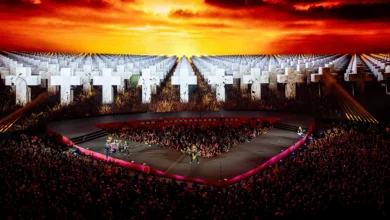
Megadeth have played “Holy Wars… The Punishment Due” for decades, but on February 20, 2026, in Calgary, it didn’t feel like a routine “final song, goodnight” moment. It felt like a statement. The Scotiabank Saddledome is the kind of arena that can swallow a band if the sound is muddy or the energy is even slightly off, yet this night had the opposite effect: the room behaved like a sealed chamber. You could sense it in the way the crowd saved a little extra in the tank, as if everyone knew that when that opening tension finally snapped into motion, the whole building would move as one. “Holy Wars” has always been built for that kind of collective release—part sermon, part street fight, part speed-run through thrash history—so Calgary was a perfect stage for it.
Context matters with Megadeth, because the song isn’t just “fast and hard.” It’s also incredibly precise. “Holy Wars” asks for machine timing without losing the sense of danger, like the track could derail at any moment but never does. That tightrope makes any live version a referendum on a band’s sharpness: if the picking blurs, the riff loses its teeth; if the drums don’t lock, the song stops sounding like a chase scene and starts sounding like a traffic jam. In Calgary, the performance carried that very specific “everything is under control, but it’s still a riot” vibe. The guitars stay articulate even when the tempo feels like it’s pushing the limits of human wrists, and the pauses land like traps snapping shut—silence used as a weapon.
The Saddledome crowd also brought a particular kind of Canadian arena intensity: loud, direct, and weirdly unified, like everyone agreed ahead of time that the chorus hits are non-negotiable. “Holy Wars” thrives on that because it’s structured like a sequence of detonations—sections that escalate, reset, then escalate again with even more heat. The song’s switches don’t confuse a crowd the way some progressive structures do; they hype people up because each turn feels like a new level in a boss fight. In Calgary, those shifts read clearly from the floor: heads snapping forward in the staccato parts, hands pumping in the bigger accents, and then that collective surge when the famous stop-start energy returns. It’s not just mosh fuel—it’s choreography for an entire arena.
What makes the Calgary take feel different is how “present tense” it sounds. A lot of veteran thrash bands can sound like a tribute to themselves, even when they’re good—solid execution, familiar cues, a respectful run through the classics. Calgary felt less like preservation and more like proof. The band plays the intro with that biting clarity that makes the riff feel like it’s carving space out of the air, and the transitions don’t sag. You can hear the discipline that comes from having played the song in every kind of room, then using that experience to lean into the sharpest edges instead of rounding them off. The result isn’t nostalgic. It’s immediate. It sounds like a song that still wants to start a fight in the parking lot after the show, not a museum piece with a label under it.
The venue itself adds to the drama. Arenas can blur fast music into a wash, but “Holy Wars” needs separation between the moving parts: the crunch of the rhythm, the punctuation of the drums, the way the riffs “speak.” Calgary’s room sound gives the track a big, metallic sheen, but the performance keeps it from becoming fog. That matters because “Holy Wars” is basically two songs welded together, and the second half has its own emotional gravity—less sprinting, more dread and propulsion. When the band hits that turn, the song stops feeling like pure velocity and starts feeling like a march through smoke. In Calgary, that pivot lands with a satisfying heaviness, like the whole room realizes the track isn’t just aggression—it’s tension, release, and then a darker kind of momentum.
There’s also a psychological layer to seeing “Holy Wars” placed as the payoff. Many Megadeth sets are built like an endurance run: deep cuts for the lifers, crowd-pleasers that keep the arena singing, and then the closer that feels like the roof is supposed to come off. That structure turns “Holy Wars” into more than a song—it becomes the final argument of the night. Calgary follows that logic perfectly. By the time the band reaches it, the crowd has already traveled through different eras and moods: the technical fireworks, the mid-tempo stomp, the sing-along hooks, the darker corners. So when “Holy Wars” begins, it feels like the band cashing in every ounce of attention they’ve earned for the last ninety minutes and converting it into pure kinetic force.
A good fan-shot video can capture something official cameras often miss: the way a crowd’s body language changes the instant a riff is recognized. That recognition is part of “Holy Wars” lore. It’s one of those intros that functions like a siren—people don’t need to “get ready,” they’re already moving. In Calgary, the fan perspective makes the performance feel like you’re standing inside the blast radius rather than watching a performance “at” you. You hear the room react in real time, you feel the little spikes in volume when the band hits a favorite turn, and you notice how the song’s tightness actually makes the chaos in the crowd look even wilder by contrast. The cleaner the band is, the more feral the floor becomes.
For longtime fans, this track is a measuring stick: a Megadeth show can be enjoyable without “Holy Wars,” but it rarely feels complete. In Calgary, it plays like a closer that refuses to coast. The riffs aren’t treated as nostalgia cues; they’re treated as sharp instruments. The tempo stays urgent, and the performance leans into the song’s personality—controlled aggression, abrupt pivots, and that feeling of sprinting through razor wire without getting cut. It’s the kind of version that reminds you why “Holy Wars” sits in that small club of metal songs that almost everyone—thrash diehards, casual rock listeners, even musicians who don’t like metal—recognizes as a masterpiece of arrangement and attitude.
Once you’ve absorbed the Calgary atmosphere, it becomes clearer why “Holy Wars” has remained so untouchable: it’s not just speed, it’s architecture. The riffing is packed with personality, the phrasing is tight enough to feel like coded language, and the structure keeps flipping the emotional temperature without losing momentum. That’s why live versions can feel so thrilling—every performance is a test of whether the band can keep that architecture standing while the room shakes. Calgary passes that test by sounding both crisp and dangerous, a combination that’s rarer than people think. It’s also why comparing the live take to the original studio recording is so satisfying: the studio version is a blueprint with perfect angles; the live version is the same building during an earthquake, still standing.
The studio track has an almost surgical cleanliness—every pick stroke feels etched, every shift is placed like a trapdoor exactly where it needs to be. What Calgary adds is friction. The guitars feel a little more abrasive, the accents hit like blunt objects, and the crowd’s reaction becomes a kind of extra percussion living around the music. The contrast highlights the song’s genius: it can survive different textures without losing its identity. You can make it pristine and it sounds like a technical manifesto; you can make it raw and it sounds like a street-level riot with a brain. Calgary sits in the sweet spot where it still feels disciplined, but the edges are alive. That blend is what makes the performance feel like a current event rather than a replay of history.
Looking back at older live-era performances shows how “Holy Wars” has evolved without changing its DNA. Early-’90s versions often feel like pure speed with an almost reckless grin—less “arena spectacle,” more “we’re trying to break the sound barrier.” That older energy is fascinating because it’s closer to the era when the song was still fresh, still a statement of intent, still a threat. Comparing that to Calgary is like comparing a wildfire to a controlled burn that somehow still scares you. Calgary has more weight and a broader, bigger-room authority, but it doesn’t lose the essential nerve of the song. It keeps that sense that the music is always one inch away from tipping into total chaos, which is exactly the sensation that made Megadeth feel dangerous in the first place.
By the time you hit later-era festival performances, the song takes on another dimension: it becomes a communal anthem for tens of thousands of people who might not know every deep cut, but they know this. Those big-event versions tend to amplify the “everyone knows what’s coming” effect—the whole crowd bracing for the hits, reacting like a single organism. Calgary isn’t a festival field, but it borrows that same communal electricity because the Saddledome is packed and attentive, and the song is saved as a climactic payoff. The difference is that an arena gives you a more concentrated pressure, like the sound and heat have nowhere to escape. That’s why Calgary feels so intense: it’s the festival-style roar compressed into a sealed dome, with the band’s precision acting like the blade that keeps cutting through it.
The more you compare, the more Calgary stands out as a “tight-but-hot” performance—less about novelty, more about authority. Some live versions win because they’re messy and wild. Others win because they’re technically flawless. Calgary’s strength is that it manages to feel organized while still feeling like it could explode. That’s an ideal match for “Holy Wars,” a song that’s basically organized violence set to music: complex, disciplined, and absolutely unrelenting. When the final hits land and the song resolves, it doesn’t feel like an ending so much as a release valve finally opening. That’s the signature of a great closer—leaving the room lighter, louder, and slightly stunned that the band can still turn an old classic into something that feels like it’s happening right now.