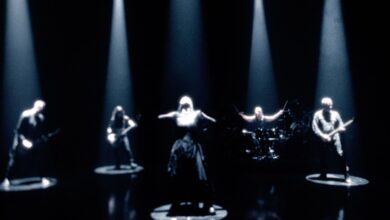
Megadeth Unleashed Pure Fury with a Razor-Sharp “Angry Again” at Winnipeg’s Canada Life Centre 2026
On February 25, 2026, Megadeth walked into Winnipeg’s Canada Life Centre with that particular “final-run” electricity in the air—the kind where fans aren’t just excited, they’re hyper-aware they might be witnessing the last chapter being written in real time. The night’s pacing mattered, too: instead of easing in with a slow build, the set (as reported by multiple concert listings and set trackers) hit fast, and “Angry Again” arrived almost immediately, right after the opener. That placement is part of what made the Winnipeg take feel different: “Angry Again” didn’t show up as a nostalgic mid-set bonus. It came as a statement—tight, early, and hungry—like the band wanted the room to lock in right now, not later.
“Angry Again” has always been a bit of a beautiful oddball in the Megadeth universe: not one of the standard radio overplays, but not a deep cut either—more like a secret handshake between eras. It carries the bite of classic Mustaine phrasing, yet it’s built to sprint: compact structure, quick hook, and that riff that feels like a clenched jaw snapping shut. In Winnipeg, that sprint quality becomes the whole identity of the moment. When a song is dropped this early in a set, there’s no “we’re warmed up” cushion and no “we’ve already won them over” safety net. It’s basically the band telling you, “Here’s the blade. Let’s see if it still cuts.” And in this room, it did—sharp enough to reset the energy in under four minutes.
One reason the Winnipeg version stands out is how it benefits from the modern Megadeth live machine: the rhythm section is built for clarity and impact, and “Angry Again” thrives when every palm-muted chug and every stop-start accent lands like a door slam. That’s where the Canada Life Centre setting matters. Arenas don’t always flatter fast thrash-adjacent material—sound can smear, and the attack can turn into a blur. But when the mix cooperates, arenas make a song like this feel physically larger than it is on record: the riff becomes a wave, the snare cracks like a flashbulb, and the chorus feels like it’s being shouted back from the rafters. Winnipeg’s version plays like the “big room” translation of a track that was originally built to be lean and nasty.
And then there’s Mustaine’s presence—still the same angular DNA, but with the seasoned control of someone who doesn’t need to prove volume equals power. On a farewell-era run, the temptation is to over-emote everything, to lean into sentimentality, to sell nostalgia like a souvenir. “Angry Again” refuses that treatment. It’s too impatient, too sarcastic, too quick to snarl. In Winnipeg, that’s exactly the charm: it doesn’t feel like a “remember this?” moment. It feels like “we still own this.” The phrasing comes out with that half-sneer, half-precision that only Mustaine does, and the band behind him plays it like a dare—fast enough to feel dangerous, controlled enough to feel elite.
If you look at the set context from the night, “Angry Again” also works as a bridge between what Megadeth was and what the farewell-era set wants to emphasize. Reported setlists for the show point to a heavy run of staples and crowd detonators—material that turns arenas into mass singalongs and synchronized headbanging. “Angry Again” sits in a sweet spot between “classic” and “curveball,” and that’s why it’s so effective in slot two. You get the opener’s adrenaline, then you get “Angry Again” as a quick left hook—something that longtime fans love because it’s slightly off the obvious path, but casual fans still recognize once the riff hits. It’s a smart piece of set architecture.
What really makes the Winnipeg performance feel distinct, though, is the way it comes off in fan-shot footage culture—how people actually experience and replay shows now. The best fan videos don’t just document; they translate atmosphere: the crowd roar swelling before the riff, the camera shaking when the chorus hits, the moment the whole floor seems to move as one organism. Winnipeg is especially ripe for that because it’s a Canadian stop on a run that’s being followed obsessively, with fans comparing nights like sports highlights. In that environment, “Angry Again” becomes a measuring stick: if it’s tight, the whole show is tight. If it bites, the band is biting. Winnipeg’s version reads as bite-first—fast, direct, and locked in.
Another layer is the band’s broader 2026 storyline hovering over everything. Multiple outlets have framed 2026 as a “final run” period for Megadeth, and even when a specific show doesn’t pause to talk about it, the crowd is thinking it. That changes the emotional temperature of songs that otherwise aren’t “farewell songs.” “Angry Again” isn’t sentimental—it’s confrontational. So when it lands in a context where people are feeling end-of-era emotions, it creates an interesting clash: a room full of fans carrying nostalgia and gratitude, and a song that basically spits, “I’m not here to cry with you.” That tension is part of the magic. It keeps the night from turning soft.
Musically, “Angry Again” is also a showcase for how Megadeth can sound both old-school and modern at the same time. The riffing is classic, but the tightness is very 2020s metal: clean transitions, consistent tempo, and that sense of a band that’s played arenas enough to understand exactly how to make each section pop. In Winnipeg, the performance feels like a distilled version of Megadeth’s live identity: precision with teeth. There’s no wasted motion. The chorus doesn’t linger. The song arrives, hits, and vanishes—leaving the crowd buzzing like they just watched a perfectly executed heist.
It also helps that “Angry Again” is short enough to function as a shock grenade early in a set. Long songs can be spectacular, but short songs can be brutal in a different way: they don’t give you time to settle in. In Winnipeg, you get that sense of the band grabbing the night by the collar and refusing to loosen their grip. And because it’s early, it changes what comes after: the crowd is already fully activated, already shouting, already moving, already locked to the band’s pulse. That makes the rest of the set feel like it’s starting at a higher altitude than usual. “Angry Again” isn’t the climax—it’s the ignition.
There’s a reason fans keep circling back to performances like this when they talk about “best nights”: the song choice is familiar enough to feel communal, but specific enough to feel personal. Not everyone in the arena came specifically for “Angry Again,” but a lot of people who love Megadeth in a deeper way did. So when it hits and hits hard, it creates that split-second feeling of being seen—like the band is nodding at the lifers in the crowd. Winnipeg gets that nod early, before anyone’s voice is blown out, before the night turns into a blur. It’s a small detail that ends up feeling like a gift.
Once you jump from the Winnipeg performance back to the original studio cut, the contrast makes the live version feel even more alive. The studio track has that classic mid-’90s tightness—clean edges, a controlled snarl, and a mix that keeps everything in its lane. Live, Winnipeg turns it into something bigger and rougher in the best way: the riff sounds more physical, the drums feel more like impact than texture, and the vocal phrasing comes off more like a taunt thrown into a crowd than a line delivered into a mic. That’s not “better or worse”—it’s the point of a great live performance. It’s the song stepping out of the recording booth and into a room full of noise, heat, and adrenaline, becoming less of a track and more of an event.
To understand why Winnipeg’s “Angry Again” feels like it belongs in the “great live moments” conversation, it helps to look back at how the song behaved onstage in earlier eras—when the band was a different animal, the rooms were different, and the culture around live footage wasn’t what it is now. In the mid-’90s, “Angry Again” had that youthful snap: it’s played with the urgency of a band still proving its speed, still sharpening its identity after the big genre shifts of the era. Watching an earlier live rendition puts the Winnipeg version in perspective: modern Megadeth doesn’t chase chaos; it weaponizes control. Where the old versions can feel like a sprint with elbows out, Winnipeg feels like a sprint on rails—dead-straight, fast, and confident.
By the time you hit the Woodstock ’99 era, “Angry Again” carries a different kind of weight: it’s not just a song, it’s part of a massive cultural snapshot—huge crowd energy, festival-scale intensity, and that late-’90s heaviness where everything feels louder, brasher, and more combustible. Woodstock performances often have this “pressure cooker” vibe, and “Angry Again” fits because it’s direct and punchy—it doesn’t need atmosphere, it creates it. Comparing Woodstock to Winnipeg is fascinating because you see two different ways the song can dominate: Woodstock overwhelms through sheer scale and chaos; Winnipeg overwhelms through tightness and authority. Same track, two very different kinds of power.
Then the Rude Awakening era shows another evolution: “Angry Again” becoming part of a more polished live presentation, where the band’s set is designed like a machine—sequenced for maximum impact, performed with consistency, and delivered with that “this is what we do” professionalism. This matters because Winnipeg’s 2026 performance feels like a descendant of that mindset, but with extra bite from the farewell-era context. Rude Awakening captures a band proving they can be devastating and controlled; Winnipeg captures a band that already knows that—and is now doing it with the urgency of a clock ticking in the background. The song becomes less “showcase” and more “statement,” which is why it lands so hard.
Modern festival footage—like the 2022-era performances—shows how “Angry Again” thrives in the contemporary metal ecosystem: tighter tempos, clearer guitar tones, and crowds that respond instantly because the song is practically built for call-and-response energy. This is where Winnipeg’s version slots in naturally. It doesn’t feel like a throwback. It feels current—like a track that still makes sense next to modern metal production and modern live expectations. That matters because not every legacy band can make a ’90s track feel present tense. “Angry Again” can, and Winnipeg proves it by making the song sound like it belongs in the now, not just in the archive.
And if you want a clean “same-year” comparison that reinforces why the Winnipeg take feels special, checking another 2026 performance shows how small differences—tempo feel, crowd volume, camera angle, room acoustics—can totally change the personality of the song. One night it sounds surgical; another night it sounds feral. Winnipeg leans toward the former without losing the latter: it’s controlled enough to be crushing, but still carries that nasty edge that makes the track worth playing at all. That’s the sweet spot. It’s the version where the band doesn’t just perform the song—they drive it like they stole it, and they do it early in the set when it matters most.
By the time the night at Canada Life Centre moves on to the bigger “arena anthem” staples, “Angry Again” has already done its job: it’s set the tone, sharpened the crowd, and reminded everyone that Megadeth’s best moments are often the ones that hit fast and leave a mark. Winnipeg’s 2026 run-through stands out because it treats the song like a weapon, not a museum piece—dropped early, played tight, and framed by a room that’s fully aware this era is finite. In a farewell-season atmosphere, that combination is rare: a song that refuses sentimentality, delivered with maximum discipline, in front of fans who are feeling everything anyway. That collision—cold precision versus hot emotion—is what makes the moment stick.