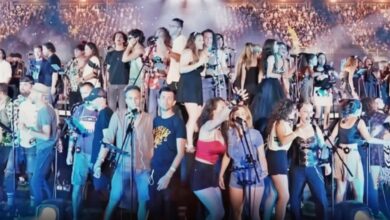
Megadeth’s “Tornado Of Souls” Live In London, Ontario On February 28, 2026 Becomes A Masterclass In Controlled Chaos
Megadeth have plenty of songs that can start a riot with one riff, but “Tornado of Souls” is different because it feels like a storm you can’t quite predict even when you know every turn. On February 28, 2026 in London, Ontario, the song hit the set like a jolt of voltage that made the entire room tighten its grip on the moment. The opening progression arrives with that unmistakable Rust in Peace-era tension, and suddenly everything feels sharper: the guitars slice instead of simply roar, the rhythm section drives like a machine with a human heartbeat, and the crowd reacts like they’ve been waiting all night for this exact trigger. It isn’t just heavy. It’s urgent, bright, and dangerous in the best way.
What makes “Tornado of Souls” such a live litmus test is that it demands two opposite qualities at the same time: precision and abandon. Play it too clean and it can feel clinical, like a museum exhibit of a classic. Play it too wild and the whole thing can smear into noise, because the song’s power is in its shape and its relentless forward motion. The London 2026 performance lands in that sweet spot where you can hear every key part, but it still feels like the band is barely holding onto the wind. That’s why people talk about this track with the same tone they use for legendary sports highlights: it’s not only about the notes, it’s about surviving the moment with style.
The atmosphere in London that night reportedly had the kind of charged impatience that big-name metal packages create, where the crowd is already loud before the headliner even touches the stage. “Tornado of Souls” turns that energy into something focused. Instead of scattered yelling, you get synchronized movement: heads snapping in time, fists punching the air on the accents, a pit that doesn’t just open but spins with purpose. This is where Megadeth’s identity shines. The band’s brand of intensity isn’t only about volume; it’s about momentum, about pushing a song forward like it’s being pulled by a force you can’t see. London felt like a room getting swept up and happily dragged along.
A big reason this performance stands out is the way the song’s mood changes live. On record, “Tornado of Souls” has an icy clarity, like a threat delivered with perfect diction. Live, especially in a venue full of people who know exactly what’s coming, it becomes a communal sprint. The riffs that sound surgical in the studio become physical, like they’re designed to move bodies first and impress musicians second. London’s crowd response matters because it reveals the song’s true role in the set: not just a fan favorite, but a turning point where the show’s energy becomes more intense and more unified at the same time.
It’s also a reminder of how rare it is for a metal song to be both technically revered and emotionally addictive. People love “Tornado of Souls” for the musicianship, sure, but they also love it because it carries a kind of dramatic tension that never turns theatrical. The lyrics and melodic contour feel stormy without being melodramatic, and the riffs have that sensation of racing forward while something heavy is chasing you. In London, that dramatic feeling becomes amplified because the crowd brings their own story to it. For some, it’s the song that made them fall in love with thrash. For others, it’s the benchmark track they measure every live show against.
London 2026 also benefits from the reality that Megadeth are a band built for sharp corners. This isn’t stadium rock where the goal is to smooth everything out into one big singalong wave. Megadeth thrive on angles, quick shifts, tight turns, and that feeling of controlled danger. “Tornado of Souls” is basically a blueprint for that approach, which is why it hits so hard when it’s executed with confidence. The band’s rhythm attack keeps the song from sagging, while the lead lines add that electric tension that makes the whole thing feel like it could accelerate at any second. It’s a performance style that doesn’t ask for attention; it takes it.
Even before the famous solo arrives, “Tornado of Souls” creates this specific kind of anticipation that you can almost hear in the crowd. People don’t just react to what’s happening; they react to what they know is coming. That anticipation is part of why the song goes viral whenever a great live clip appears. The build is real, the payoff is real, and the audience behaves like they’re watching a high-wire act. London’s version reportedly carried that same high-wire feeling: the band pushing forward, the crowd pushing back, and everyone in the room leaning into the tension together. It’s not nostalgia. It’s adrenaline with history attached.
There’s also something symbolic about this song showing up on a 2026 date: it’s proof that the Rust in Peace material isn’t just “classic,” it’s still competitive. A lot of older songs survive as legacy moments. “Tornado of Souls” survives as an active weapon. It still sounds modern because it was built with a kind of structural intelligence that never aged out: riffs that are memorable without being simple, rhythm that’s aggressive without being sloppy, and a sense of drama that doesn’t rely on production tricks. In London, that durability becomes visible in the best possible way: you don’t have to explain why it’s great, you just watch the room react.
The fan-shot angle is where the London performance becomes more than a “good rendition” and starts feeling like a captured event. You can sense the venue’s air change as the song locks in, that shift from general concert noise to focused intensity. The crowd isn’t politely observing musicianship; they’re participating in it, moving with the riffs and anticipating each turn like it’s a shared map. What’s especially telling in moments like this is how the room responds when the song tightens its grip: the cheers aren’t random, they spike at the exact places fans have internalized. That’s the signature of a track that lives in people’s bodies, not just their playlists.
Hearing the studio version right after the London clip is like stepping from a storm into a control room where every instrument is lit up in clean lines. The recording’s clarity makes it obvious why the song became sacred to guitar players and thrash fans alike: everything is carved with intent, every shift feels purposeful, and the tension never drops. But it also highlights what live performance adds. The studio track feels like a perfectly engineered machine. The London performance feels like that machine getting fed crowd electricity and transforming into something wilder. The difference isn’t “better or worse,” it’s texture. The record is the blueprint; the show is the building shaking.
Dropping into an older live era shows how “Tornado of Souls” has carried different personalities across decades while staying unmistakably itself. Earlier performances often have that raw, hungry edge where the band sounds like it’s sprinting on pure nerve, and the crowd energy can feel less curated and more combustible. That contrast makes London 2026 even more impressive, because it shows what experience adds without dulling the threat. London isn’t the scrappy version; it’s the confident version, where the band knows exactly how to shape the song’s drama and how to ride the crowd’s anticipation. Watching the evolution is part of the fun: the same storm, different weather systems.
The Budokan-era clip carries a special kind of significance because it taps directly into the mythology of this song in the public imagination. “Tornado of Souls” is one of those tracks that fans talk about with almost reverent detail, and any modern performance that connects with the classic-era aura tends to get amplified fast. Seeing the song delivered in a high-profile setting highlights how universal its impact is: it doesn’t need a small club to feel intense, and it doesn’t lose its bite on a bigger stage. When you place that next to London 2026, you start to see why London stands out: it has the intimacy of a closer room with the confidence of a band that’s played the world.
More recent live clips from the mid-2020s show how the song has become a consistent centerpiece that fans measure nights by. The structure is familiar, but the personality changes with the crowd, the room, and the band’s momentum that evening. That’s the key to why London 2026 can feel like its own story: even when the notes are the notes, the atmosphere is never identical. Some nights feel more aggressive, some feel more triumphant, some feel tighter, some feel more chaotic. London’s reputation, based on how fans describe nights like this, comes from the combination of tension and release: the room hangs on the build, then erupts as if everyone crossed the finish line together.
What ultimately makes “Tornado of Souls” in London on February 28, 2026 worth writing about is that it’s a reminder of what great live metal actually is. It’s not perfection for perfection’s sake. It’s risk, executed with enough skill that the risk feels thrilling instead of messy. The song invites obsession because it balances speed, drama, and that sharp Megadeth identity in one package, and a strong live take turns that package into a moment people claim as their own. London got a version that felt like a storm with a steering wheel: fast enough to scare you, controlled enough to make you trust it, and loud enough to feel like it rewired your heartbeat for a few minutes.