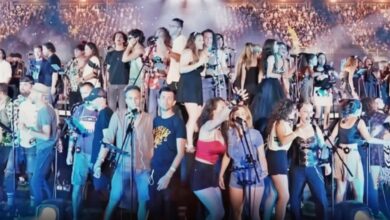
Megadeth Detonate “Holy Wars… The Punishment Due” In London, Ontario On Feb 28, 2026 With A Set-Defining Thrash Storm
Megadeth have plenty of songs that can whip a crowd into chaos, but “Holy Wars… The Punishment Due” is the one that feels like a gate swinging open into their entire worldview. In London, Ontario on February 28, 2026, that opening riff didn’t simply start a song—it snapped the whole room into a single, fast-moving organism. The track’s design is ruthless: it hits hard, turns on a dime, and never lets the tension drain out. Live, it feels even sharper, because every pause and accent becomes a cue the audience already knows by heart. In a set filled with heavy artillery, “Holy Wars” still lands like the centerpiece, the one people circle afterward when they talk about what made the night feel dangerous in the best way.
What makes the London performance matter is the timing and the context. This was a modern-era Megadeth show on a big winter run, the kind of tour where crowds arrive already warmed up and ready to explode the second the headliner offers a reason. London’s venue energy had that “any second now” impatience—people packed in, phones hovering, friends leaning close so they can yell over the pre-show noise. When “Holy Wars” starts, it instantly reorganizes that chaos into focus. You can feel how the crowd reaction changes from general excitement to a targeted surge, as if everyone decided simultaneously that this is the moment to give everything they have left.
There’s a specific kind of thrill in hearing “Holy Wars” live because it isn’t just fast—it’s structured speed, like a machine that can still bite you. The riffs are aggressive but precise, the rhythm section drives like it’s pulling the whole band forward by a chain, and the vocal phrasing punches through with that clipped urgency that makes the lyrics feel like warnings rather than poetry. London got the song delivered with intent, not routine. That matters with a classic, because classics can become comfortable if a band treats them like a guaranteed applause line. The best nights are when the band plays it like it still needs to be proved, and the crowd responds like they’ve been waiting years to prove something too.
One reason “Holy Wars” has such a long afterlife is that it contains multiple moods without ever losing momentum. It’s not a straight-line thrash sprint; it’s a controlled storm with a mid-song shift that feels like the ground changing under your feet. On the Rust in Peace version, the song runs about 6 and a half minutes, and in that time it manages to feel like a full narrative rather than a single riff repeated. In London, that shape becomes physical. You don’t just hear the transition—you feel it in the way the pit changes speed, in the way the crowd’s shouting becomes more rhythmic, in the way the room seems to “lock” into the second half with a different kind of weight.
The most satisfying Megadeth live moments often come from the band’s ability to keep things tight without sanding off the danger. “Holy Wars” demands that balance more than almost anything else in their catalog, because the riffs are so recognizable that any looseness stands out immediately. London’s performance hits hard when the band keeps the edges sharp but the groove intact. That’s where the song becomes a masterclass instead of a nostalgia clip. You can sense the discipline underneath the aggression—the way the drums guide the turns, the way the guitars snap together on the stops, the way the whole band hits those signature accents as if they’re dropping heavy doors in perfect sync.
Crowd psychology is half the reason this track feels monumental live. “Holy Wars” is one of those songs where fans don’t just sing along—they anticipate. They react to what’s coming, not only what’s happening. That anticipation builds a pressure inside the venue, like everyone is holding their breath for the next corner. In London, that pressure turns into release in waves: the opening charge, the chant-like moments where the whole room shouts a phrase at once, then the heavier section where the song feels like it’s stomping instead of sprinting. When the audience is fully with the band, the track stops feeling like a performance and starts feeling like a shared ritual.
Another detail that makes the London version stand out is how “Holy Wars” functions as a statement of identity in a modern set. Megadeth can fill a night with giant crowd-pleasers, and the audience would still leave happy. But “Holy Wars” is more than a crowd-pleaser—it’s a mission statement: complicated, confrontational, and built with a kind of musical intelligence that still feels competitive decades later. That’s why the song never ages into the background. It insists on being the focal point. In London, it doesn’t come across like “the old classic the band has to play.” It comes across like the band reminding everyone, in real time, exactly why they sit at the top of this genre.
The London performance also carries a modern edge because of the way current audiences consume live music. A single clip can race across feeds in minutes, but only certain songs consistently trigger that “rewatch” effect. “Holy Wars” has it, because it packs multiple climaxes into one track. The shifts create natural moments people want to clip, and the intensity creates natural moments people want to relive. London 2026 fits that pattern: a big night, a big crowd, a song with an instantly recognizable opening, and a structure that keeps escalating. When all of that clicks, the result isn’t just “a good performance.” It becomes the performance people point to when they want to describe what the whole night felt like.
Fan-shot footage captures the real temperature of “Holy Wars” in a way polished pro audio rarely does, because it keeps the crowd inside the frame of the song. In London, the most striking element is how quickly the room shifts from excitement to full commitment the moment the riff starts. You hear the audience not as background noise, but as a living layer that rises at the exact points everyone already knows. That’s the signature of a true anthem in heavy music: the crowd doesn’t wait to be invited, they arrive pre-programmed. The clip also preserves the physicality of the night—how the energy spikes, how the space tightens, how the sound of thousands reacting at once turns the song into something bigger than the band alone.
The official video version is the blueprint, and revisiting it after the London clip makes the song’s architecture feel almost unreal. The studio-era clarity shows how deliberately everything is placed—the sharp attack of the opening, the way the riffs interlock, the dramatic pivot into the heavier “Punishment Due” segment, and the sense that the song is constantly climbing even when it’s already at full speed. What’s fascinating is how little the track relies on tricks. It doesn’t need a giant pop chorus or a simplified structure to be memorable; it’s memorable because it’s built with conviction and tension. That’s why live versions like London work so well: they don’t replace the original, they activate it.
The 1992 Hammersmith performance is one of the clearest windows into the song’s early live personality, when it still carried that raw, slightly dangerous edge of a band proving itself night after night. Watching that era alongside London highlights what experience adds without muting the threat. Older performances can feel more combustible, like everything is running on nerve. Modern performances often feel more controlled, like the band knows exactly how to pace the impact. “Holy Wars” benefits from both approaches. In London, the song can feel like a perfected weapon. In 1992, it can feel like a weapon still hot from the forge. Both are thrilling for different reasons, and that’s why comparisons are so addictive.
The 2005 Buenos Aires version carries a different kind of intensity: the pressure of a massive crowd that treats the song like a national anthem. This performance helps explain why “Holy Wars” is such a reliable peak moment across continents and decades. When the audience is that loud and that unified, the track becomes communal in a way that’s bigger than any one venue. Placing it next to London 2026 is revealing because it shows what changes and what doesn’t. The riffs still demand precision. The transitions still feel dramatic. The chorus-like shout moments still hit like signals the crowd understands instantly. What changes is the room’s personality—Buenos Aires feels like a tidal wave, London feels like a storm in a tighter space.
The Wacken 2017 performance adds the festival-scale perspective, where “Holy Wars” has to cut through open-air space and still feel like a controlled detonation. Big festivals can sometimes flatten nuance, but this track survives because its opening is so commanding and its structure creates multiple impact points. Comparing Wacken to London is a great way to understand why London feels special: a closer venue can make the song feel more immediate, more physical, more like it’s happening right on top of you. Festival versions feel triumphant and huge, while nights like London can feel intimate and dangerous at the same time. When a song holds its power in both settings, that’s not nostalgia—that’s durability.
What ultimately makes “Holy Wars” in London on February 28, 2026 worth writing about is that it captures the core truth of Megadeth live: the band’s heaviness comes from precision under pressure. This isn’t music that floats; it hits. The riffs are shaped like blades, the rhythm is shaped like a chase, and the dynamics are shaped like a trap closing in stages. When it’s performed well, the song feels like a story told at high speed without losing clarity. London’s version carries that high-wire feeling that fans crave: the sense that the band is sprinting through sharp corners and landing every turn. That’s why people walk out calling it the highlight—it doesn’t just entertain, it electrifies.
There’s also a special satisfaction in hearing a legendary track hit perfectly on a night when the crowd is clearly ready to give it back. “Holy Wars” is one of those songs that rewards audience knowledge. The more familiar the room is with its twists, the stronger the room reacts, and the stronger the band plays, and it becomes a feedback loop of intensity. London fits that loop. You can feel the crowd’s anticipation pushing the performance forward, and you can feel the band feeding on that push, turning the song into a statement rather than a routine. That’s the difference between “they played it” and “they owned the moment.”
The song’s mid-section shift also tends to separate ordinary nights from unforgettable ones, because it requires the room to change gears emotionally. Some crowds only know how to react to speed. Great crowds react to weight too. In London, the heavier “Punishment Due” portion can feel like the moment the room collectively digs its heels in and stomps instead of runs. That contrast—sprint into stomp, fury into menace—creates the kind of drama that makes a live clip feel like a full event rather than a single riff. When that transition lands cleanly, it’s one of the most satisfying turns in thrash history, and it’s exactly the kind of moment fans replay until they can feel it again.
And then there’s the simple, undeniable reason this track keeps winning live: it’s built to make people move. “Holy Wars” doesn’t politely invite energy; it demands it. Even in 2026, even after decades of heavy music evolution, the song still sounds urgent. It still sounds like it’s pushing forward with a purpose. London’s performance is another example of why certain songs never become “old.” They become permanent. They survive because they create a reaction that feels immediate and physical, and when a room full of fans responds like London did, the performance stops being a date on a tour schedule and becomes a memory people carry like a badge.