Natalie Colavito Ignites The Voice Australia Stage With Explosive “Whole Lotta Love” Duet With Adam Lambert
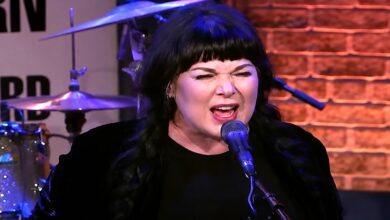
Natalie Colavito’s blind audition on The Voice Australia felt less like a standard reality-show introduction and more like the kind of lightning strike that can change a singer’s entire public identity in a matter of minutes. By choosing Led Zeppelin’s “Whole Lotta Love,” she walked straight into one of rock’s most intimidating songs, a track so deeply associated with swagger, danger, and impossible vocal confidence that most singers would never dare touch it on a blind audition stage. That alone made the moment unusual. What made it memorable was the way she attacked it without hesitation, turning a familiar television format into something far more unruly and exciting. Instead of playing it safe, she arrived with the energy of someone determined to force the room to react, and that is exactly what happened.
The Voice is built on suspense, on those few seconds when a coach decides whether a voice is strong enough to make them hit the button, but Colavito’s performance scrambled that formula by making the audition itself the headline. In the 2024 blind auditions, with Adam Lambert joining a diverse panel of coaches, the show already had an unusually eclectic mix of musical instincts in the chairs. That mattered, because Natalie was not singing a polite crossover ballad or an expected pop standard. She was charging into a blues-hard-rock classic with enough grit to demand attention from judges who each hear power very differently. The result was a performance that became notable not merely because chairs turned, but because it broke the usual distance between coach and contestant.
Part of the thrill came from the song itself. “Whole Lotta Love” is not just a hit; it is one of rock’s signature detonations, a piece of music that still sounds dangerous decades after its release. Built around one of the most recognizable riffs ever written, it leaves very little room for a timid singer. The vocalist has to dominate the track or disappear inside it. Colavito understood that instinctively. She did not approach the number as a museum piece or as an excuse for vocal acrobatics alone. She sang it like a live-wire challenge, leaning into the song’s attitude while also adapting it to the television environment, where every glance, pause, and breath has to reach both the studio audience and the cameras. That balance between control and abandon gave the performance its edge.
What made the audition stand out even more was its refusal to behave like a nostalgia exercise. Plenty of singers turn to classic rock on talent shows, but they often do it in a way that feels reverent and neatly packaged, almost as if they are asking permission to borrow greatness for two minutes. Colavito’s version pushed in the opposite direction. She treated the song as current, alive, and combustible, which is exactly why the performance resonated beyond older fans who already knew the track inside out. The audition suggested that a younger singer could still seize a canonical rock anthem and make it feel like an event rather than a history lesson. That is a big reason the clip traveled so well online and why viewers responded to it as a discovery moment instead of just another cover.
Then came the twist that turned a strong audition into a genuinely viral set piece. Adam Lambert, who had already established himself as one of the most theatrically fearless and rock-fluent judges in the lineup, did not simply praise the performance from his chair. He ended up joining Colavito on stage for an impromptu duet, creating the rare kind of coaching moment that viewers immediately replay and share. That physical leap from judge to participant changed the emotional temperature of the room. Suddenly the audition was no longer about whether Natalie could survive the format. It was about whether the format itself could contain the amount of energy spilling out of the stage. For a few minutes, it could not.
Lambert’s involvement mattered for more than spectacle. He has spent years building a reputation as a singer who can move between glam, classic rock, pop drama, and arena-sized theatricality without losing his identity, so his response to Colavito’s performance functioned almost like an endorsement from inside the genre she had chosen to challenge. He was not reacting as a generic television judge searching for ratings bait. He was reacting as a vocalist with deep rock instincts, someone who recognized that she had walked into dangerous material and made it feel natural. The duet gave viewers something talent shows rarely deliver convincingly: a spontaneous exchange that felt rooted in shared musical excitement rather than producer-scripted sentiment.
The staging of the moment also tells an interesting story about why it landed so strongly. Blind auditions usually depend on isolation. The contestant stands alone, the judges sit apart, and the tension comes from separation. When Lambert joined her, that entire structure briefly collapsed. The wall between evaluation and performance disappeared, and the scene became collaborative instead of competitive. Viewers love those moments because they reveal something more human than strategy. A coach stops being a critic and becomes a fan in real time. Colavito benefited from that shift, of course, but the performance also benefited because it became bigger than a reality-show checkpoint.
There is also a larger reason this audition mattered: rock songs do not always get treated as prime currency in modern television singing competitions, especially when producers know that safer contemporary hits can be more instantly legible to broad audiences. A performance like Colavito’s pushes back against that assumption. It reminds audiences that when rock is delivered with conviction, it still has enormous television power. More importantly, it proves that the genre can still create communal excitement on a mainstream platform rather than existing only as a heritage product for specialists.
Watching the performance now, what remains striking is how naturally Colavito occupies the song’s swagger without turning it into impersonation. That is one of the hardest things about covering Led Zeppelin. Too much imitation and the performance feels trapped by Robert Plant’s shadow; too much reinvention and the song can lose the raw intensity that made it famous in the first place. Colavito threads that line impressively. She keeps the attack and the attitude but brings a different tonal shape, one that reads less like vintage blues-rock posturing and more like modern power singing with a theatrical edge.
Returning to the original “Whole Lotta Love” only makes the achievement clearer. The track remains a masterclass in tension and release, from its colossal riff to its explosive vocal delivery. It is one of those recordings that seems to announce an entire worldview within seconds. That is precisely why covering it on a show like The Voice is such a gamble. You are not just covering a song; you are stepping into one of rock’s most imposing mythologies. Colavito’s audition worked because she did not try to out-history the original. Instead, she borrowed the song’s danger and translated it into an audition room.
The official live performances of the song in its early years show the blueprint that almost every later singer must wrestle with: looseness, menace, groove, and a constant sense that the band is pushing the song forward rather than simply replaying it. That older live approach is useful for understanding why Natalie’s audition felt authentic despite happening in a tightly produced TV format. She was clearly not trying to make the song neat. She was trying to make it surge.
Adam Lambert’s own history with the song adds another fascinating layer to the story. Long before he was judging contestants on Australian television, he had already demonstrated a natural affinity for songs that demand high drama, rock aggression, and fearless upper-register commitment. His earlier performances of the track show why he responded so quickly to Colavito’s choice. He knows exactly how much nerve the song requires, and he also understands that it rewards singers who commit fully.
That is also why the duet landed as more than a novelty. Lambert has spent years fronting one of rock’s most legendary bands on tour, and that experience has sharpened his ability to meet giant material head-on without looking overwhelmed by legacy. When he met Colavito inside the song, the scene briefly resembled a passing of confidence rather than a passing of torch. He was not diminishing her by entering the frame; he was effectively validating the scale of the performance.
What lingers most is the sense of possibility the audition opened up. The Voice often thrives on emotional backstories and technical skill, but moments that genuinely alter the atmosphere are much rarer. Colavito’s audition did that because it combined several pleasures at once: the thrill of hearing a difficult classic attacked without fear, the surprise of seeing a judge cross the boundary into performance, and the larger cultural satisfaction of watching rock still generate real excitement on a mainstream platform.
There is an old temptation to describe breakout TV auditions as “star-making” and leave it at that, but this one was more interesting than the cliché. What made the clip spread was not just that Natalie Colavito could sing, but that she understood the theatrical mathematics of rock performance: choose a song with danger, commit fully, and make people feel that anything could happen next. Then something did happen next, and that is why the moment still resonates.