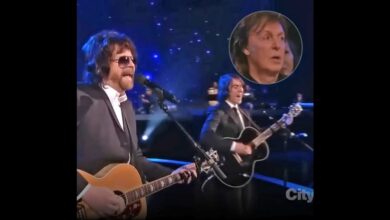
Queen, Beatles Legends Unite At Party At The Palace 2002 In A Once-In-A-Lifetime All-Star Performance
On June 3, 2002, something extraordinary unfolded in the gardens of Buckingham Palace—an event that felt less like a concert and more like a once-in-a-lifetime collision of musical history. The occasion was the Golden Jubilee of Queen Elizabeth II, and the celebration, known as “Party at the Palace,” brought together an almost unbelievable lineup of artists spanning generations. With around 12,000 people inside the gardens and millions more watching worldwide, the stage was set for a night that would echo through music history.
From the very beginning, the tone of the evening was anything but ordinary. As the sun began to dip over London, anticipation built across the crowd gathered in one of the most iconic locations in the world. This wasn’t just another festival or awards show—it was a royal celebration, a cultural moment where pop and rock legends were invited to perform in the Queen’s own backyard. The scale alone made it feel monumental, but it was the lineup that truly elevated expectations to another level.
Then came one of the most unforgettable openings in live music history. Brian May of Queen stood alone on the roof of Buckingham Palace, guitar in hand, delivering a powerful rendition of “God Save the Queen.” Backed by an orchestra far below, the performance created a surreal visual—rock music meeting royal tradition in a way that had never been done before. It was bold, dramatic, and instantly iconic, setting the tone for everything that followed.
As the show moved forward, it became clear that this wasn’t about individual performances—it was about collaboration. The stage welcomed a rotating cast of legendary artists, each bringing their own signature sound, yet all feeding into a shared energy that defined the night. Phil Collins anchored much of the performance on drums, while artists like Eric Clapton, Rod Stewart, and Joe Cocker delivered moments that felt both personal and historic at the same time.
Among the many highlights, Paul McCartney stood at the center of it all—not just as a performer, but as a unifying force. While it could have easily been a showcase of his own legendary catalog, he chose something deeper. Instead of focusing solely on his own songs, he leaned into The Beatles’ legacy, honoring not just the music, but the memory of John Lennon in front of a massive, emotional audience.
One of the most powerful moments of the night came when McCartney and Eric Clapton joined forces for “While My Guitar Gently Weeps.” The performance carried a quiet intensity, blending Clapton’s expressive guitar work with McCartney’s vocals in a way that felt both respectful and deeply moving. It wasn’t just a song—it was a tribute layered with history and emotion.
But as incredible as those moments were, the true magic of the night revealed itself during the grand finale. As the concert approached its closing stretch, something remarkable happened—nearly every major performer returned to the stage. What followed was less of a performance and more of a celebration, a collective expression of everything the night had built toward.
“All You Need Is Love” was the song chosen to bring everyone together, and it couldn’t have been more fitting. Originally a Beatles anthem of unity, it transformed into something even bigger as voices like Rod Stewart, Joe Cocker, and Paul McCartney took turns leading the verses, while legends like Brian Wilson, Eric Clapton, Brian May, and others joined in.
Watching that moment unfold felt almost unreal. You had members of Queen, The Beatles’ legacy, rock pioneers, and global icons all sharing the same stage, not competing for attention but contributing to a single, unified performance. It was chaotic in the best possible way—raw, joyful, and completely unrepeatable.
What made it even more powerful was the context. Earlier that same day, “All You Need Is Love” had been played across towns and cities throughout the UK as part of the Jubilee celebrations. By the time it reached the Buckingham Palace stage, the song had already become the emotional thread connecting the entire nation—and now, it was being performed by some of the greatest musicians alive.
The crowd responded exactly as you’d expect—singing, cheering, and fully embracing the moment. Inside the palace gardens, thousands waved flags and sang along, while outside, massive crowds gathered along The Mall to be part of the experience. It wasn’t just a concert anymore—it had become a shared national celebration.
And then came “Hey Jude,” another Beatles classic that brought the night to its emotional peak. As McCartney led the song, the famous “na-na-na” outro turned into a massive singalong, uniting not just the performers on stage, but everyone watching, both in person and around the world.
Behind the scenes, the structure of the event played a key role in its success. With a house band that included elite musicians and an orchestra conducted with precision, the performances flowed seamlessly despite the constant rotation of artists. It allowed for spontaneity without sacrificing quality, giving the night its unique blend of precision and unpredictability.
What stands out most, looking back, is how effortlessly different eras of music came together. From classic rock pioneers to pop icons, the event bridged generations in a way that few concerts ever have. It wasn’t just about nostalgia—it was about celebrating a legacy that continues to influence music today.
The scale of the broadcast only added to its impact. With hundreds of millions tuning in worldwide, the performance reached far beyond the palace walls, turning a national celebration into a global moment.
In the end, what made this event truly special wasn’t just the lineup or the location—it was the spirit behind it. There was a sense that everyone involved understood the magnitude of the moment, and instead of trying to outshine one another, they chose to build something together.
Moments like this don’t happen often. You don’t often see The Beatles’ legacy, Queen, Eric Clapton, Rod Stewart, Brian Wilson, Black Sabbath, and Joe Cocker sharing a stage—not as separate acts, but as part of a single, unified experience.
And that’s what makes the “Party at the Palace” performance unforgettable. It wasn’t just a concert. It was a moment where music history came alive—loud, emotional, and completely legendary.