The Day Metallica Sued a Stadium and Won: Philadelphia, November 11, 1997
On November 11, 1997, in the parking lot of the CoreStates Center in South Philadelphia, more than 50,000 people stood shoulder to shoulder in the cold and watched Metallica play a song that no one in the world had ever heard live before. The song was called “The Memory Remains.” It would not be officially released for another seven days. By the time it was released, the live debut had already become legend.
But the real story of that night isn’t the song. It’s the war Metallica had to fight to play it.
In the autumn of 1997, Metallica were the most divisive band in heavy metal. Their previous album, Load, had landed in 1996 with a sound that bore almost no resemblance to the band that had recorded Master of Puppets a decade earlier. Out went the thrash. In came blues, country textures, and alt-rock atmosphere. Out went the long hair. In came shorter cuts, designer photoshoots with Anton Corbijn, and an aesthetic that looked more like a Depeche Mode album cover than a metal record. A significant portion of their fanbase felt betrayed. The internet of the late nineties was filling up with angry letters and burned T-shirts and screeds about Metallica selling out.
Reload, the follow-up album, was scheduled for release on November 18, 1997. The two records had been written and recorded in the same sessions, and Reload was, in essence, the second half of the same statement. The band needed to do something dramatic to launch it — something loud, something public, something that would shake off the criticism and remind the world that Metallica were still, at their core, a stadium-sized rock and roll band with their fans at the center of everything.
The idea was simple. They would play a free concert. One night, one city, no tickets sold. They asked their fans to choose where it would happen. A national radio campaign went out, and over the following weeks, fans were urged to call, write, and email their votes. By the time the dust settled, around 200,000 votes had been cast, with one city standing above the rest: Philadelphia. The relentless campaigning of local rock station 94 WYSP and its operations manager Tim Sabean had pushed the City of Brotherly Love to the front of the line. The CoreStates Center sports complex in South Philadelphia — a massive parking lot capable of handling tens of thousands of standing fans festival-style — was identified as the venue.
James Hetfield’s response was characteristically blunt. He told the press to ignore the red tape, said the fans had delivered, and joked that there was no better place to play millions of decibels than what he called the “Hard-CoreStates” arena.
Then the politicians showed up.
Within days of the announcement, Philadelphia City Council was in open revolt. The fiercest objections came from City Councilman James Kenney — who decades later would become Mayor of Philadelphia — who told the press that putting a heavy metal concert in a residential parking lot was a recipe for disaster. He warned about noise. He warned about traffic. He suggested the band should play inside the Spectrum arena instead, with its 18,000 seats and four solid walls. And, in a quote that would echo for decades, he wondered aloud where Philadelphia was supposed to park the cars if the parking lot was full of “Beavis and Butt-Heads.”
The pressure worked. The CoreStates Complex, watching the political winds shift, withdrew its invitation and offered the Spectrum instead — a venue that would have held barely a third of the people Metallica wanted to bring in.
Most bands, in that situation, would have folded. Metallica did the opposite. They sued the stadium.
On the Saturday before the planned concert, U.S. District Judge Harvey Bartle III ruled in Metallica’s favor, finding that the CoreStates Complex had entered an oral contract with the band and was legally obligated to honor it. The Complex appealed to the U.S. Third Circuit Court of Appeals. With the show now less than 48 hours away and tens of thousands of fans converging on the city, Judge R. L. Nygaard issued his decision late on Monday afternoon — barely 24 hours before showtime. The appeal was rejected. The show was on.
Hetfield’s response, again, was vintage. He praised the American judicial system. He pointed out that even Metallica could get a fair hearing if their argument was reasonable. The band’s fan club had already begun referring to the show, half-jokingly, as the “Million Decibel March” — a reference to the Million Woman March that had taken place a few weeks earlier on Philadelphia’s Benjamin Franklin Parkway. By the time the legal dust settled, the title had stuck.
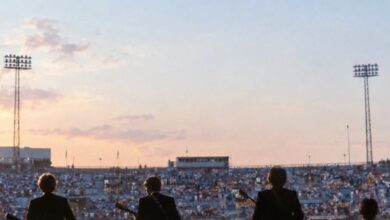
November 11, 1997 was a Tuesday. A school day. A workday. None of which mattered. Fans started showing up at the CoreStates parking lot before dawn. Some had tickets that had been distributed through Tower Records and West Coast Video outlets across the city. Many didn’t. As the day progressed, the fences came down. People climbed barricades. The official count of attendees has been placed by Kirk Hammett at over 50,000 — a number that does not include the people who watched from rooftops, parking decks, and streets surrounding the complex.
The setlist had been built to do exactly what Hetfield had promised: rebuild trust with the hardcore fanbase. It opened with a cover of Diamond Head’s “Helpless” — an obscure new wave of British heavy metal cut that the band had recorded years earlier — followed by “The Four Horsemen,” played live on electric guitars for the first time since 1993. Three songs from Master of Puppets made it in. Two from Kill ‘Em All. Only one song from the Black Album, the breakthrough record that had made them global stars. The new material was barely represented at all — just two songs from Load, two from the unreleased Reload. This was not a press tour. This was Metallica reminding their oldest fans why they had been Metallica fans in the first place.
And then, six songs into the set, James Hetfield stepped to the microphone and the band launched into something the world had never heard before.
“The Memory Remains” was the first single from Reload. It featured Marianne Faithfull on backing vocals — the legendary English singer whose voice had haunted Rolling Stones records in the sixties and whose presence on a Metallica song was, to many fans, both bizarre and brilliant. The studio version had been finished only weeks earlier. The album wasn’t out yet. Radio was just beginning to play the song. And on that cold Tuesday night in a Philadelphia parking lot, in front of fifty thousand people who had fought political resistance and broken fences to get there, Metallica played it live for the first time.
The performance worked. The riff hit. The crowd, most of whom only knew the song from a few radio plays at most, locked into the chorus. Hetfield sang Faithfull’s haunted hum himself, and the song — which would peak at number 28 on the Billboard Hot 100 in January 1998 and become Metallica’s last top-40 hit until 2008 — was born into the live setting in front of the most die-hard audience the band could have asked for.
The rest of the set was a victory lap. More covers — Diamond Head’s “Am I Evil?,” Queen’s “Stone Cold Crazy,” Killing Joke’s “The Wait” — all of which would resurface a year later on the Garage, Inc. compilation. “Master of Puppets.” A second encore that closed with “Damage, Inc.” When the cannons of South Philadelphia finally went quiet, Metallica had played fourteen songs and won back a fanbase that had spent eighteen months questioning them.
The footage from the night was eventually released as a fan-club bootleg titled Banned in Philly — a reference to the political and legal war that had nearly killed the show before it happened. For decades, the video circulated on VHS rips and grainy YouTube uploads, an artifact of a moment that nobody who attended would ever quite stop talking about. Then, in April 2026, Metallica announced the Reload deluxe box set — and at the center of it was the Banned in Philly DVD, restored and released officially for the first time. The live debut of “The Memory Remains,” which had lived for nearly thirty years in bootleg form, finally had a proper home.
There is a footnote to the night that captures everything about how legendary it became. The Philadelphia Flyers were playing the Ottawa Senators that same night, just inside the CoreStates Arena next to the parking lot. One of their players, Finnish defenseman Janne Niinimaa, was a massive Metallica fan. He skipped the game to attend the concert. He was benched, and traded a few months later. The cost of seeing Metallica’s free show that night was, for at least one person, an entire NHL career trajectory.
That is what November 11, 1997 was. A band that had been written off as sellouts, a city government that tried to shut them down, a stadium that sued and lost, fifty thousand fans in a freezing parking lot, and a song nobody had heard before becoming one of the most enduring tracks of the band’s career — all in a single Tuesday night.
Sometimes the best concerts aren’t the ones you’re invited to. Sometimes they’re the ones you have to fight for.