Yungblud’s “My Only Angel” Live in Toronto 2 May 2026
On May 2, 2026, Yungblud arrived at Toronto’s Coca-Cola Coliseum with a sense of momentum that was impossible to ignore. As one of the first major stops of the North American leg of the Idols World Tour, the night carried an energy that felt like a beginning rather than just another date on a schedule. The venue filled quickly, fans packing into every corner, their anticipation building into something almost tangible as the lights dimmed and the first sounds began to echo through the arena.
From the opening moments, it was clear that this wasn’t going to be a conventional performance. Yungblud thrives in unpredictability, and Toronto gave him exactly the kind of audience that feeds into that chaos. The crowd surged forward with immediate intensity, reacting to every beat and movement as if they were part of the show itself. That connection blurred the line between performer and audience from the very start.
The Idols era has brought a noticeable shift in his sound, moving from pure punk aggression into something broader and more emotionally layered. That evolution shaped the structure of the show, which unfolded like a carefully paced narrative. High-energy tracks collided with more introspective moments, creating a rhythm that kept the audience constantly engaged, never quite knowing what would come next.
As the set progressed, the energy inside the Coliseum began to take on a life of its own. What started as explosive chaos evolved into something more focused, more deliberate. The audience wasn’t just reacting anymore—they were participating, anticipating each shift and amplifying it. It felt less like a performance and more like a shared experience unfolding in real time.
“My Only Angel” arrived as a pivotal moment within that structure, emerging after a sequence of driving, high-intensity tracks. Its placement within the set wasn’t accidental—it acted as a turning point, pulling the energy inward and shifting the emotional tone of the night. The song has been a recurring part of the Idols tour setlist, often used to introduce a different kind of atmosphere into the show.
As the opening notes rang out, the mood inside the venue changed almost instantly. The frantic energy that had defined the earlier part of the show began to settle, replaced by something more focused and reflective. The crowd, still buzzing with adrenaline, seemed to instinctively understand the shift, allowing the moment to breathe.
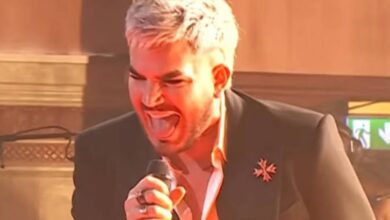
Yungblud’s approach to the performance changed as well. The constant motion that defined much of the set slowed, giving way to a more grounded presence. He leaned into the song, allowing its emotional weight to carry the moment rather than relying on sheer energy. That restraint made every movement and every note feel more deliberate.
Vocally, the performance stood out as one of the most striking of the night. There was a rawness in his delivery that cut through the scale of the venue, making the song feel intimate despite the thousands in attendance. It wasn’t about perfection—it was about emotion, about delivering something that felt real and immediate.
The audience responded with a rare kind of focus. Instead of erupting immediately, they held back, listening, absorbing the moment. It created a kind of stillness that is uncommon in a show of this size, where silence can feel just as powerful as sound.
As the song began to build, that stillness gradually gave way. Voices started to rise, first scattered, then unified. By the time the chorus landed, the entire venue was singing together, thousands of voices merging into one. It transformed the performance into something communal, something shared.
The lighting design subtly reinforced the emotional arc of the song. Softer tones dominated the early moments, casting the stage in a muted glow that emphasized the introspective mood. As the song built, the lighting expanded, becoming brighter and more expansive, mirroring the emotional release happening in the crowd.
What made “My Only Angel” so effective in Toronto was its contrast with the rest of the set. Surrounded by louder, more aggressive tracks, it provided a moment of vulnerability that added depth to the overall performance. That contrast made the high-energy moments feel even more powerful by comparison.
The placement of the song also highlighted the flexibility of the Idols World Tour setlist. Known for evolving depending on the crowd and the atmosphere of each show, the setlist allows moments like this to emerge organically, making each performance feel unique rather than rehearsed.
As the performance reached its closing moments, the intensity didn’t explode outward—it lingered. The final notes hung in the air, creating a suspended moment where the entire venue seemed to pause. It was as if no one wanted to break the spell too soon.
Then, almost all at once, the silence gave way. The crowd erupted into cheers and applause, a release that felt just as powerful as any high-energy moment earlier in the night. It wasn’t just a reaction—it was recognition of what had just happened.
Moments like that can’t be scripted. They emerge from the unpredictable chemistry between artist and audience, from timing and emotion aligning perfectly. In Toronto, “My Only Angel” became one of those moments, standing out as a defining highlight of the night.
Long after the concert ended, the memory of that performance continued to resonate with those who were there. Fans shared their experiences, trying to capture something that was, by its nature, impossible to fully recreate.
In a show filled with intensity, movement, and explosive energy, “My Only Angel” stood apart as something quieter but ultimately more powerful. It was a reminder that sometimes the most unforgettable moments in live music are the ones where everything slows down, and the emotion speaks for itself.